
Background:
The previous post discussing the CC Design exhaust system I am currently using drew attention to a series of resonators and an updated muffler that were recently delivered for testing. In this post, I discuss the results of a test drive using the revised muffler.
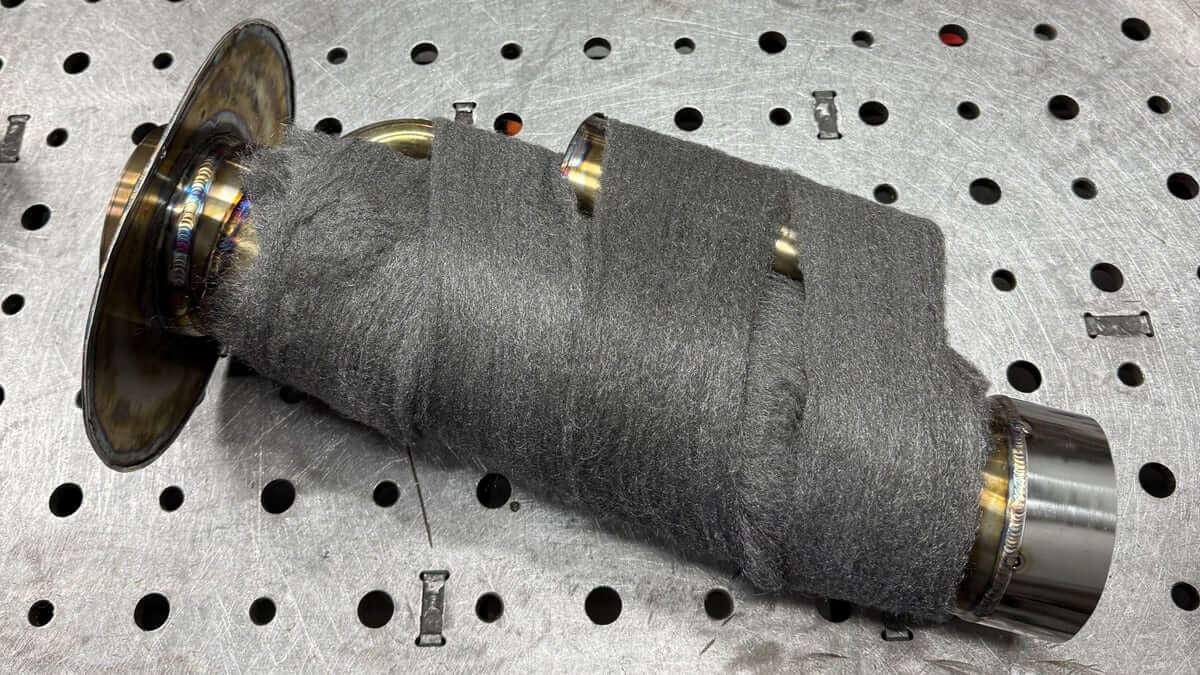
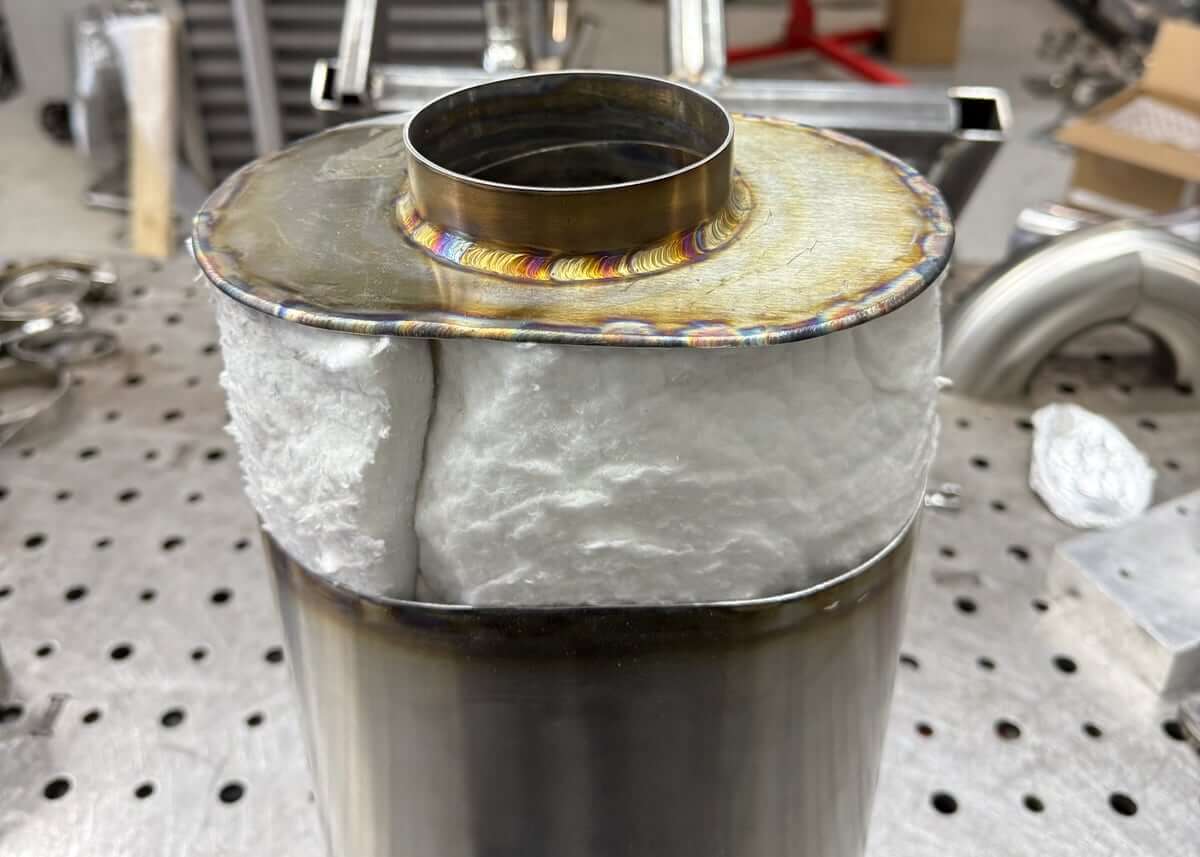
The changes to the muffler include a stainless steel mesh around the center perforated flow path and ceramic fiber packing material that fills the muffler case.
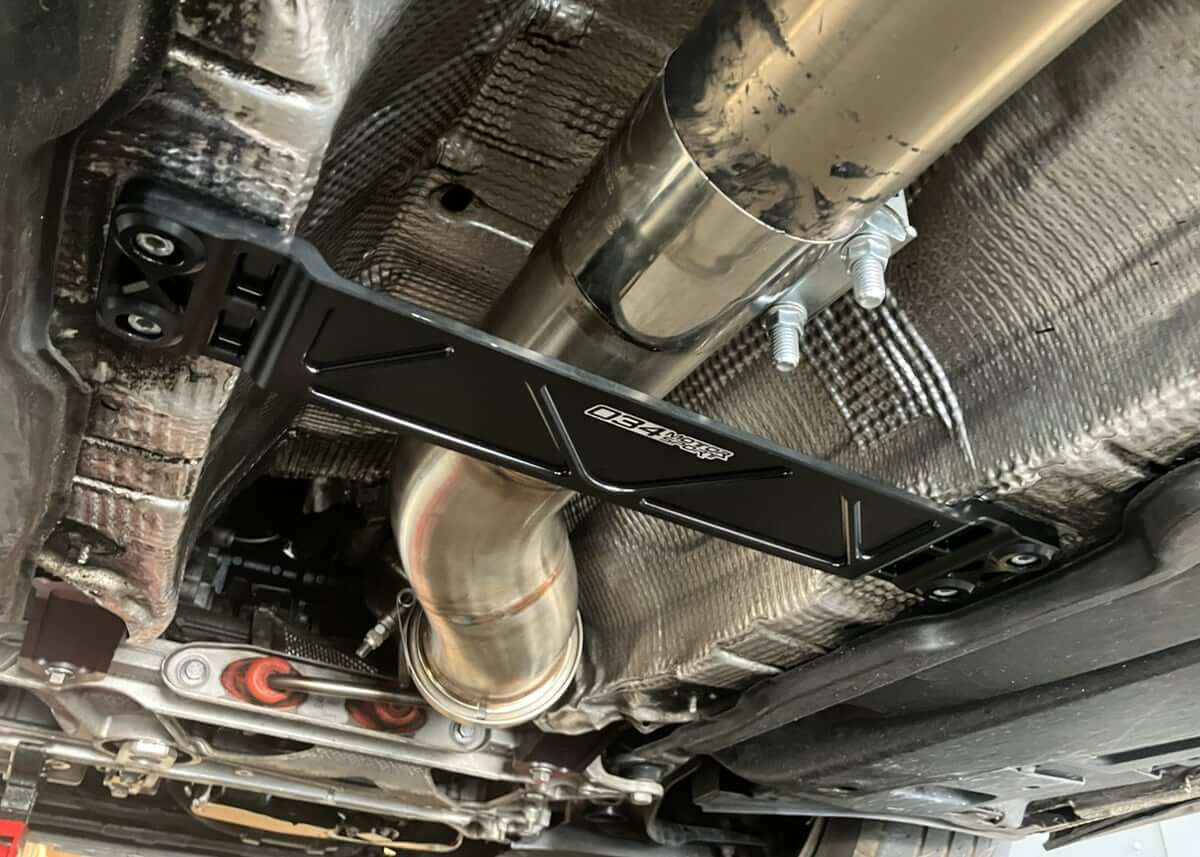
To give the 3.5″ exhaust system adequate clearance, I am installing the 034 Motorsport X-Clear Driveshaft Tunnel Brace.
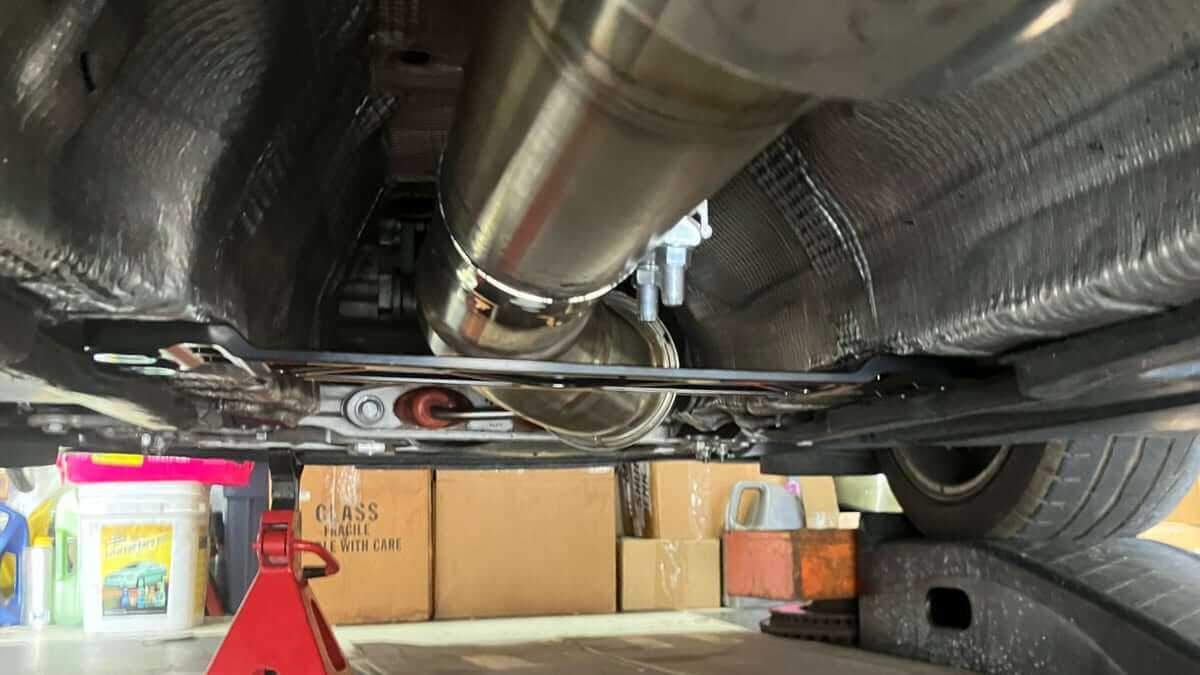
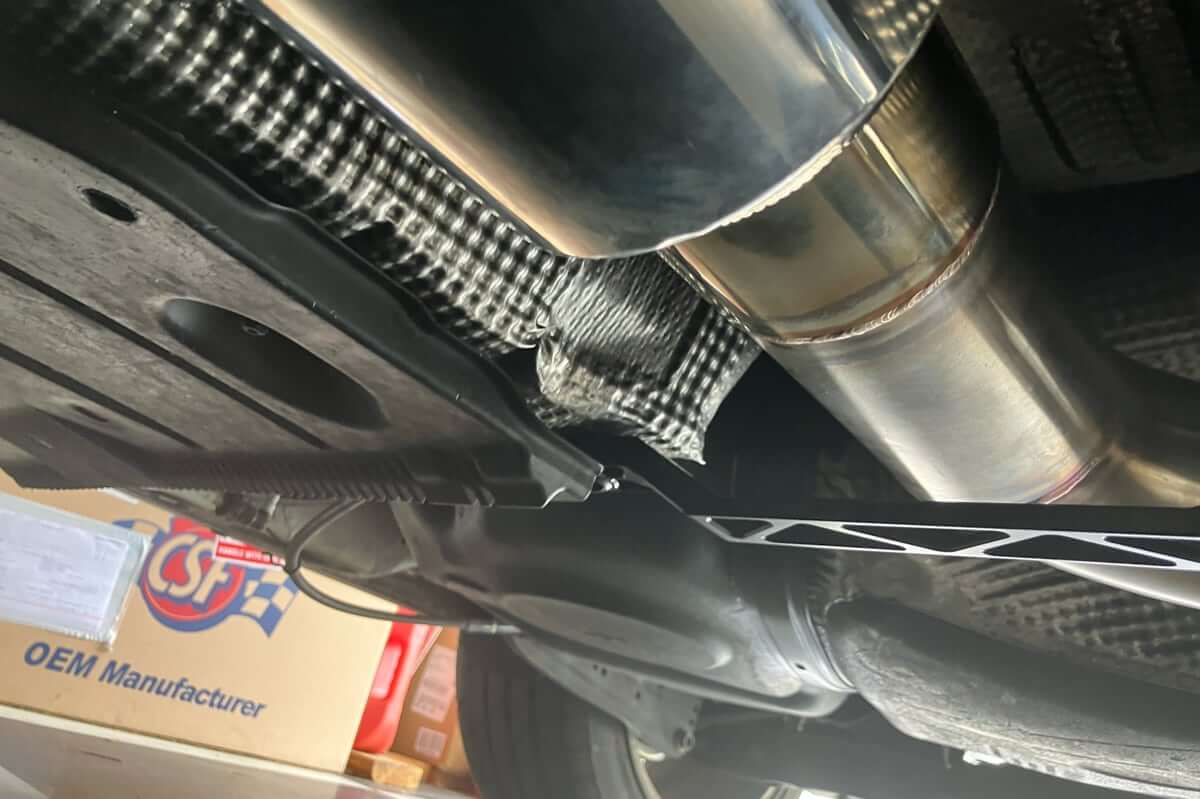
Drive Data:
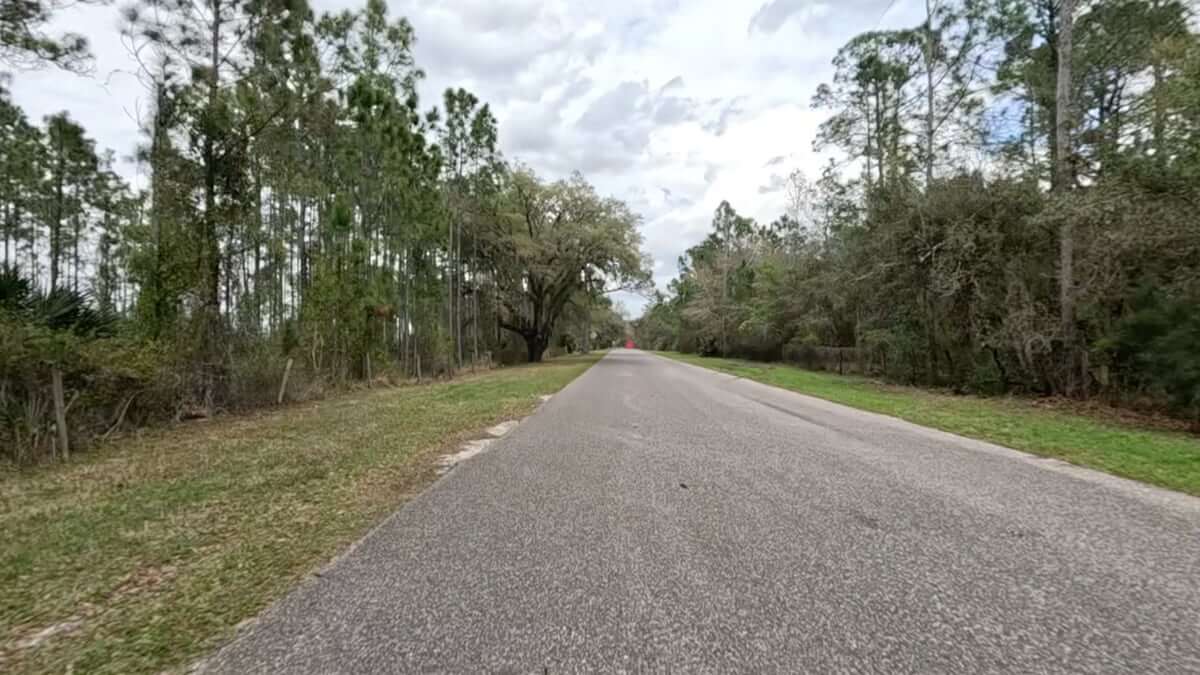
With the new muffler in place, I set out to record the sound levels and frequencies inside the cabin across varied driving conditions.
Sound recording is being done using a pair of iPhone applications. The iPhone is mounted inside the cabin between the driver’s and passenger’s headrests.
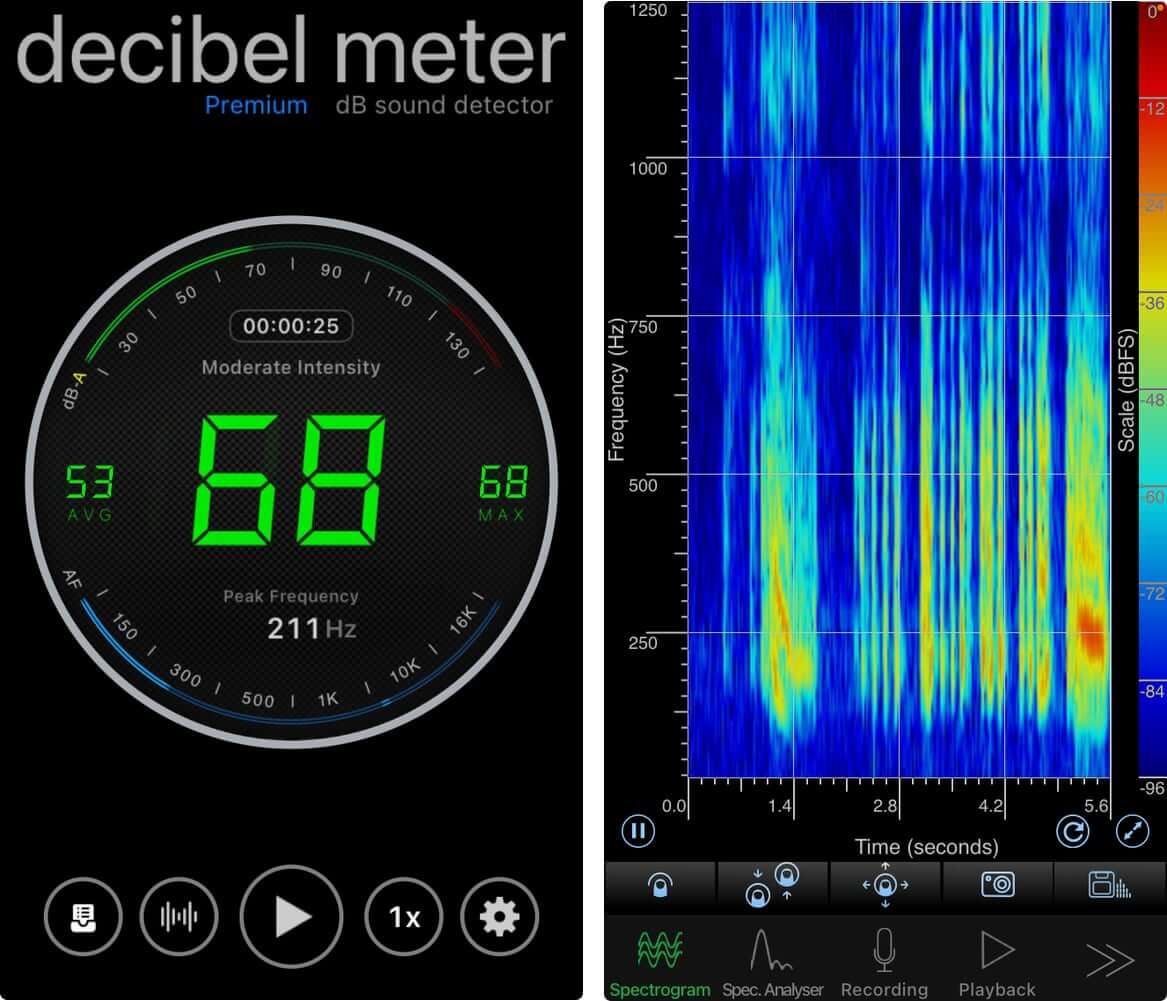
These two applications enable the collection of significant data on the exhaust system’s sound pressure level and average frequencies over time. This can then be synced with vehicle operating data logged using SimosTools.
Summary Statistics:
The following table summarizes the data that has been collected using the various configurations:
- Magnaflow – Baseline configuration using a Trackslag Catless 3″ downpipe, Baun Performance 3″ midpipe with Vibrant resonator, AWE-Tuning exhaust with Magnaflow muffler.
- CCD Unmuffled – CC Design Catless 4″ downpipe, 3.5″ midpipe with Vibrant resonator, NO primary muffler, two small Stainless Bros. mufflers near exhaust tips.
- CCD Muffler – Same as Unmuffled except with the addition of a primary muffler using fiberglass packing.
- CCD Muffler-1 – Same as CCD Muffler with the revised CC Design primary muffler using ceramic fiber.
Note: The smaller-diameter “Magnaflow” piping creates a different acoustic environment that contributes independently to its frequency profile.
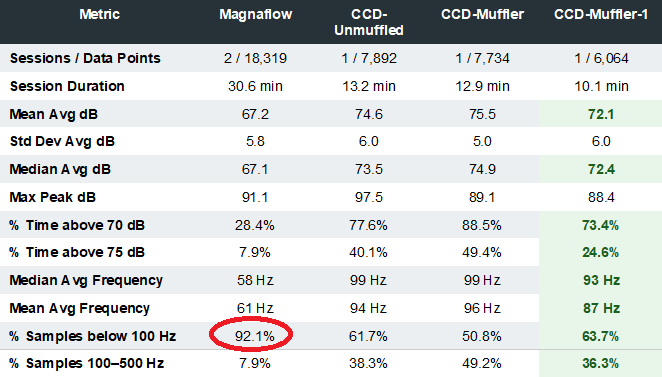
Highlighted in red is a key finding: the Magnaflow-equipped baseline setup has over 90% of its average frequencies below 100 Hz.
Note: This is significant because these low frequencies fall below the range the driver perceives as cabin drone. The exhaust drone is most fatiguing in the 100–500 Hz range because it overlaps with the cabin’s structural resonant frequencies. (concept addressed at ScienceInsights.org)
The CC Design revised muffler (Muffler-1) achieves the lowest mean and median Avg dB, and the lowest % time above both the 70 dB and 75 dB fatigue thresholds of any CC Design configuration tested to date.
Sound Level vs Engine Speed
The next chart shows how cabin noise increases with engine speed using light to moderate accelerator pedal input.
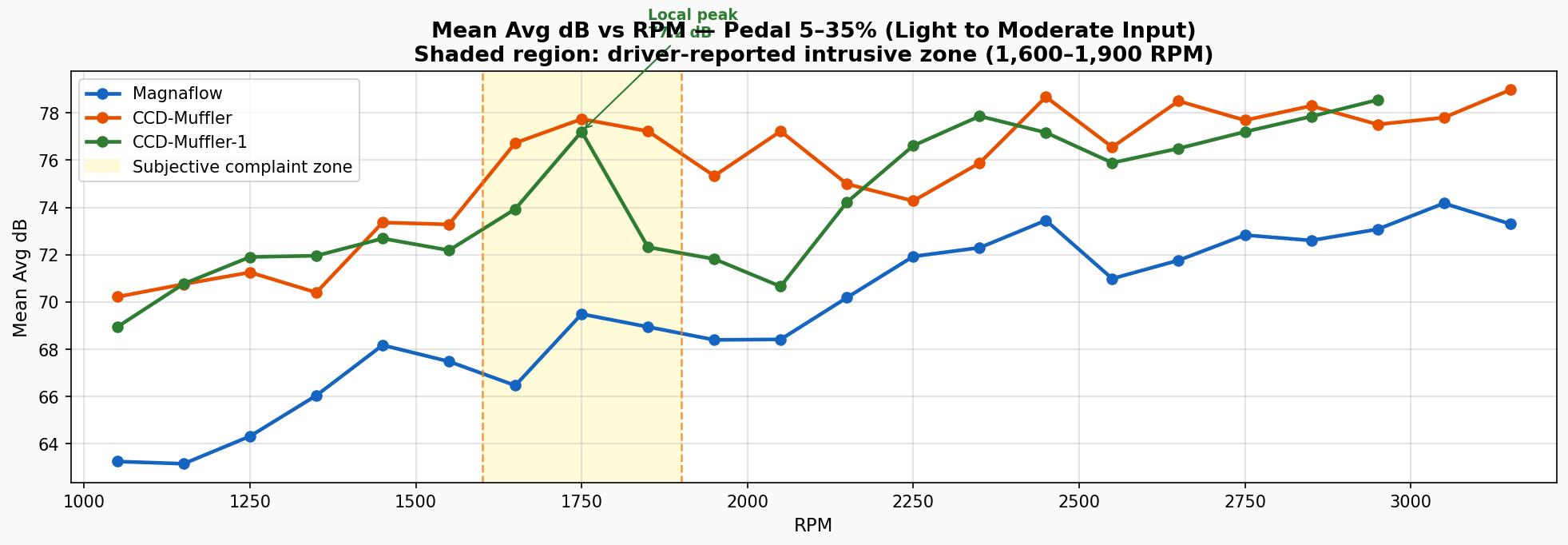
The driver reported “intrusive zone” (yellow shading) is an engine speed range where, subjectively, the exhaust sound became more noticeable to the driver. The localized increase in Mean Avg dB by Muffler-1 in this range confirms the driver’s subjective observation.
The next chart compares Mean Avg dB across engine speed bands for all systems tested.
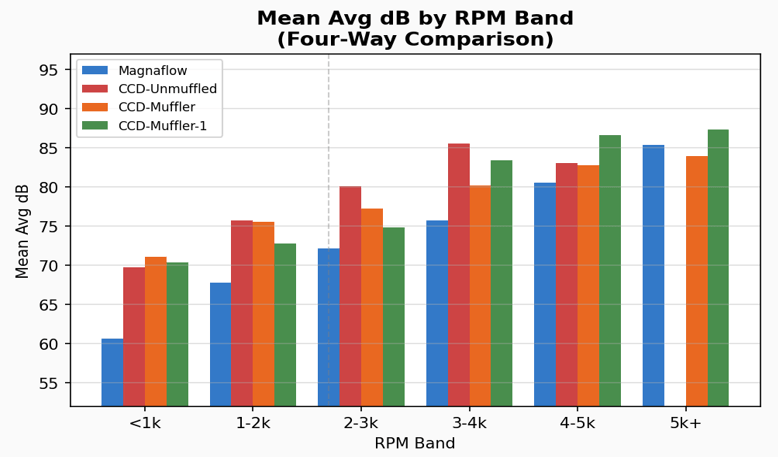
The revised muffler helps quiet cabin noise up to ~3,000 RPM, after which it is louder than the previous version.
The following table is a numeric representation of the information shown in the chart above.
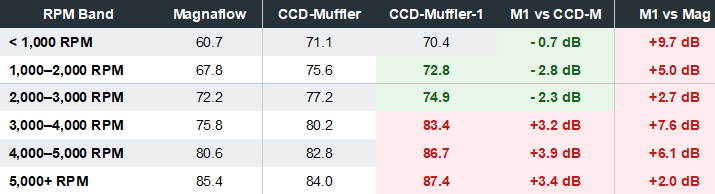
The 1,000–2,000 RPM band is the most practically important: it covers the majority of light cruise driving, and the revised muffler (Muffler-1) brings this band to 72.8 dB — 2.8 dB below the previous muffler and only 5.0 dB above Magnaflow, the smallest gap between any CC Design configuration tested thus far and the Magnaflow baseline in this critical range.
The next table compares the CC Design exhausts with the baseline Magnaflow.
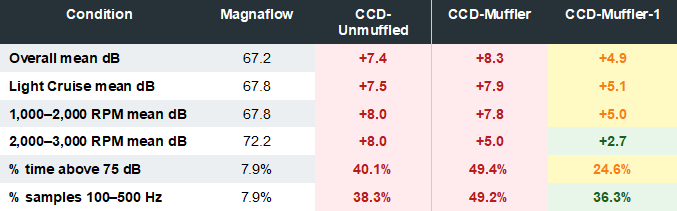
The revised muffler moves meaningfully closer to the Magnaflow baseline across all cruise and overall metrics.
Sound Level and Frequency
The next charts show how sound level and frequencies change as the accelerator pedal is depressed.
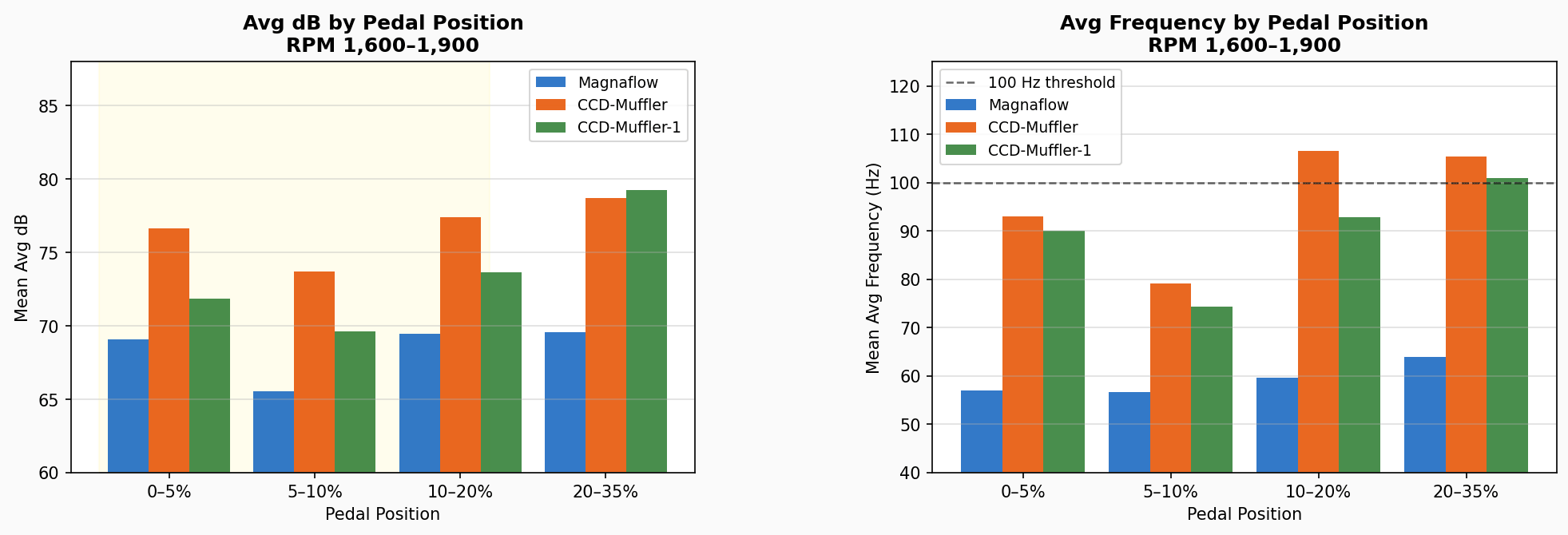
Again, the revised muffler gives improvements, moving it closer to the Magnaflow baseline.
Next is a key finding: the exhaust muffler components do not provide broadband attenuation. Adding the first muffler shifted more acoustic energy into the 100–500 Hz drone range, worsening the frequency distribution and providing evidence that the muffler’s internal geometry was exciting rather than damping harmonics at cruise RPM.
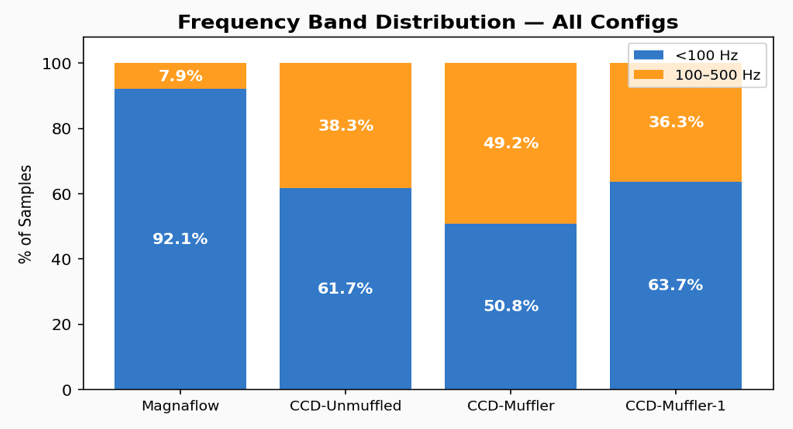
This is evidence that the resonator is a key component, which will be the focus of the next tests with the exhaust.
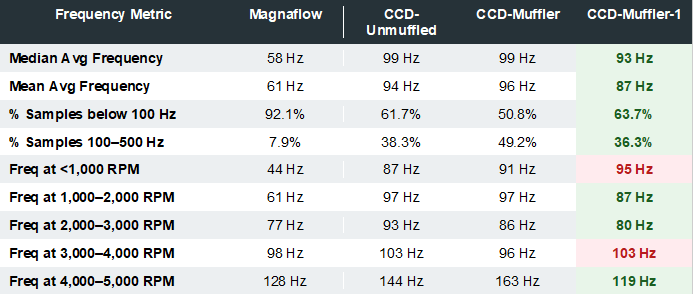
The revised muffler shows meaningful improvement in frequency character compared to the previous muffler, with the dominant frequency distribution shifting toward lower values across most of the RPM range.
Improvement Analysis
Across the engine speed range, the revised muffler predominantly improves the sound level compared to the first muffler. This is also seen when comparing the systems based on the Pedal Position.
The left chart (dB delta by RPM, with the intrusive zone shaded) uses green bars in the negative region to show improvement below the zero line and flips positive (red bar regressions) above it. Within the intrusive zone, there’s a visible “reduction” of improvement around 1,750 RPM.
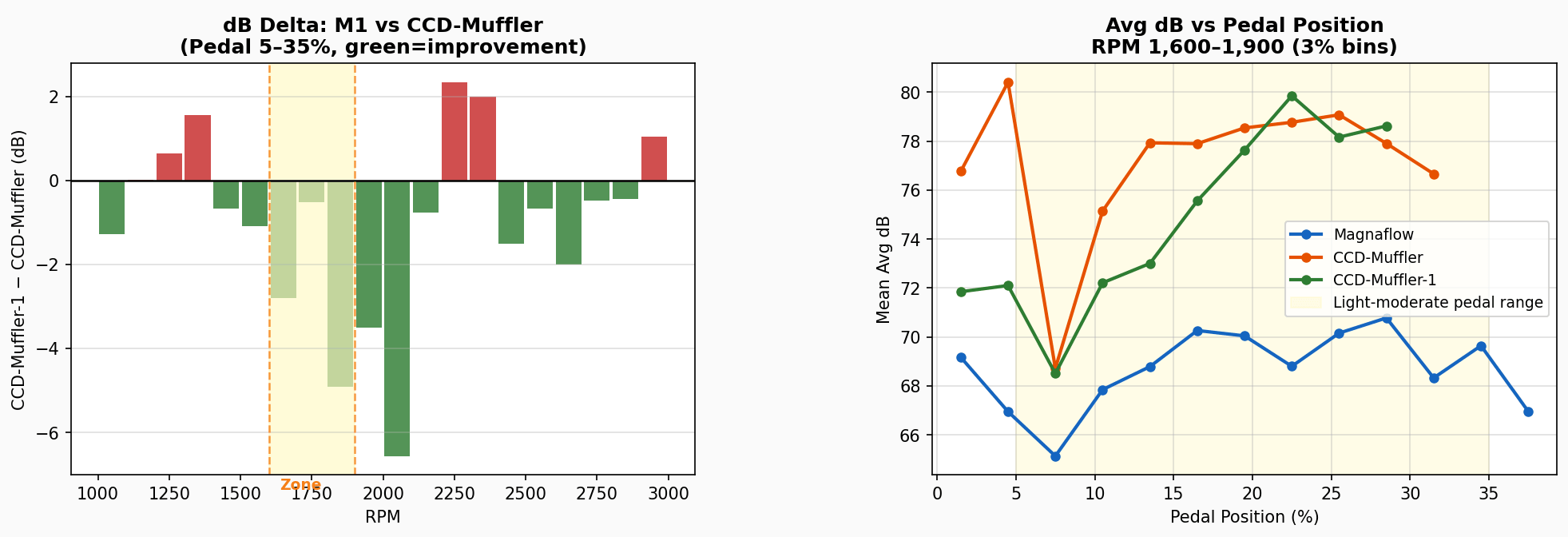
The right chart (Avg dB vs Pedal Position) shows that, with the CC Design mufflers, further accelerator pedal depression increases the mean sound level more rapidly compared with the Magnaflow setup.
Conclusions:
The CC Design muffler revision represents a meaningful improvement over the previous CC Design muffler at low-to-mid RPM, but regresses above approximately 2,200 RPM.
Frequency character also improves measurably: the proportion of time in the 100–500 Hz drone band drops from 49% back to 36%.
Next Step:
The Stainless Bros. resonator chamber is 6″ in diameter, compared to the Vibrant’s 5″, and is 1″ longer at 15″ compared to the Vibrant’s 14″ body length.
A hypothesis is that the larger body volume of the Stainless Bros unit will provide additional attenuation at cruise RPM, and that the main question is whether it can also improve the frequency distribution toward the Magnaflow’s sub-100-Hz profile.
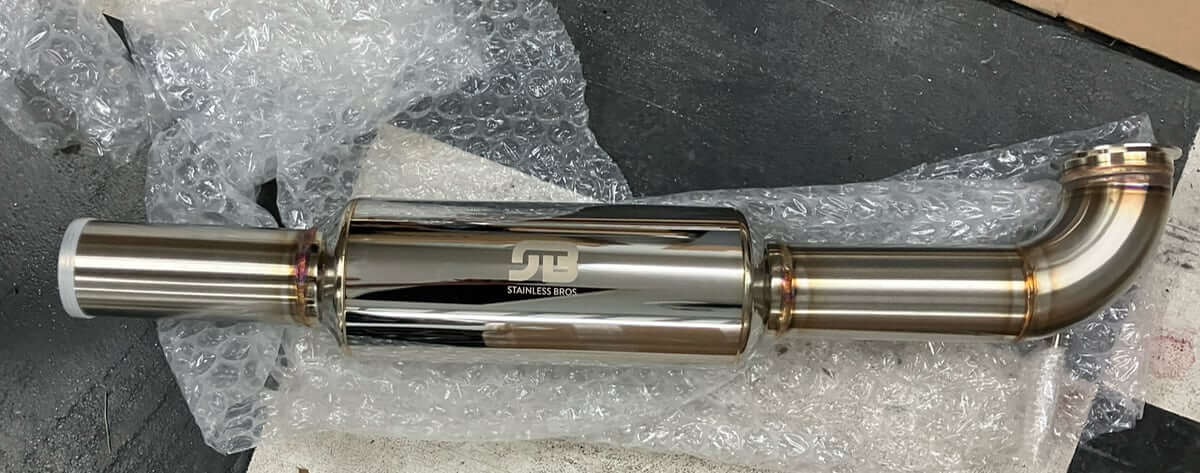
This resonator will be installed, and sound recordings will be repeated to check for improvements.