
Background:
A previous post on the CC Design exhaust discussed test results using a revised muffler. In this post, test results related to changing the resonator are discussed.
The question the testing was designed to answer is whether swapping the resonator in a 3.5″ CC Design aftermarket exhaust system can meaningfully reduce cabin noise and drone without changing the rest of the system.
CC Design Exhaust:
The CC Design exhaust is the system under test, and the resonator is the focus of this phase. Prior analysis showed that muffler changes alone produced limited frequency improvement. This is an area of concern due to the percentage of time the vehicle operates within a frequency range that produces an in-cabin drone.
Resonators help quiet the exhaust system by cancelling out a certain range of sound frequencies before they enter the muffler which silences them.
The goal of testing different resonators is to find one that adequately reduces the frequencies that are annoying to the driver, primarily between 100 Hz and 500 Hz.
Test setup:
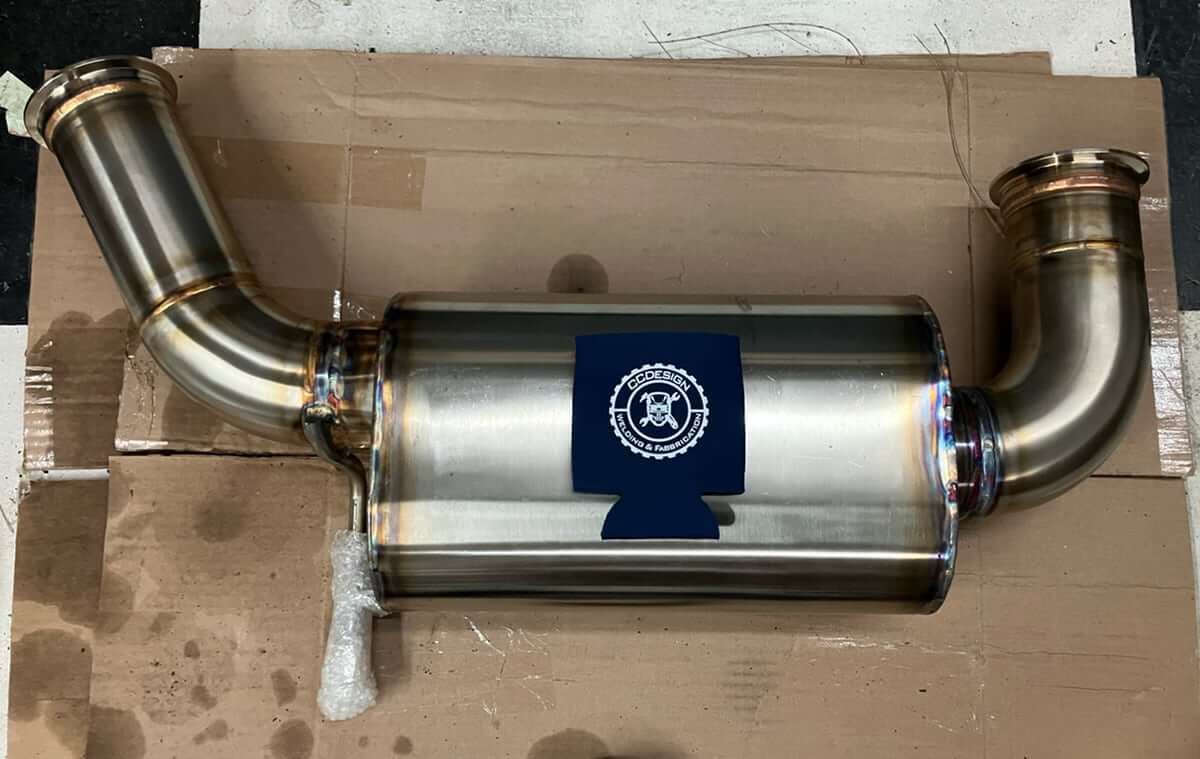
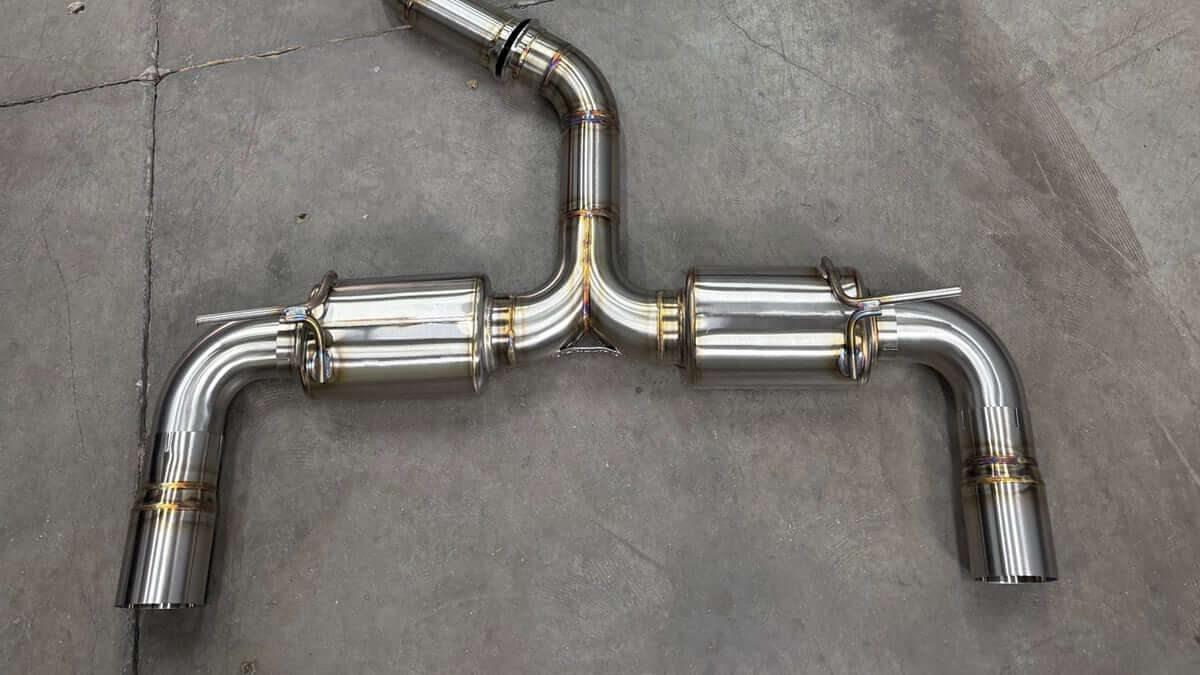
The exhaust setup on the GTI is a CC Design 4″ catless downpipe, a 3.5″ midpipe with a resonator, and a muffler section consisting of one primary muffler and two smaller Stainless Bros mufflers, prior to the exhaust tips.
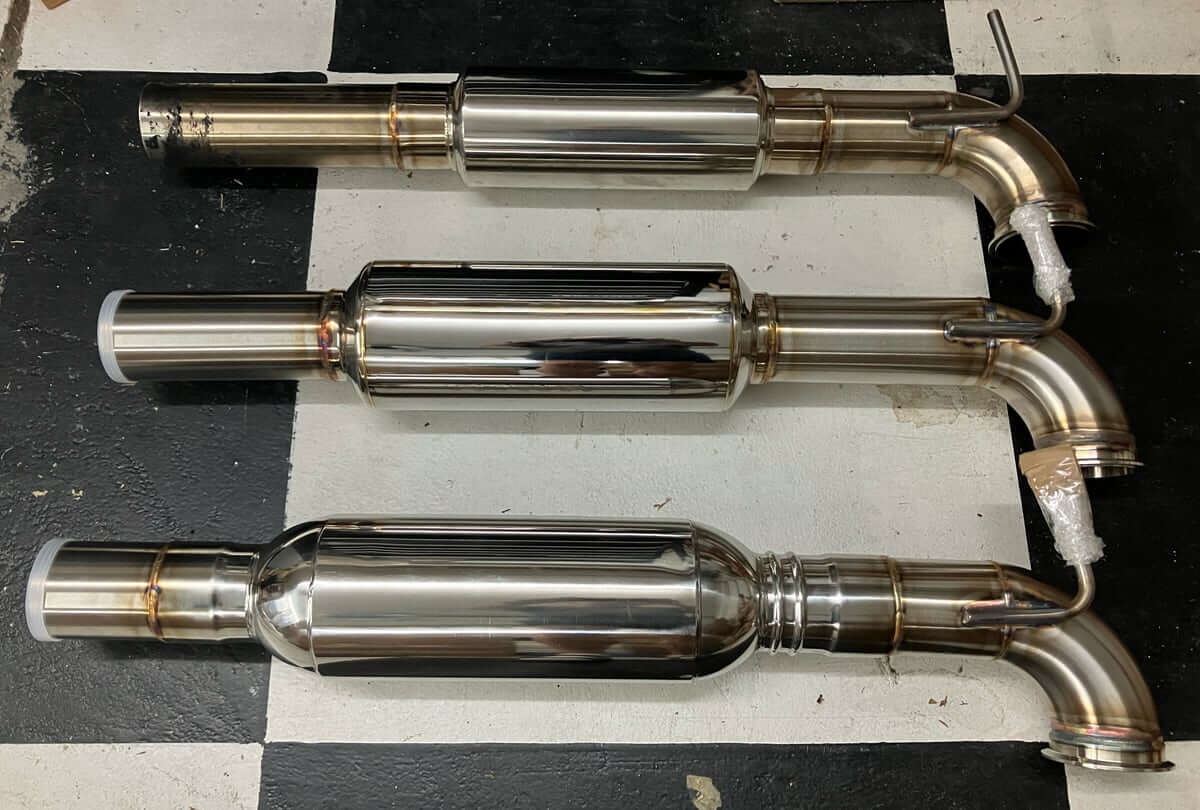
The three resonators under test are the Vibrant Performance 17970 (5″ body, 14″ body length), which is the baseline CCD configuration, and the two replacements: the Stainless Bros Lightweight Race Muffler (6″ body, 15″ body length) and the Aero Exhaust Turbine (6″ body, 18″ body length).
Note: The key dimensional difference between the Vibrant and Stainless Bros/Aero Exhaust is approximately 100% more packing volume, which is hypothesized to increase the acoustic absorption capacity available to attenuate exhaust energy before it reaches the muffler.
Sound recording is accomplished using an iPhone mounted between the headrests, measuring Peak dB (A-weighted), Average dB, and Average Frequency (Hz). Vehicle operating data (RPM, vehicle speed, gear, and pedal position) is recorded using the OBD-II port and SimosTools.
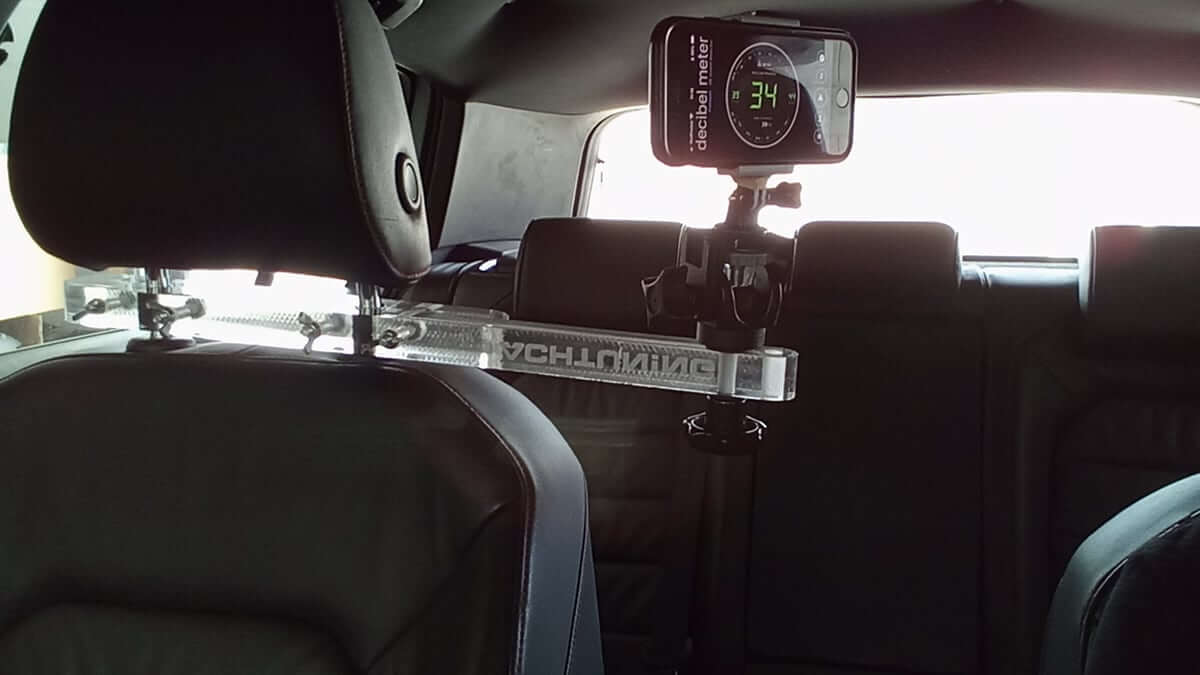
The operating conditions vary across all tests (RPM, Speed, Gear) and follow a similar pattern. Variations in operating conditions arose, so an RPM-weighted normalization was applied to help cancel out differences between test sessions.
Test results:
Magnaflow baseline:
The 3″ Magnaflow system with Vibrant resonator is the reference for comparison. Importantly, this system produced 92% of samples below 100 Hz, only 7.9% of drive time above 75 dB, and a mean cruise sound level of around 67.8 dB.
The Magnaflow (Vibrant) keeps the dominant cabin note at the engine’s fundamental exhaust-pulse frequency (see Note) rather than allowing harmonics to dominate, which is why it sounds like a deep note rather than a drone.
Note: The fundamental exhaust-pulse frequency derives from the combustion process vibrations, producing the engine’s sound character (discussed in more detail in this Car and Driver article)
All system comparisons:
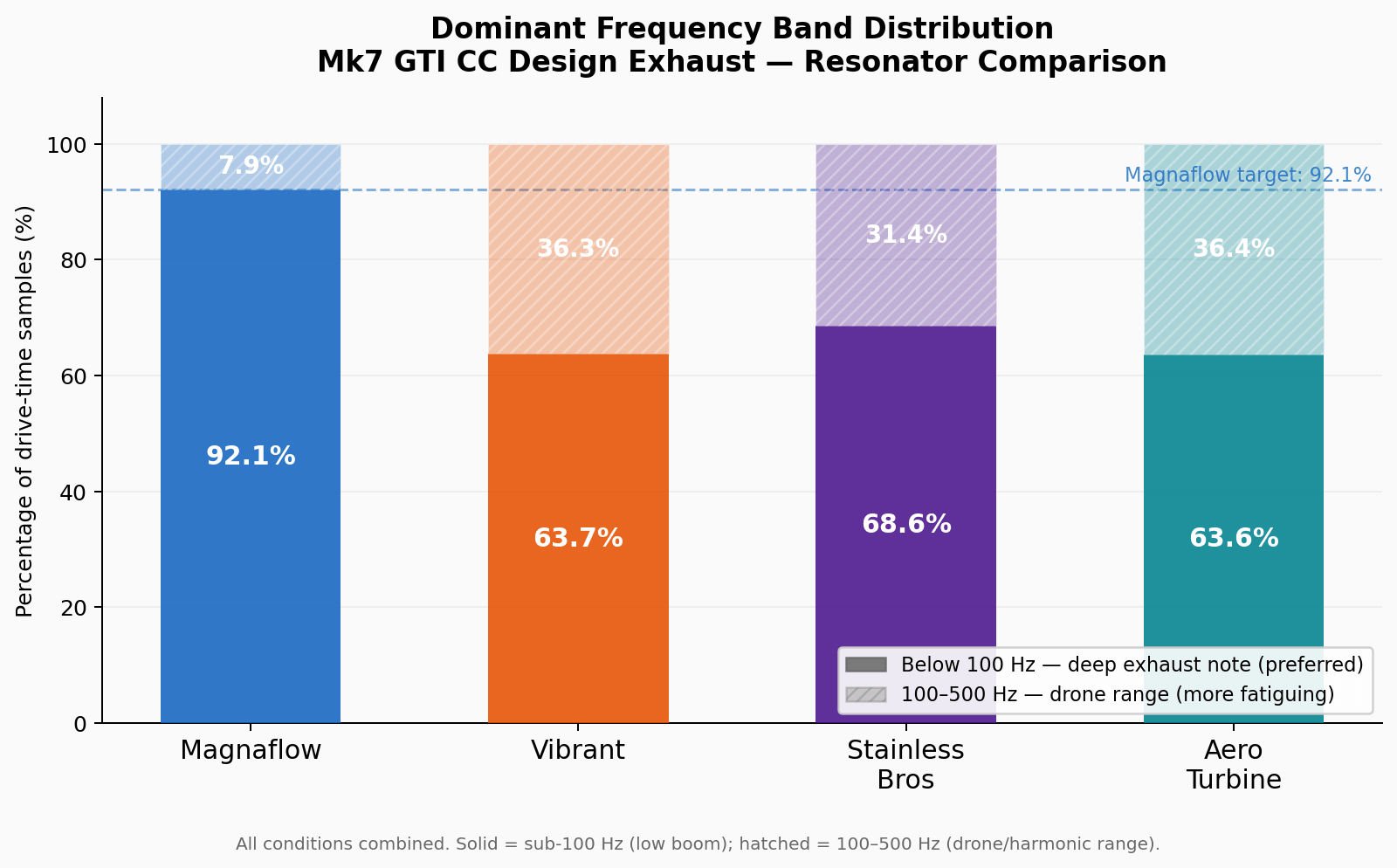
The stacked bar chart shows the frequency band distribution for all tested resonator configurations — Magnaflow (baseline), Vibrant, Stainless Bros, and Aero Turbine.
The contrast between Magnaflow’s 92.1% less-than-100-Hz solid bar and the heavily hatched CC Design configurations illustrates why frequency matters, regardless of volume.
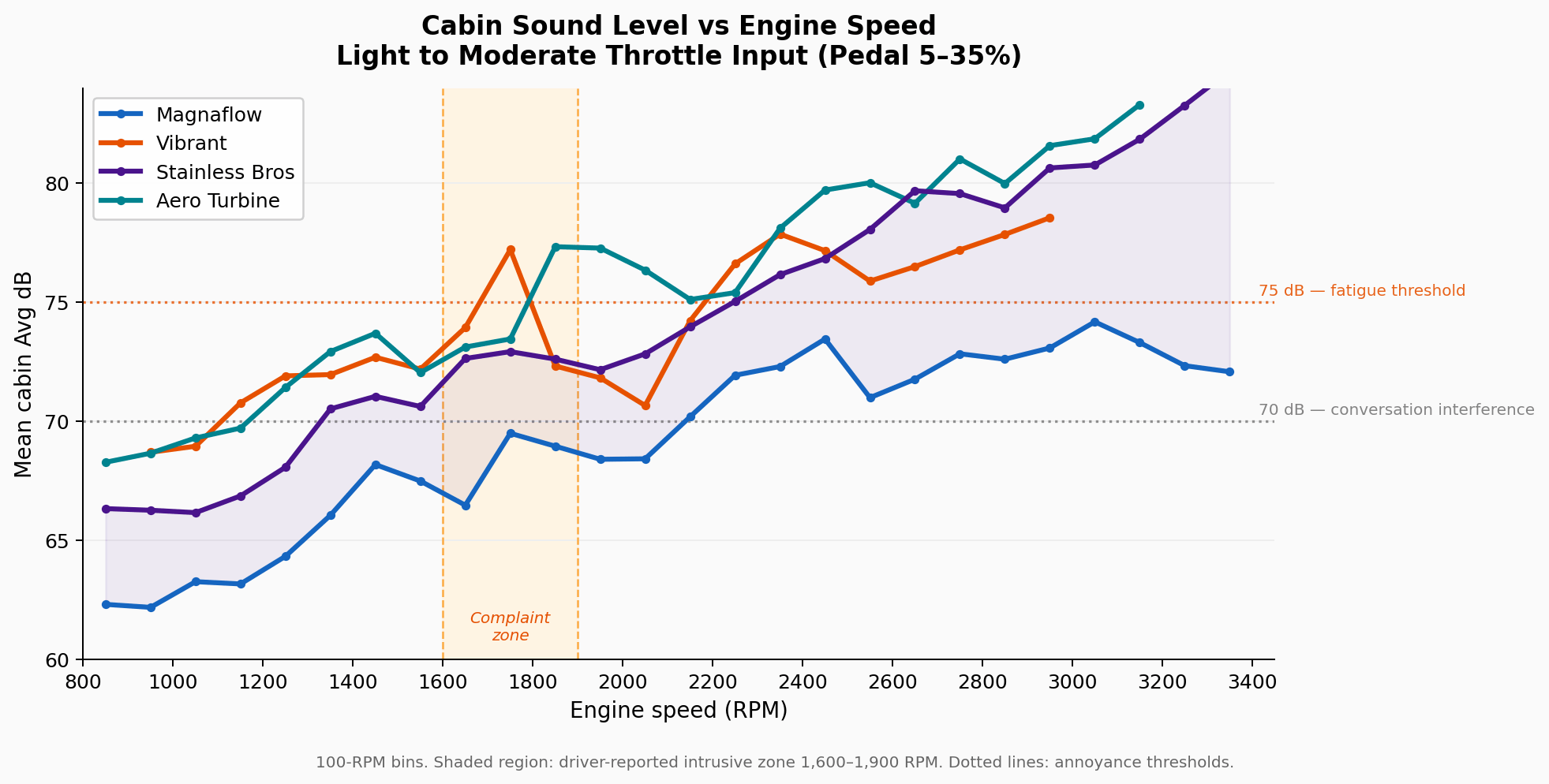
The next chart shows a dB vs. RPM line chart at accelerator pedal positions 5–35% and the “complaint zone” (shaded yellow), a region where the operator subjectively noticed an increase in drone.
There are also 70/75 dB threshold lines indicating where the sound level begins to interfere with passenger conversations and where it becomes fatiguing over time.
Note: The 70/75 dB levels are EPA-established values. (link)
The gap between the Magnaflow line and the three CC Design configurations is visible across the full RPM range.
The Stainless Bros’ improvement over Vibrant and Aero Turbine is apparent through most of the RPM range.
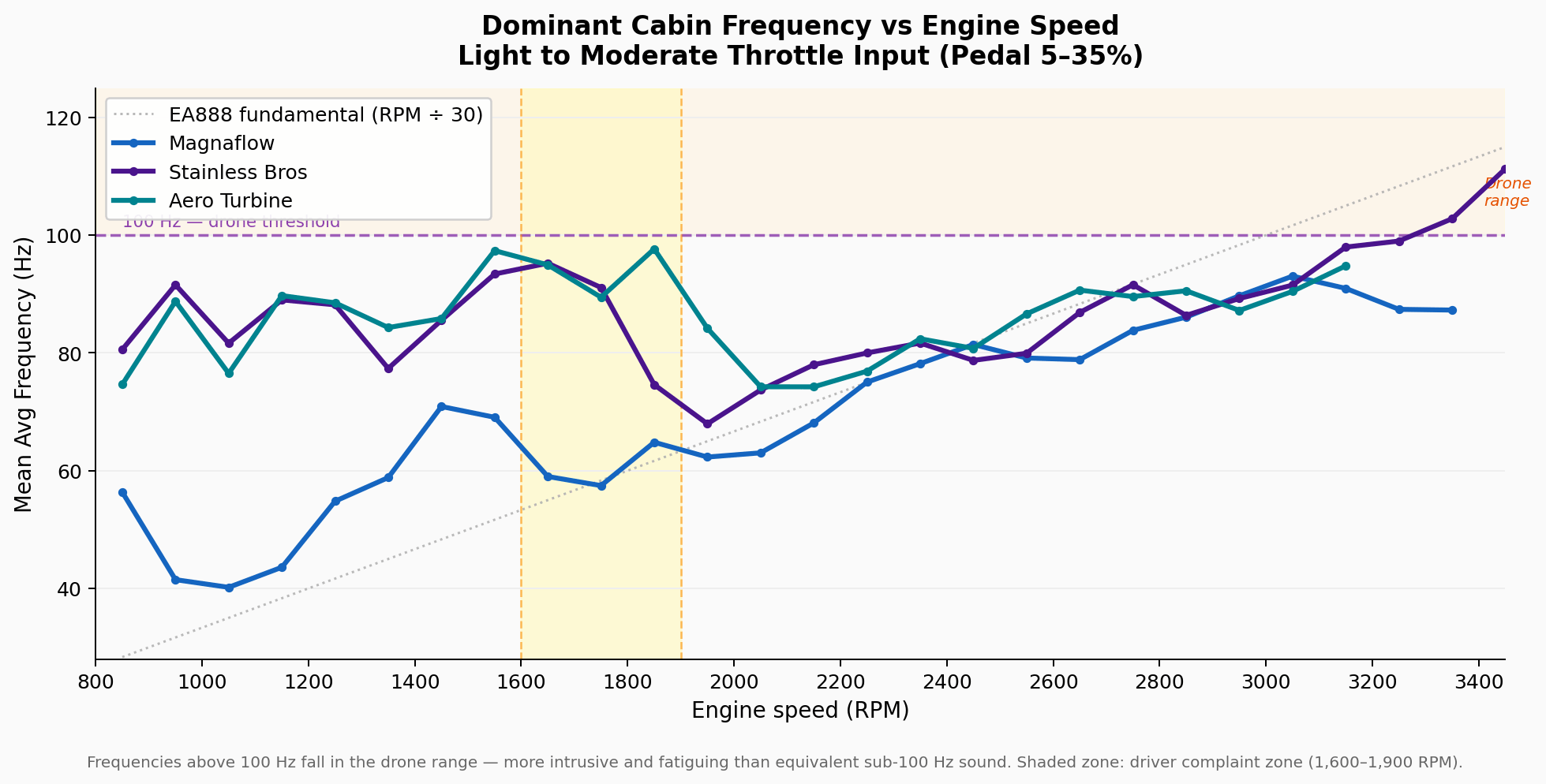
The third chart is a Mean Average Frequency vs RPM line chart with the 100 Hz drone boundary marked.
This chart explains why the Stainless Bros sounds better than the Aero Turbine (a subjective observation noted during driving); it keeps the exhaust note in a lower, less intrusive frequency range at cruise RPM.
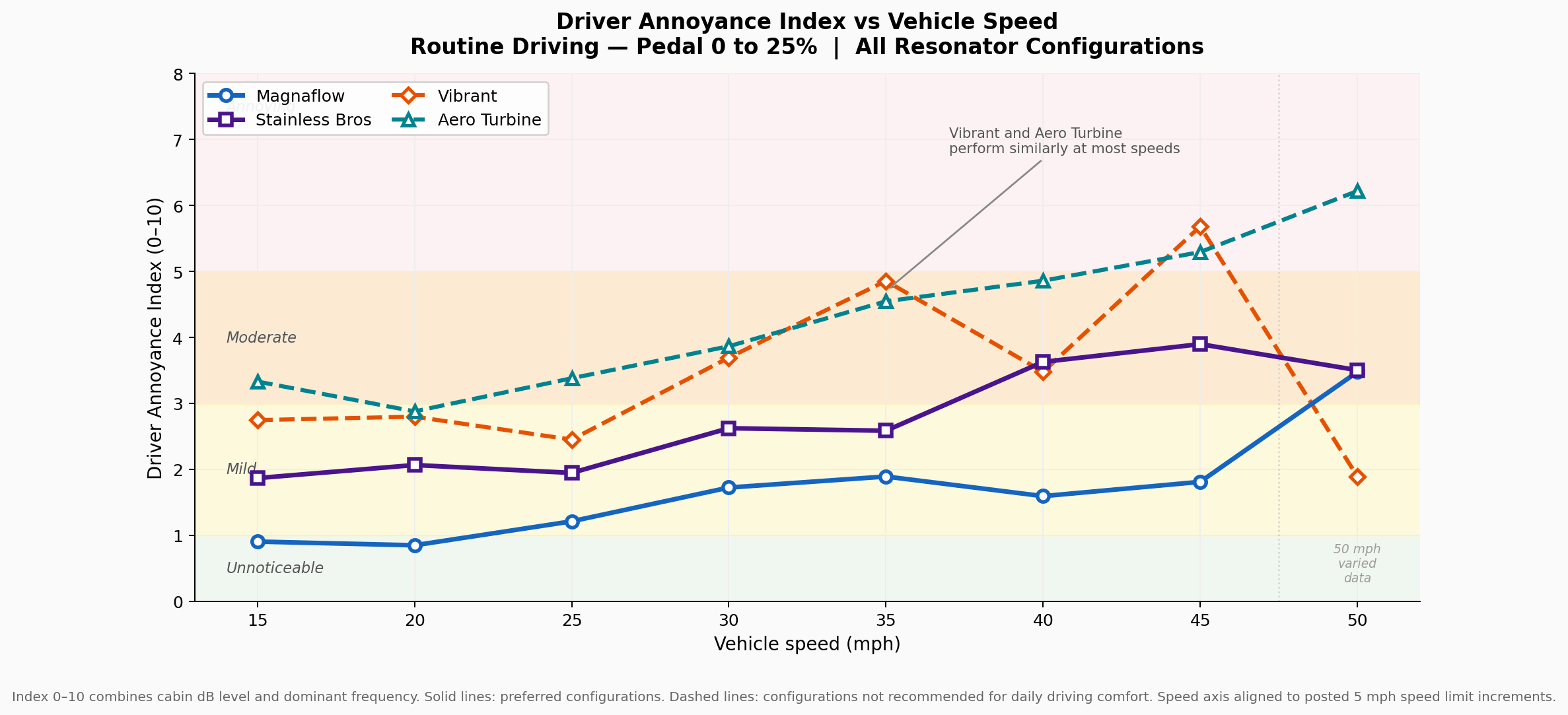
The fourth chart shows a metric that combines Sound Level and Frequency, called the Driver Annoyance Index. The Driver Annoyance Index vs vehicle speed is displayed on the chart.
Note: The index combines two components additively, capped at 10. The loudness component uses a scale that increases at a rate of dB. The penalty roughly doubles each time the signal crosses 70 dB, then again at 75 dB and 80 dB, reflecting the nonlinearity of human loudness perception. The frequency penalty adds nothing below 80 Hz, then ramps to 1.0 at 100 Hz and continues to 3.0 at 200 Hz, capturing the specific intrusiveness of drone-band content.
The Aero Turbine and Vibrant lines sit above Stainless Bros across the full 15–45 mph range, which is the region where most of the data was recorded.
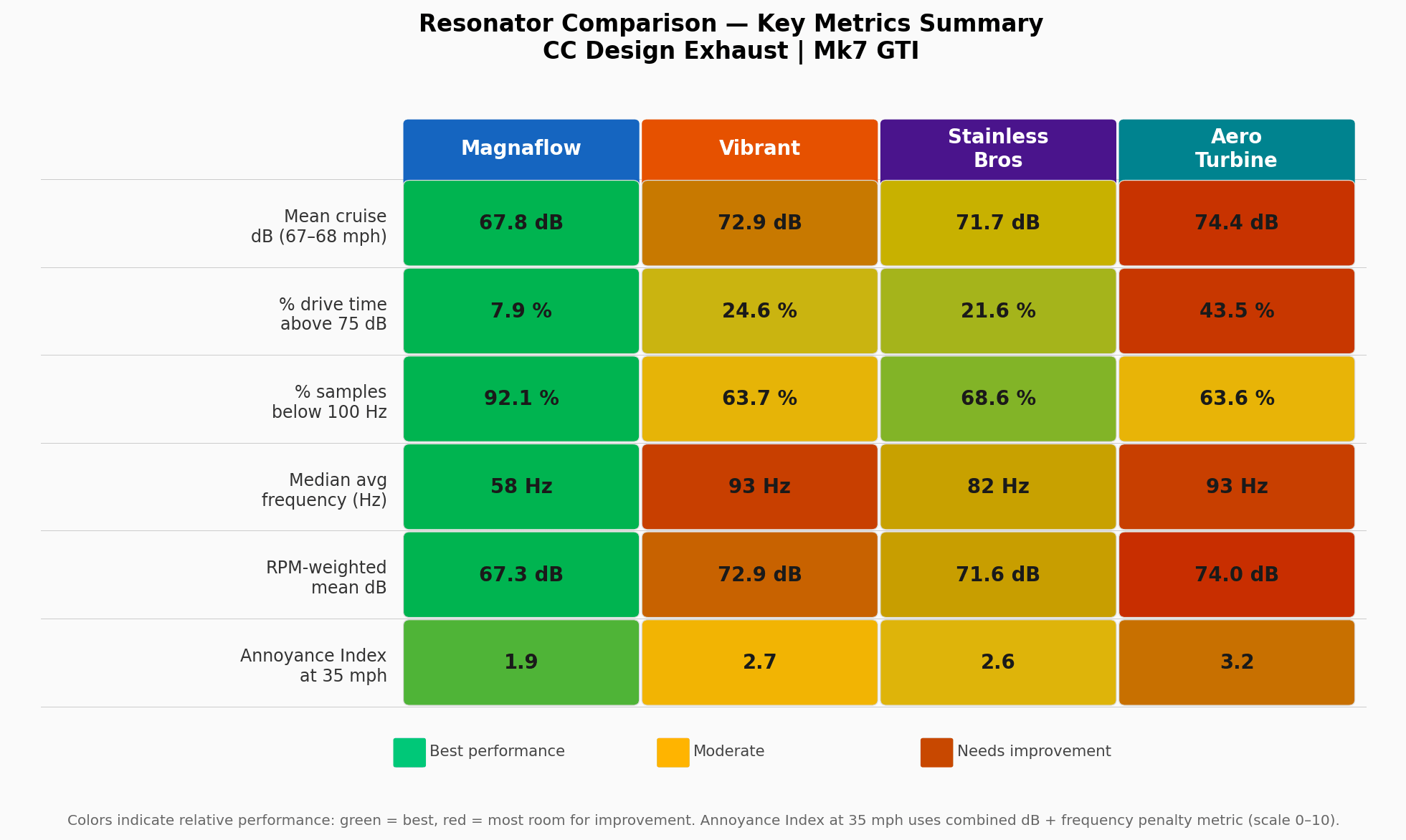
The fifth presentation is a summary comparison table showing the four configurations across six metrics: mean cruise dB, % time above 75 dB, % sub-100 Hz, median frequency, RPM-weighted dB, and Annoyance Index at 35 mph.
Conclusions:
Stainless Bros is the best-performing CC Design resonator configuration, but it remains distinct from the Magnaflow baseline.
Note: The baseline Magnaflow configuration uses 3″ piping, whereas the CC Design uses 3.5″ piping, which may affect the results.
The Aero Turbine regresses relative to the Stainless Bros result across nearly all cruise metrics and does not improve on the Vibrant baseline configuration in frequency characteristics.
Heavy-load conditions are largely absent from this comparison, and higher-RPM data are sparse, leading to uncertainty at higher engine speeds.
In terms of the question posed at the start of this post, whether swapping the resonator in a 3.5″ CC Design aftermarket exhaust system can meaningfully reduce cabin noise and drone, the Stainless Bros configuration represents a step forward for daily driving comfort, but still fails to meet the baseline system performance.