
Introduction:
This blog has documented concerns about EQT’s advertising of the Blaze AToM intake across a number of prior posts spanning 2022 to 2025. Some of those posts are linked at the end of this article for readers who want the full history. The short version: from its introduction, the AToM was advertised with performance claims unsupported by the cited evidence, and comparisons showing the AToM outperforming competing intakes consistently omitted a critical variable—the inlet adapter connecting the intake to the turbocharger—that was the actual source of the apparent performance difference.
In 2025, EQT’s owner Ed Susman acknowledged in a post that the inlet adapter is the performance differentiator. That disclosure did not appear in the product advertising.
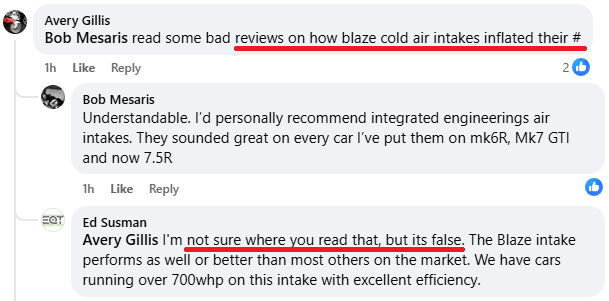
Recently, a consumer raised concerns on social media, stating they had read reviews suggesting the Blaze intake had inflated performance numbers. Susman’s response was brief:
I’m not sure where you read that, but it’s false. The Blaze intake performs well or better than most others on the market. We have cars running over 700whp on this intake with excellent efficiency.
Ed Susman – Owner of Equilibrium Tuning Inc.
This post examines that response.
A Note on Refuting Simple Denials
There is a relevant principle sometimes called Brandolini’s Law: the amount of effort required to refute a false claim is an order of magnitude greater than the effort required to make it.
A four-sentence denial can require four paragraphs of documented evidence to address properly — not because the evidence is weak, but because establishing context, citing sources, and walking through logic takes more words than asserting a conclusion.
What follows is necessarily longer than Susman’s response. That asymmetry is not a sign that his position has merit.
Claim 1: “I’m not sure where you read that, but it’s false.”
The consumer’s concern — that reviews suggest the Blaze intake has inflated performance numbers — is not false. It is documented.
EQT’s original advertising stated the AToM was “one of the best-performing and flowing options on the market as verified by independent testing.”
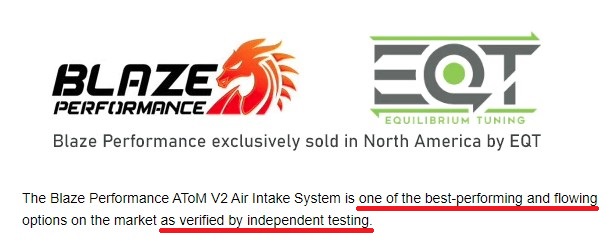
The independent testing cited was a single satisfied customer’s experience. A customer testimonial is not independent testing. Independent testing means a controlled comparison conducted by a party with no financial interest in the outcome, using methodology that controls for variables. What EQT described does not meet that standard. This was documented in December 2022. [Link]
Subsequent comparisons showing the AToM outperforming competing intakes — promoted by an EQT employee and featured in a customer testimonial video in EQT’s direct marketing channel — omitted the fact that the competing intake in those comparisons was paired with an undersized inlet adapter. An undersized adapter restricts airflow to the turbocharger independently of which intake is installed. Attributing a performance difference to the intake when the comparison variable is actually the adapter is an invalid comparison. This was documented in June 2023 [Link] and November 2023. [Link]
The consumer who raised concerns about inflated numbers had a legitimate basis for that concern. Telling them it is false is not accurate.
Claim 2: “The Blaze intake performs as well or better than most others on the market.”
Two things are worth noting about this claim.
First, the language has retreated from the original advertising. “One of the best-performing options on the market as verified by independent testing” has become “performs as well or better than most others.”
These are different claims. The first is a strong superlative backed by a cited verification. The second is a softer comparison with no cited basis. Susman presents this as a defense of the original claim when it is actually a revision of it — one that a consumer reading only this response would have no reason to notice.
Second, and more fundamentally: what is this claim based on? The documented history of how EQT has supported performance claims for this product includes a single customer testimonial miscategorized as independent testing, comparisons that omit the adapter variable, and a cancelled purchase order from an independent tester (me) who attempted to evaluate the product formally. [Link]
None of this constitutes a reliable evidence-based foundation for a comparative performance claim. Asserting the claim more confidently does not change the supporting evidence.
Claim 3: “We have cars running over 700whp on this intake with excellent efficiency.”
This statement answers a different question than the one being asked.
The question implied by the consumer’s concern is whether the AToM’s advertised performance advantage over competing intakes is real and properly attributed. The 700whp reference addresses whether the intake becomes a flow restriction at extreme power levels. These are not the same question.
The fact that a high-power application uses the intake successfully says nothing about whether the intake outperforms competitors, which is the claim at issue. This is a form of invalid comparison: presenting evidence that addresses one question as though it answers another.
It is also worth noting the structure of the rhetoric. A high power rating — 700 whp — is impressive to an enthusiast audience. Introducing it in response to a concern about performance claims creates an impression of capability without actually addressing the concern. This technique has a name in logic: a red herring.

The Contradiction Susman’s Response Does Not Address
The most significant problem with this denial is not any of the three claims above. It is what the response omits entirely.
In 2025, Susman himself disclosed in a post that the inlet adapter is the source of the performance difference attributed to the AToM in comparisons with competing intakes. That disclosure is documented here. [Link]
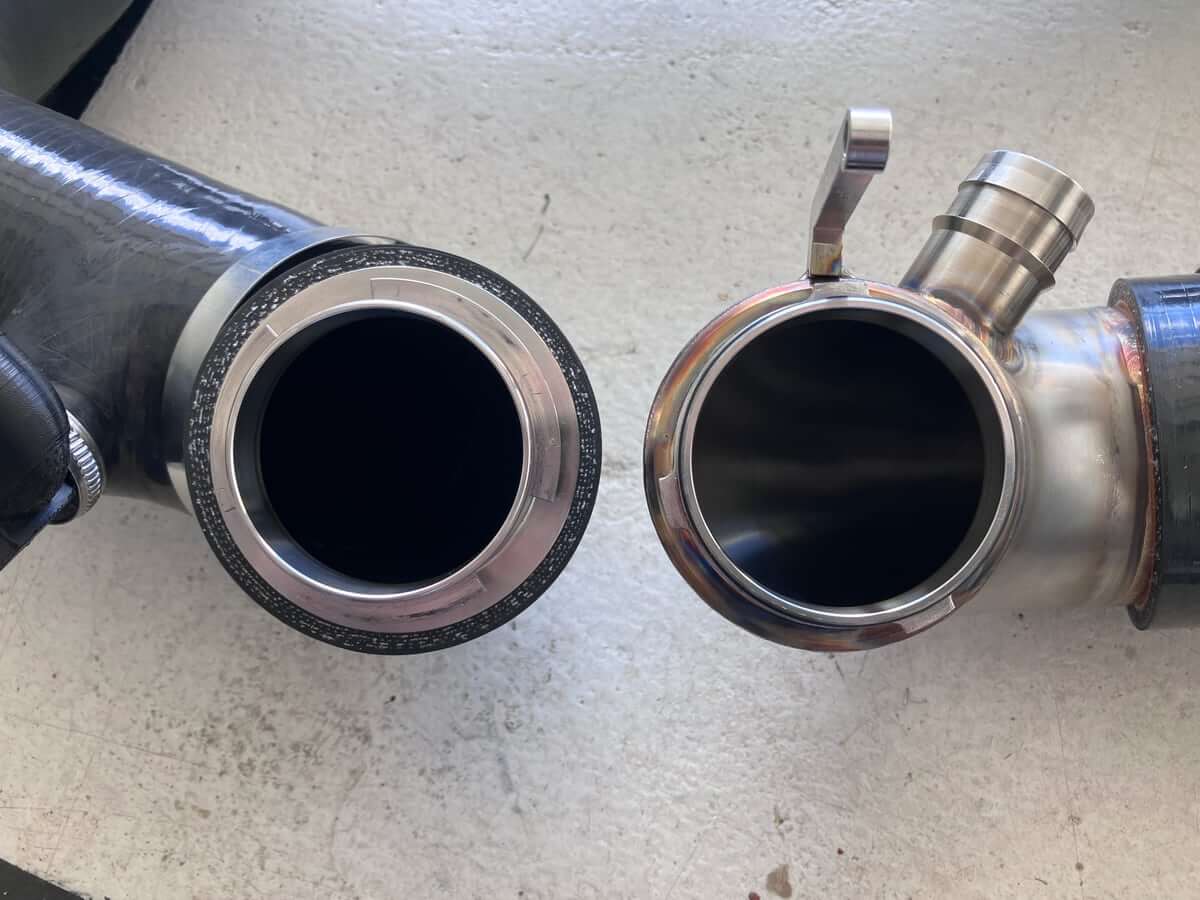
He now tells a consumer that concerns about inflated performance numbers are false — without mentioning the adapter. The same variable he previously acknowledged as the actual performance driver is absent from his response to a direct consumer question about inflated performance claims.
A denial of inflated performance claims, made by someone who has already disclosed the mechanism by which those claims were inflated, is not a rebuttal. It is a repetition of the original problem, and it is made to a consumer who had no way of knowing that the person denying the concern had already confirmed its basis in a separate post.
What Consumers Should Know
Evaluating performance claims for the Blaze AToM requires asking one specific question that EQT’s advertising and Susman’s recent response both leave unanswered:
In any comparison showing the AToM outperforming a competing intake, what inlet adapter was used with each intake, and were those adapters the same size?
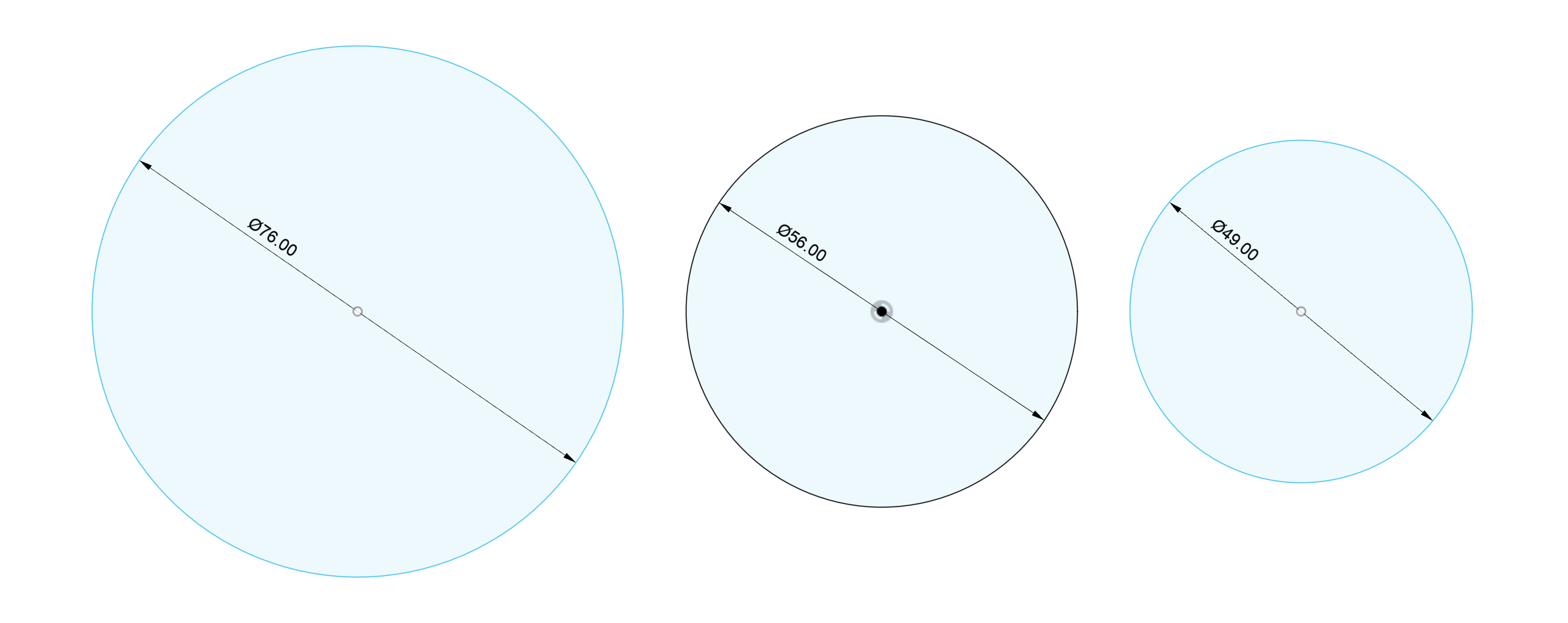
If that question is not answered in the comparison, the comparison does not establish what it appears to establish. This is not a complicated standard. It is the minimum requirement for a valid controlled comparison — controlling for variables that are not the subject of the test.
EQT has had three years and five documented opportunities to present comparisons that meet this standard. The adapter variable has been omitted each time. Susman’s own 2025 disclosure explains why that variable matters. His recent denial to a consumer does not change what the documented record shows.
A Final Note
Addressing a four-sentence social media comment has required this much documentation for one reason: each sentence in Susman’s response either misrepresents the record, restates an unsupported claim in softer language, or introduces an irrelevant data point designed to impress rather than inform. Refuting each element accurately requires citing the documented evidence behind it.
This asymmetry — between how quickly a false or misleading claim can be made and how much effort accurate rebuttal requires — is exactly what makes documented fact-checking valuable. Susman’s response took seconds to write. The record it contradicts took three years to build. Consumers who read only the response, not the record, are not equipped to evaluate what they are being told.
That is what this blog exists to address.
Prior Documentation
Some history of the Blaze AToM advertising concerns is available in the following posts, in chronological order: