
Background:
I saw this comment a little while ago in the responses to a post from an owner who was wondering about using a bicooler with a hybrid turbocharger.

When I discussed Bicoolers versus Aftermarket Stock mounts in a May 2021 post, I mentioned that conditions could factor into the results.

At that time, my data was based primarily on use with an IS38 turbocharger, which produced boost pressure peaks of 27-28 psi for 3-4 seconds.
Since then, I have used larger hybrid turbochargers, such as the Mabotech M520 and M720, which produced a boost pressure of 34 psi and was sustained for approximately 7 seconds.
In this post, I will add additional results from these larger hybrid turbochargers and assess the validity of the advice given regarding a bicooler versus an aftermarket stock-mount IC (SMIC).
Statement review:
The first objective statement made by the person is:
if you’re running stock intercooler with twintercooler cooler fmic you’re still pushing hot air out of the stocky.
Reddit member
Depending upon the criteria for what qualifies as “hot air“, this statement could be true. If air temperature out of the IC being greater than the outside air temperature is defined as “hot air” (i.e., it could be 1 degree Fahrenheit “hotter“), then the statement is true because air-to-air heat exchangers do not reach 100% efficiency.
On the other hand, this would also apply to all SMICs, since none achieve 100% cooling efficiency.
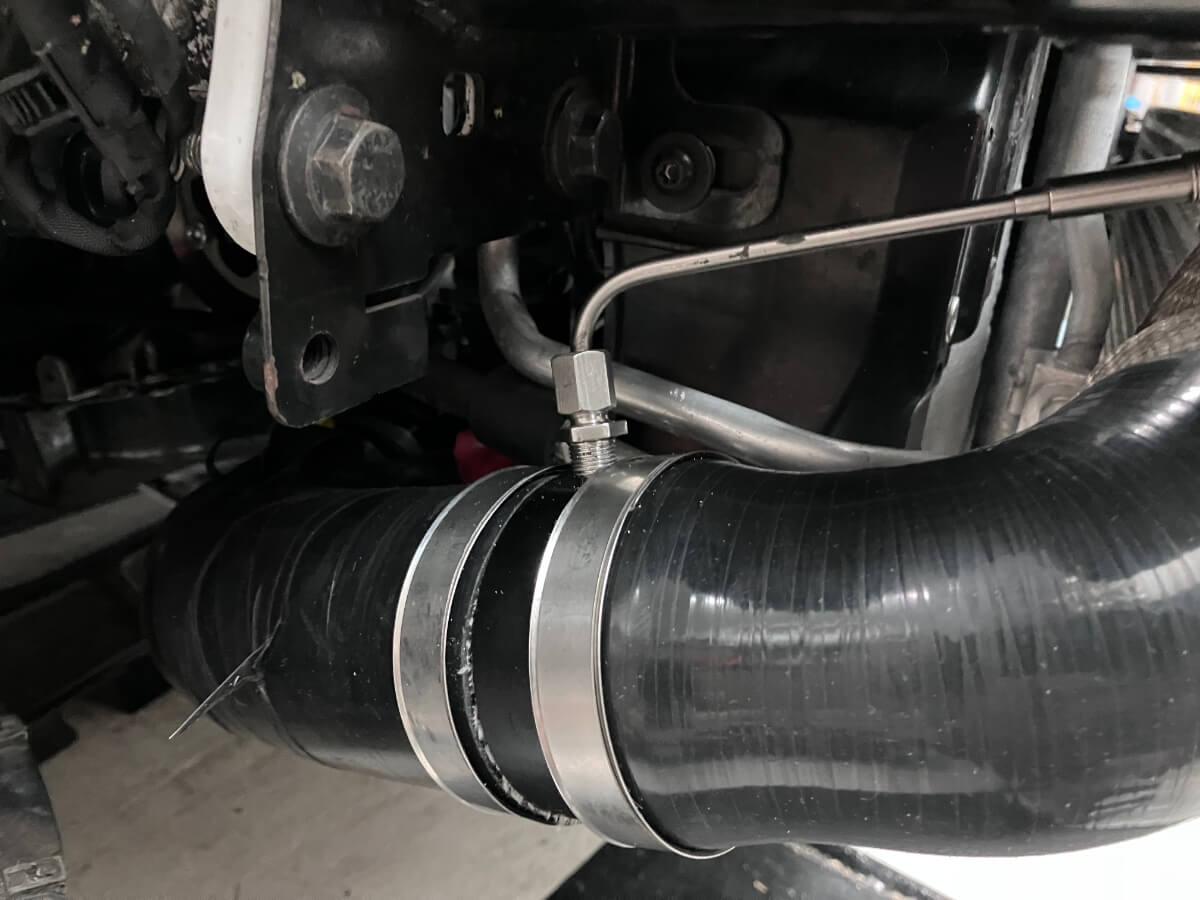
As a practical matter, determining whether the air temperature exiting the stock intercooler is “hotter” when configured as a bicooler would require installing separate air temperature sensors at the stock intercooler outlet and the front-mount intercooler outlet.
Given that the person starts their advice with “AFAIK” (as far as I know), it is highly unlikely that they have done this.
Thinking logically about the situation presented with a bicooler, splitting the airflow between two cores, does not necessarily lead to the conclusion that the air exiting the stock intercooler will be hotter.

Heat exchangers transfer heat from the internal airflow to the external cooling airflow. The turbocharger is discharging air that contains a specific amount of heat energy. For example, operating at around 28 psi with an intake air temperature of 75 degrees Fahrenheit, the compressed air is discharged with a heat load of about 30 kilowatts. (This is a rough estimate that is dependent on numerous factors; the concept is what’s important with this example.)
Since the bicooler splits the airflow between the two cores, assuming a 50-50 split, the heat load each intercooler must handle is cut in half; each handles 15 kilowatts.
This compares with the 30 kilowatts that the user recommended aftermarket SMIC receives.
It is not intuitively obvious that a SMIC handling 30 kilowatts of heat load will outperform a stock IC handling 15 kilowatts of heat load.
The person bases their conclusion and recommendation on the assumption that the stock IC is discharging “hotter” air.
Data review:
IS38 turbo –
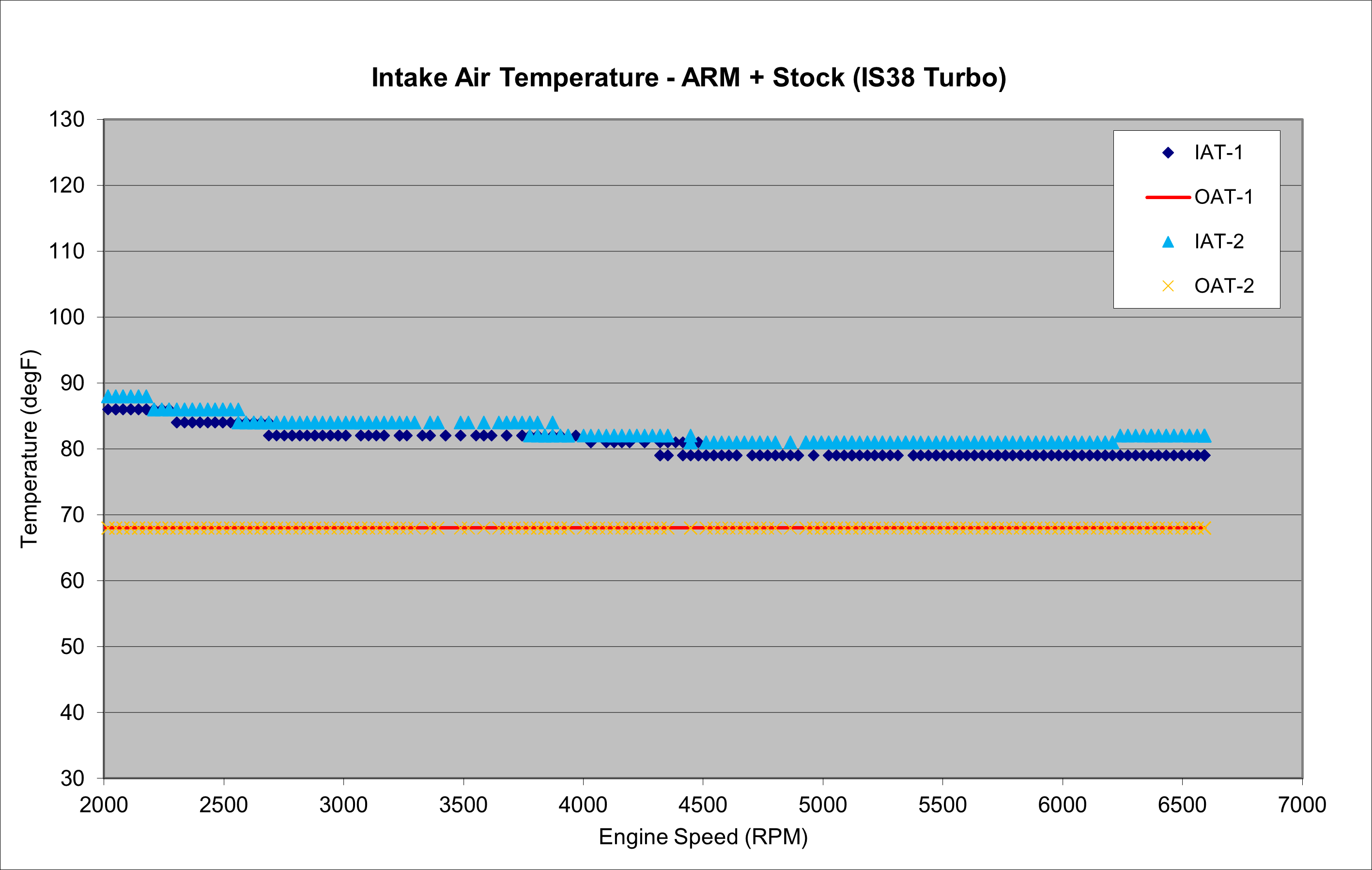
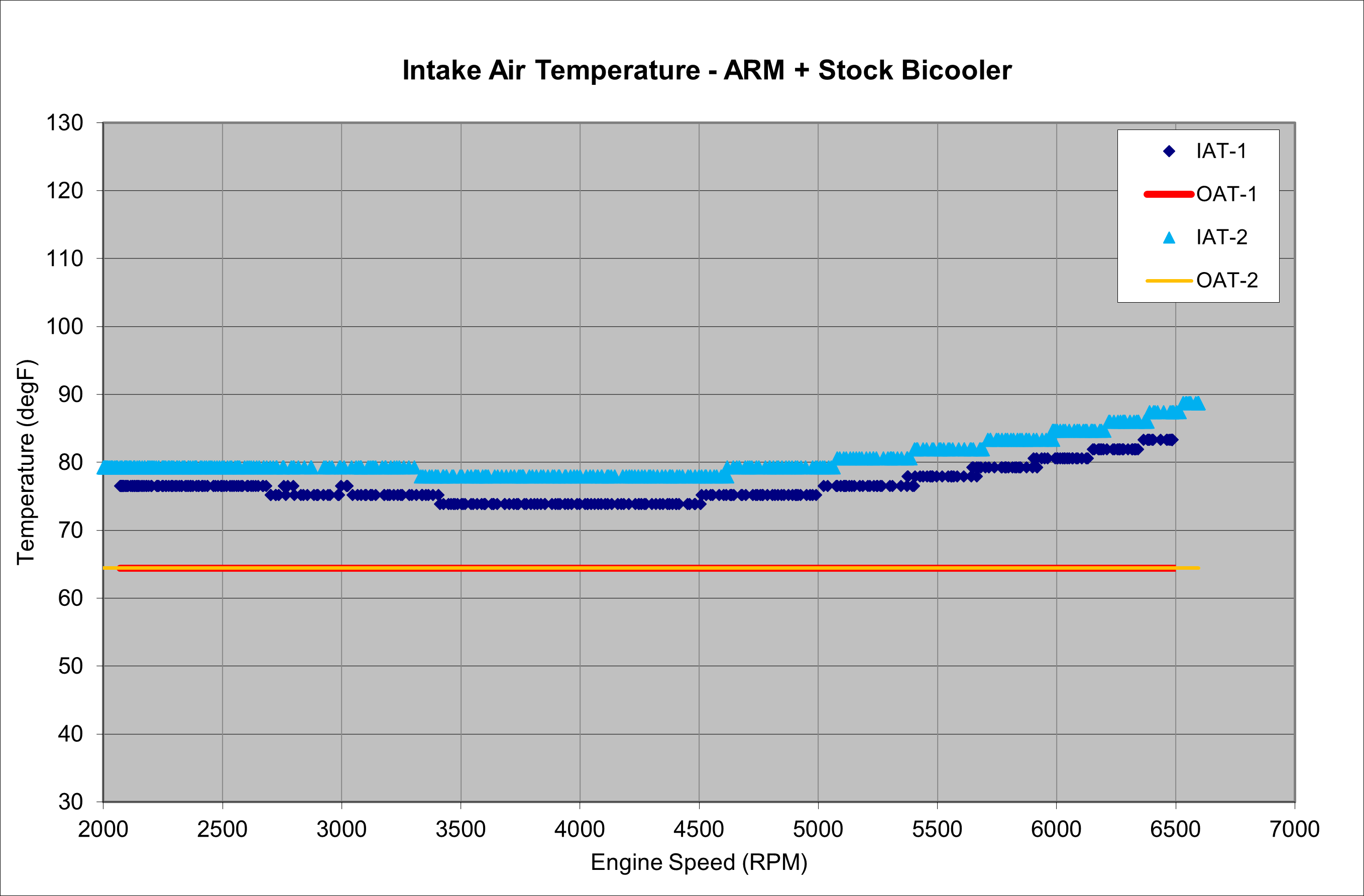
The first examples compare a bicooler with the ARM FMIC and stock GTI IC to several aftermarket intercoolers, using an IS38 turbocharger.
Note: This data is not from a hybrid turbocharger, as referenced in the original Reddit discussion, but I am presenting it so it can be compared with a hybrid turbocharger.
Importantly, this data represents the IC performance during a full-throttle third-gear pull, starting around 2,000 RPM and ending around 6,500 RPM.
Note: I use this scenario for comparison as it simulates the vehicle overtaking another or merging into traffic from a relatively low speed to a high speed over a short distance.
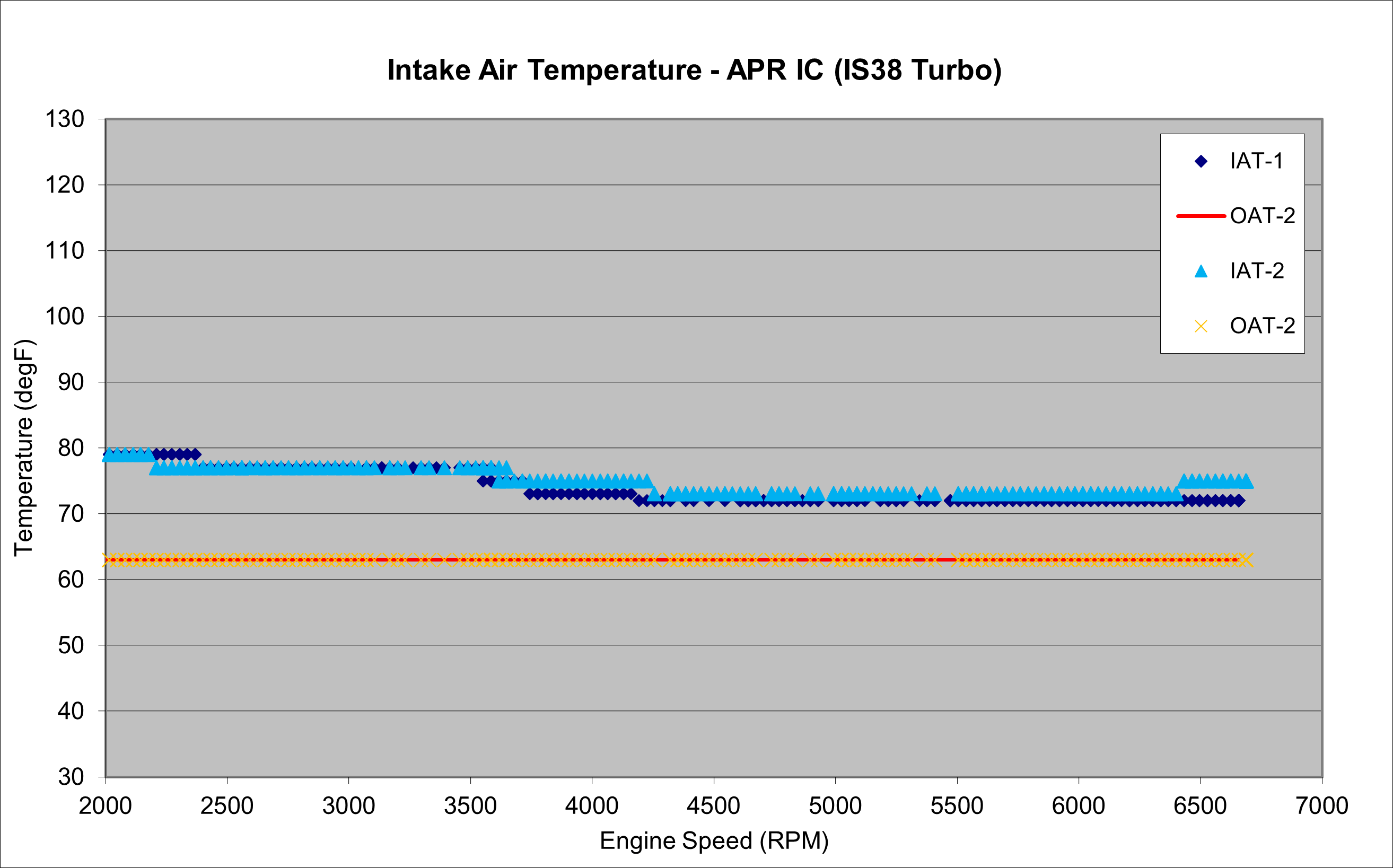
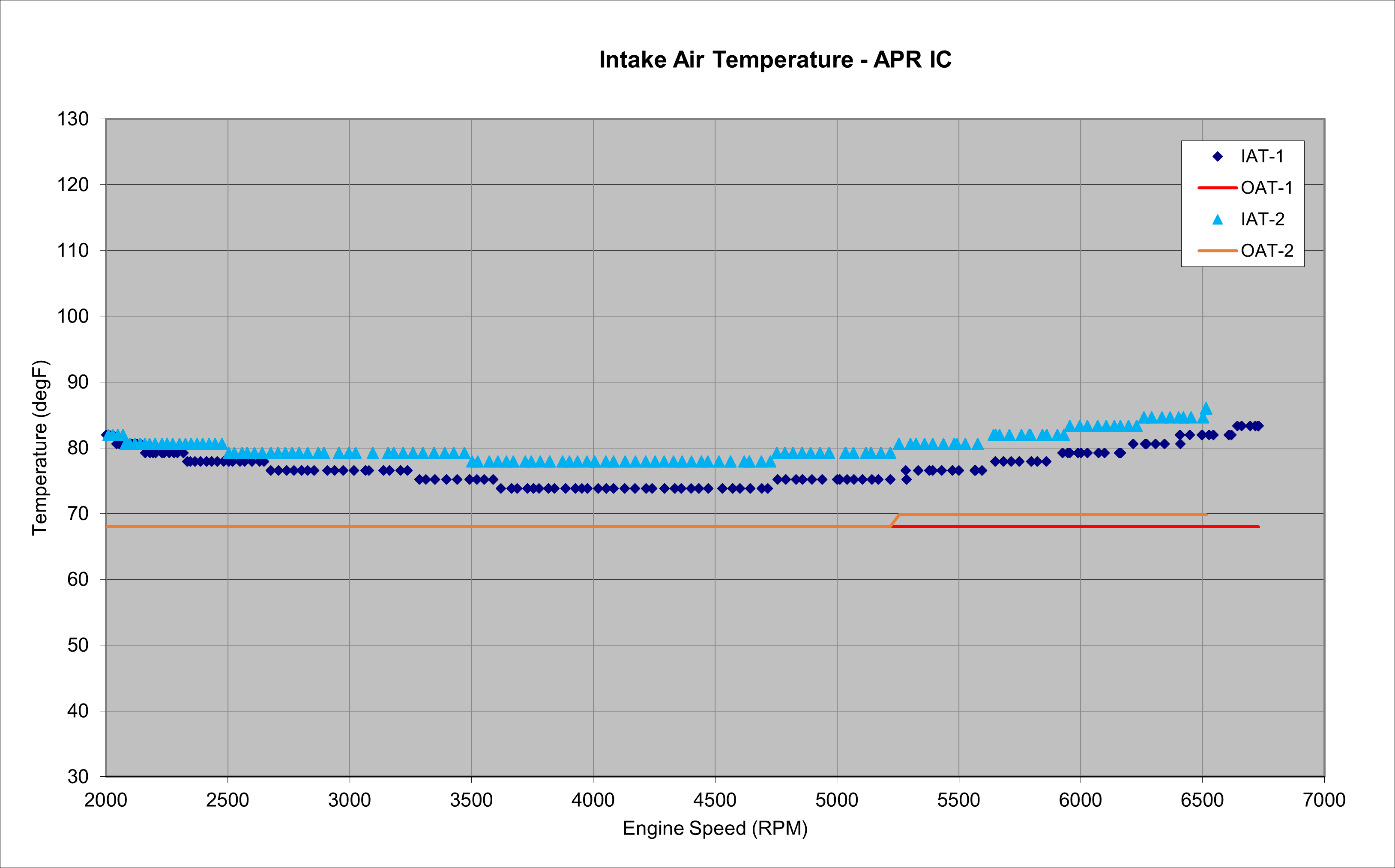
Next is the same measurement using an APR stock location intecooler.
Then a do88 stock location intercooler.
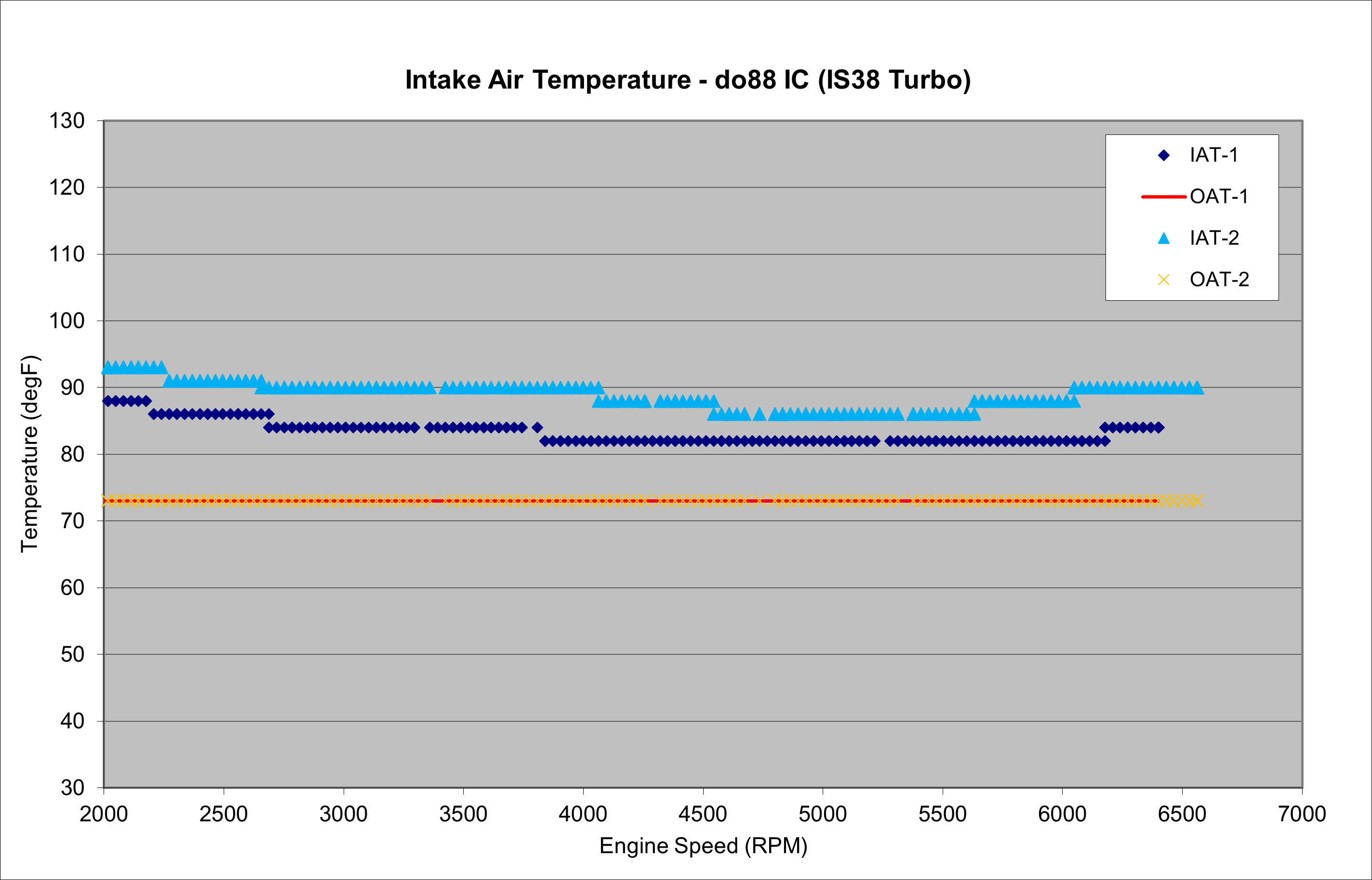
A third example is from an Integrated Engineering (V2) stock location intercooler.
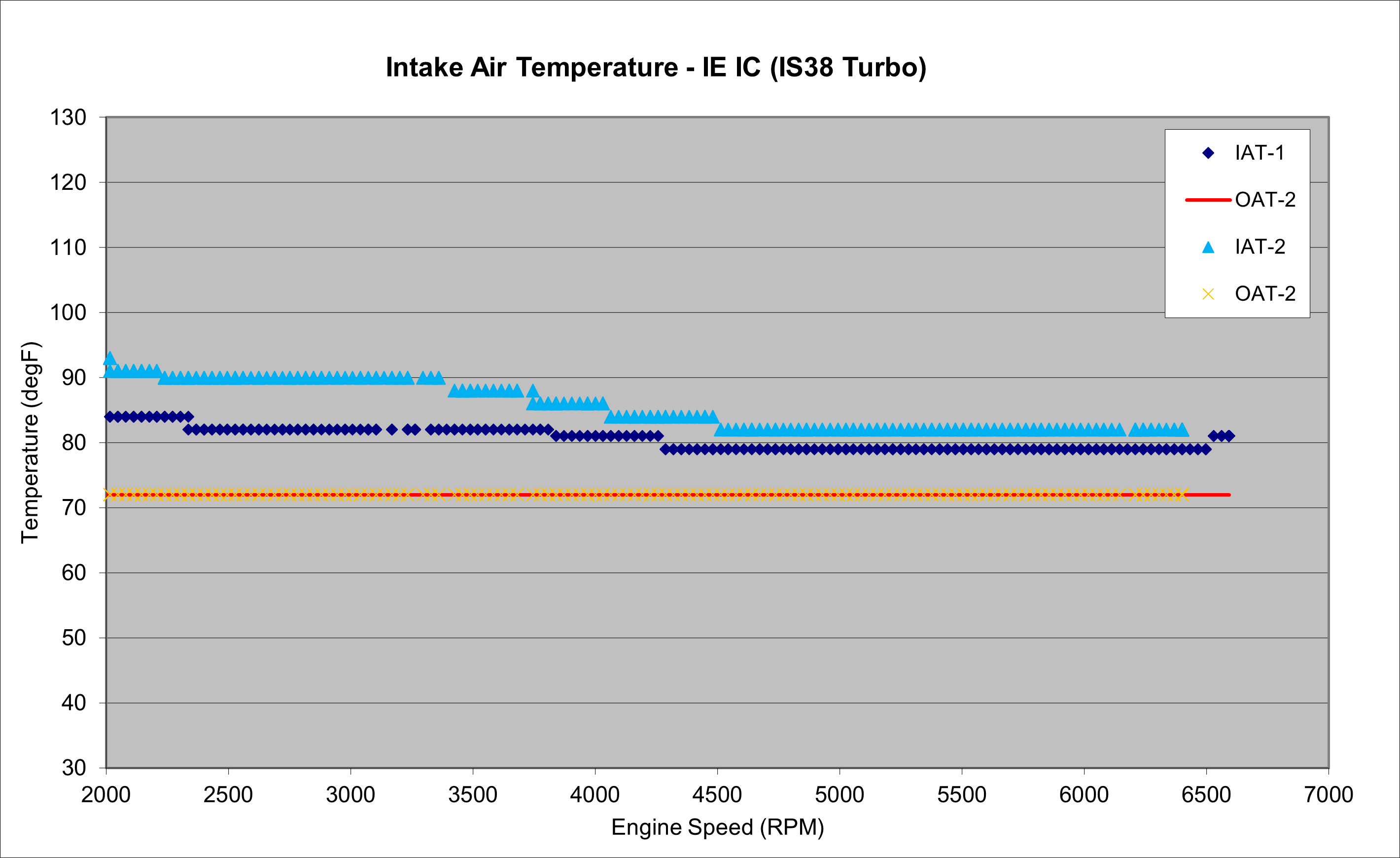
The average intake air temperature above the outside air temperature (dIAT) at 6,000 RPM is calculated from the two data points.
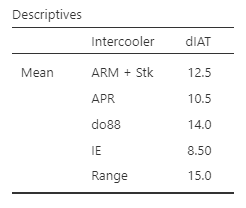
Note: Two data points are insufficient to calculate a reliable mean value. The values are a ballpark estimate. The next chart shows how the two data points span a range of values.
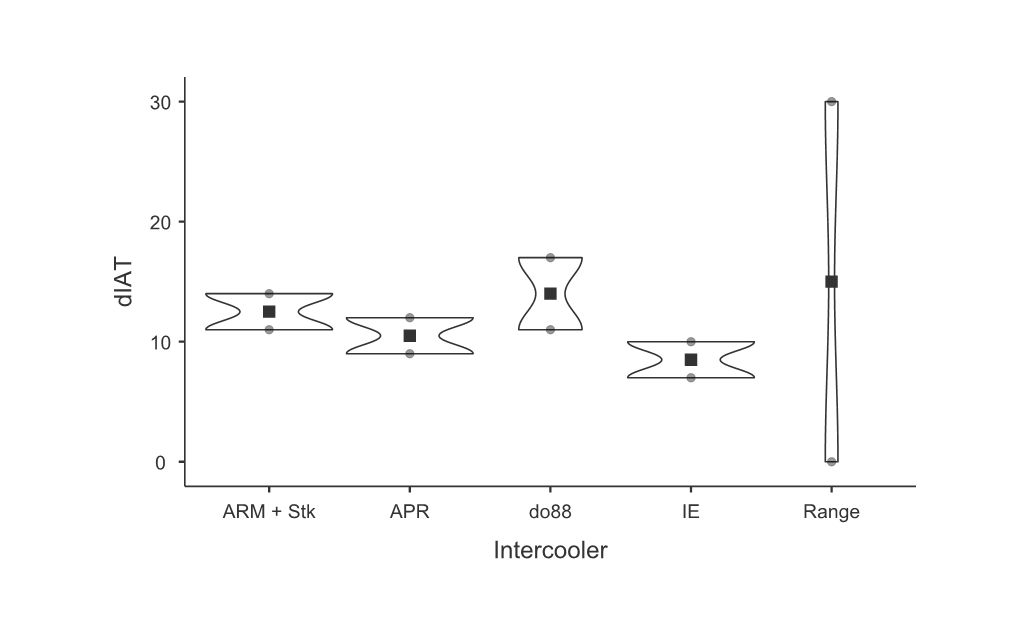
Intake air temperature minus the outside air temperature is only half of the picture. The other half of the picture is based on the air temperature entering the intercooler; without it, it is not possible to estimate the intercooler’s efficiency.
Measurements of air temperature exiting the turbocharger compressor indicate it can reach nearly 400 degrees Fahrenheit with an IS38 turbocharger.
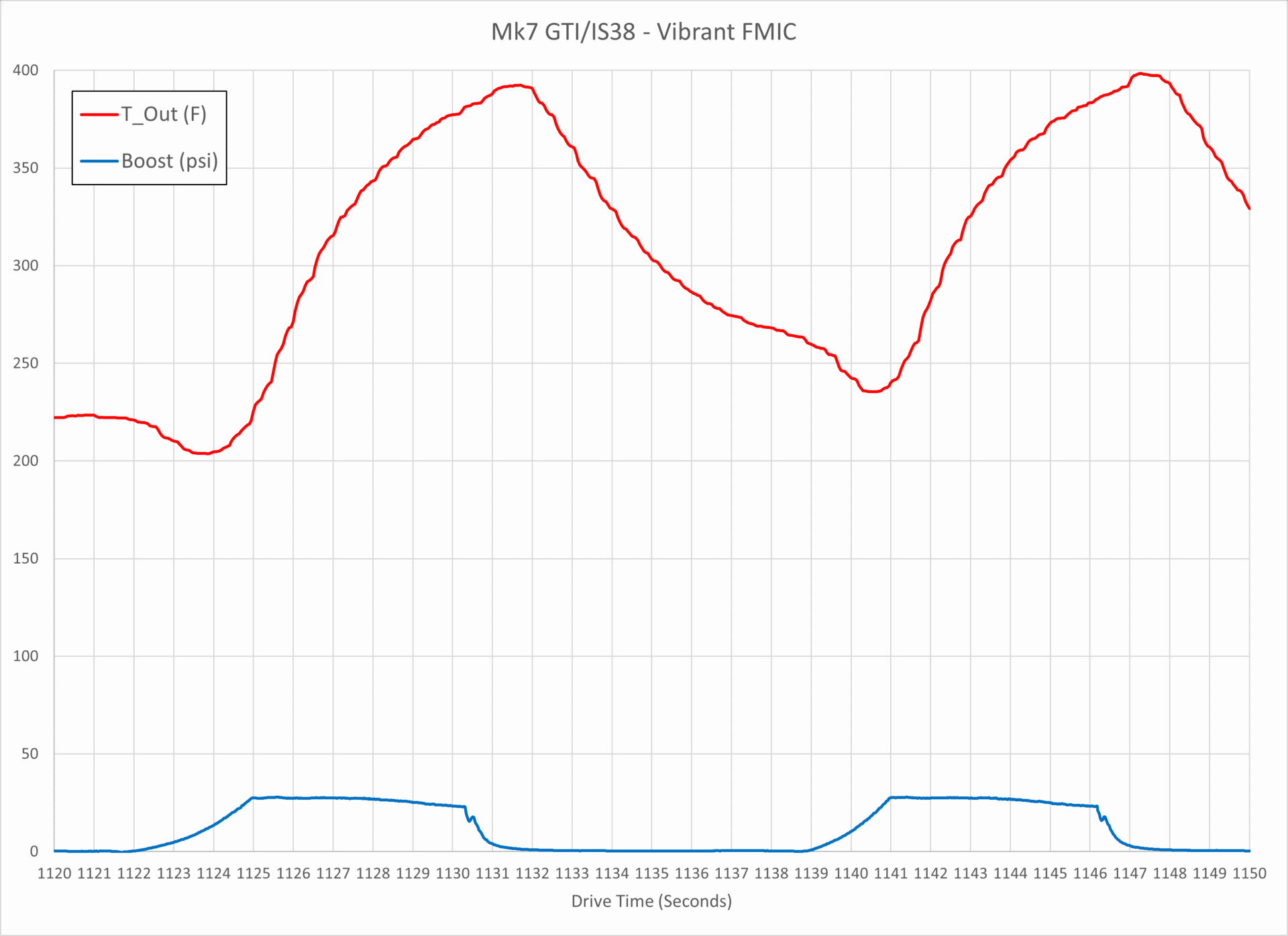
Picking a realistic reference value for the compressor outlet air temperature enables the estimation of the intercooler’s peak efficiency. As the table below shows, the efficiency of these intercoolers is very similar, with all performing well.
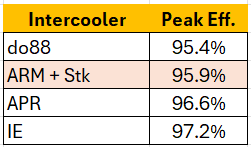
As discussed in the May 2021 post, there’s no significant benefit of an aftermarket stock-location IC over the bicooler under the conditions described for this comparison.
M520 hybrid –
Turning to the results for a hybrid turbocharger, the chart shows temperature measurements with the stock GTI IC and ARM FMIC bicooler.
Note: The engine speed range of 2,000 to 6,500 RPM is covered in fourth gear, which takes longer than in third gear.
Next is the APR stock location IC.
The Integrated Engineering (V1) IC:
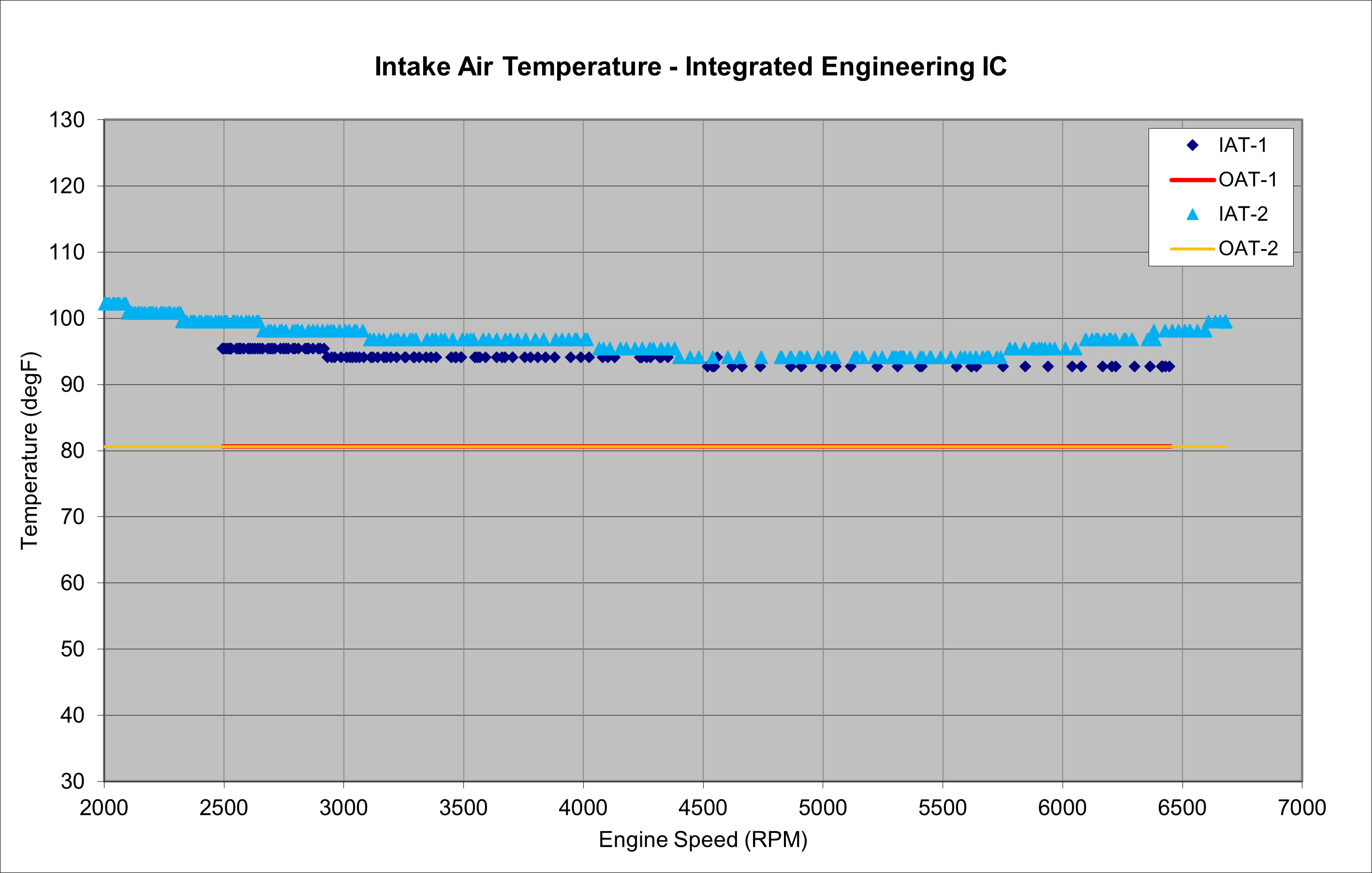
The Mabotech stock location IC:
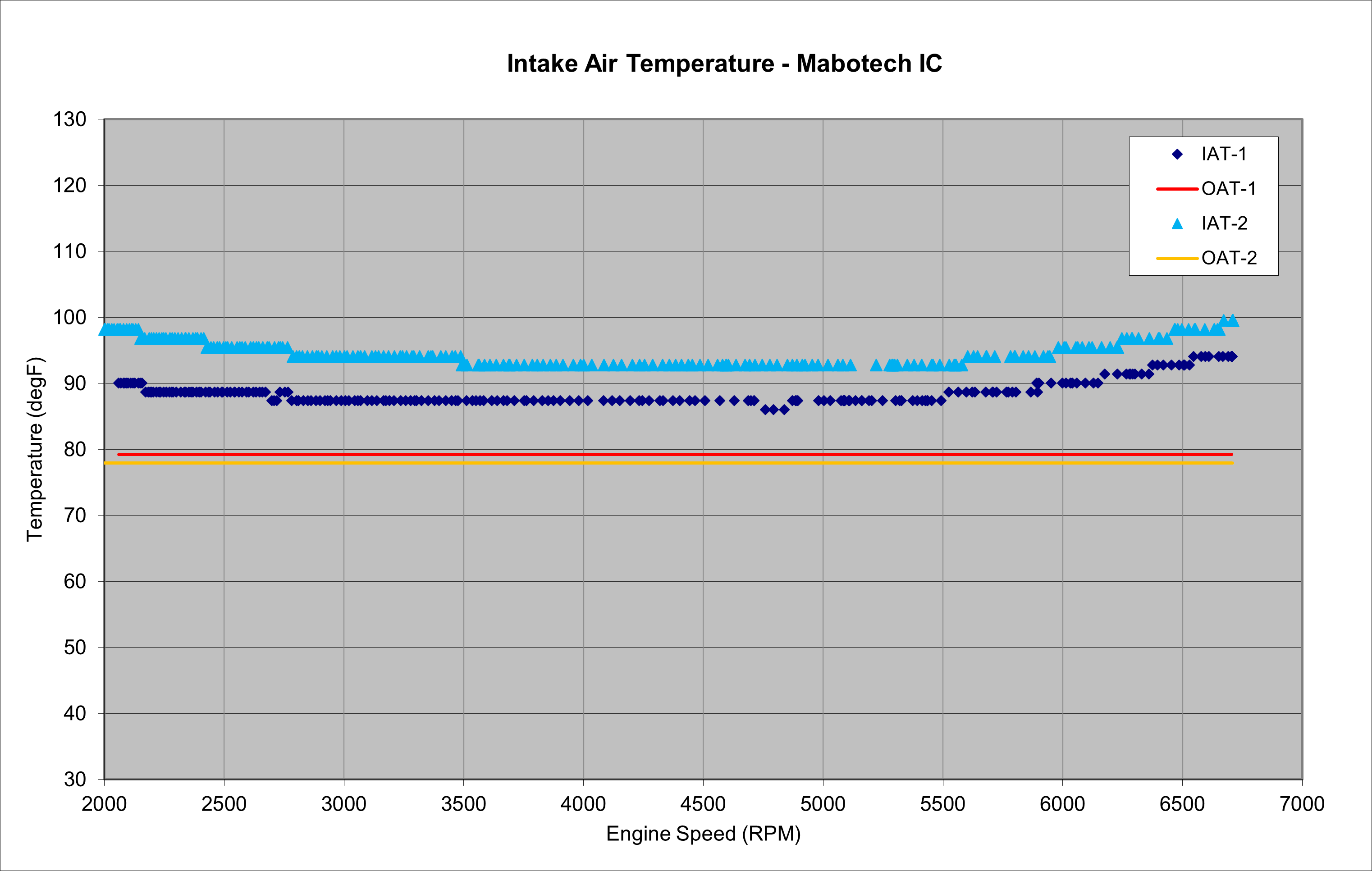
The difference between the Intake Air Temperature and Outside Air Temperature at 6,000 RPM is summarized in the table.
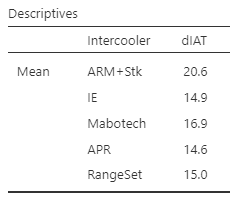
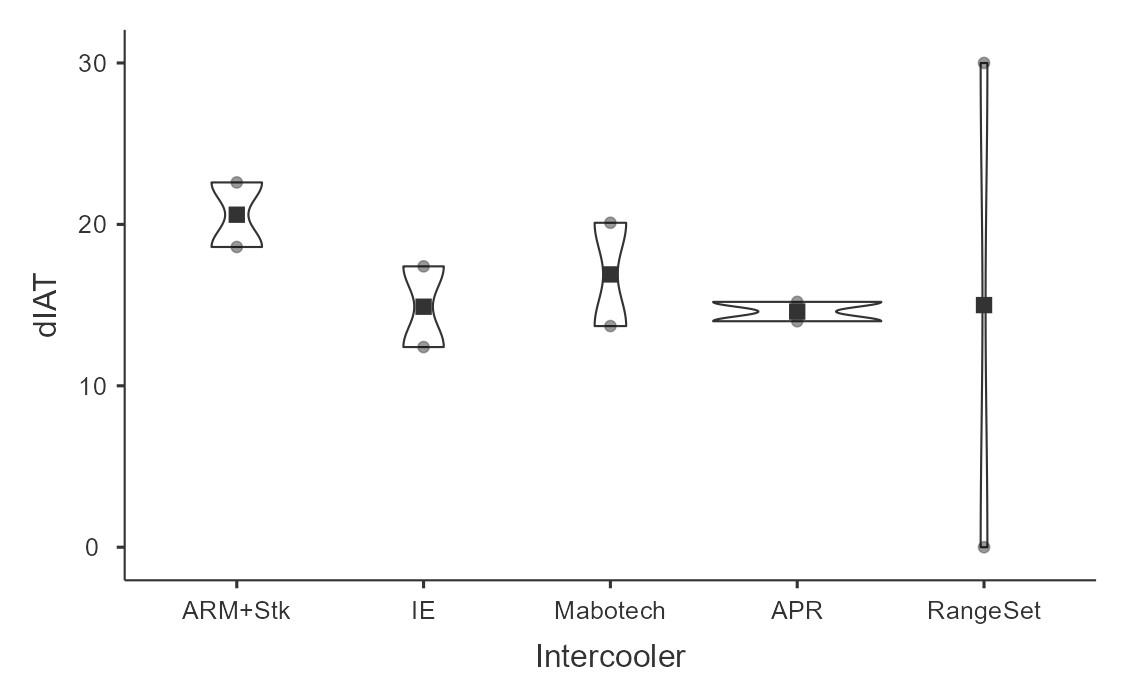
Similar to the IS38 turbo data, the differences between these intercoolers on this metric are minimal. The chart below shows the range of the two values for each intercooler.
Again, this is only half of the picture. To compare the efficiency of these intercoolers, the compressor outlet air temperature is used. At the boost pressure my tune was operating at, the M520 air temperature is lower than the IS38.
The maximum difference in IC efficiency is less than 5%, and all IC setups operate at peak efficiency over 90%.
Note:
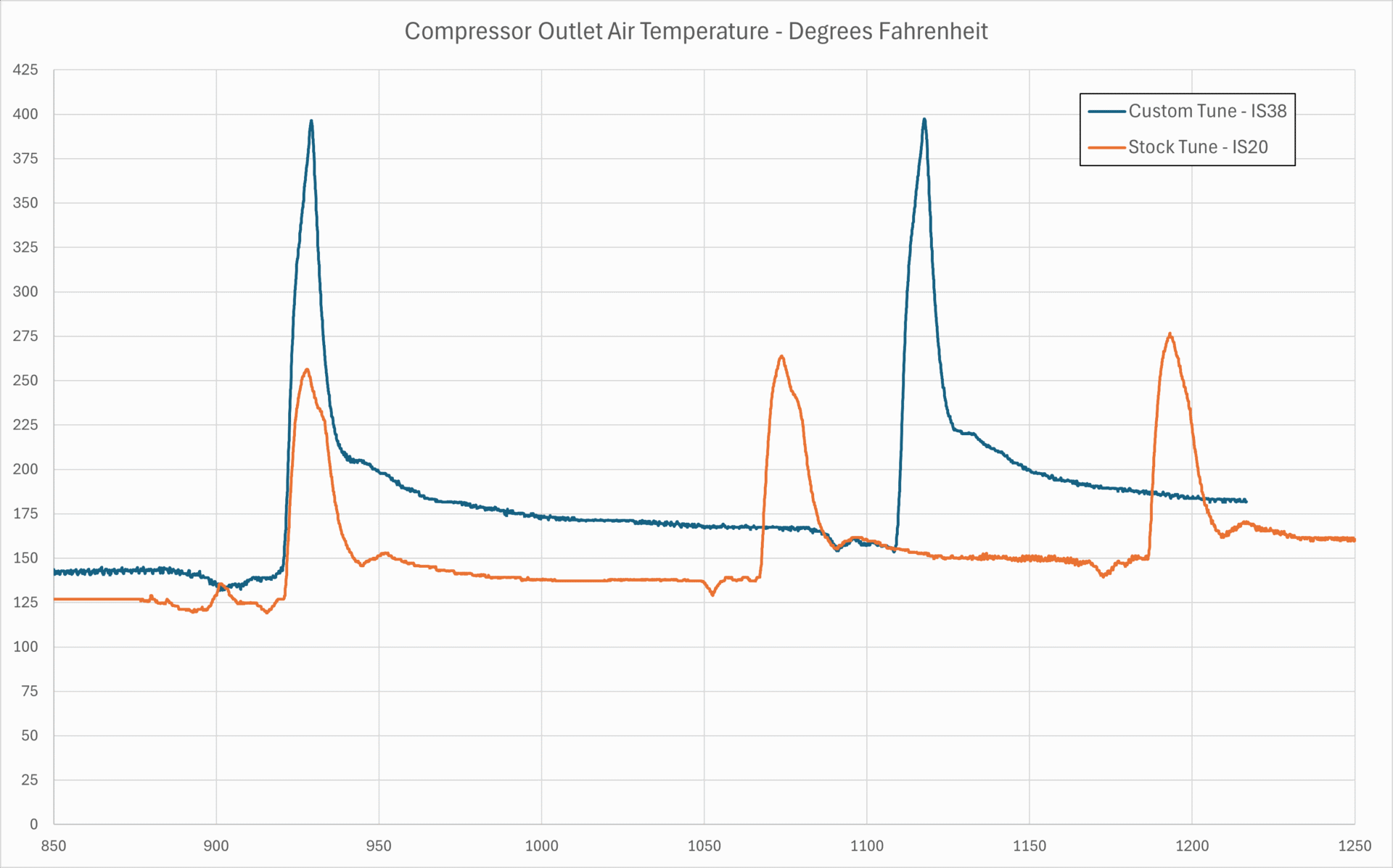
While the two examples used in this comparison had similar compressor outlet air temperatures, this is not always the case. The chart below shows the air temperature from a custom-tuned IS38 and a stock-tuned IS20. Peak differences approach 150 degrees Fahrenheit.
Conclusions:
The recommendation that the better intercooler option for use with a hybrid turbocharger is a stock-location aftermarket intercooler, not a bicooler, is not supported by the evidence presented in this post.
Measurements recorded with a hybrid turbocharger and both intercooler options indicate similar performance from the intercoolers under the conditions used for this comparison.