
Background:
A quirk of the Mk7 community is a persistent belief held by some owners that a diverter valve (DV) spacer causes boost pressure leaks.
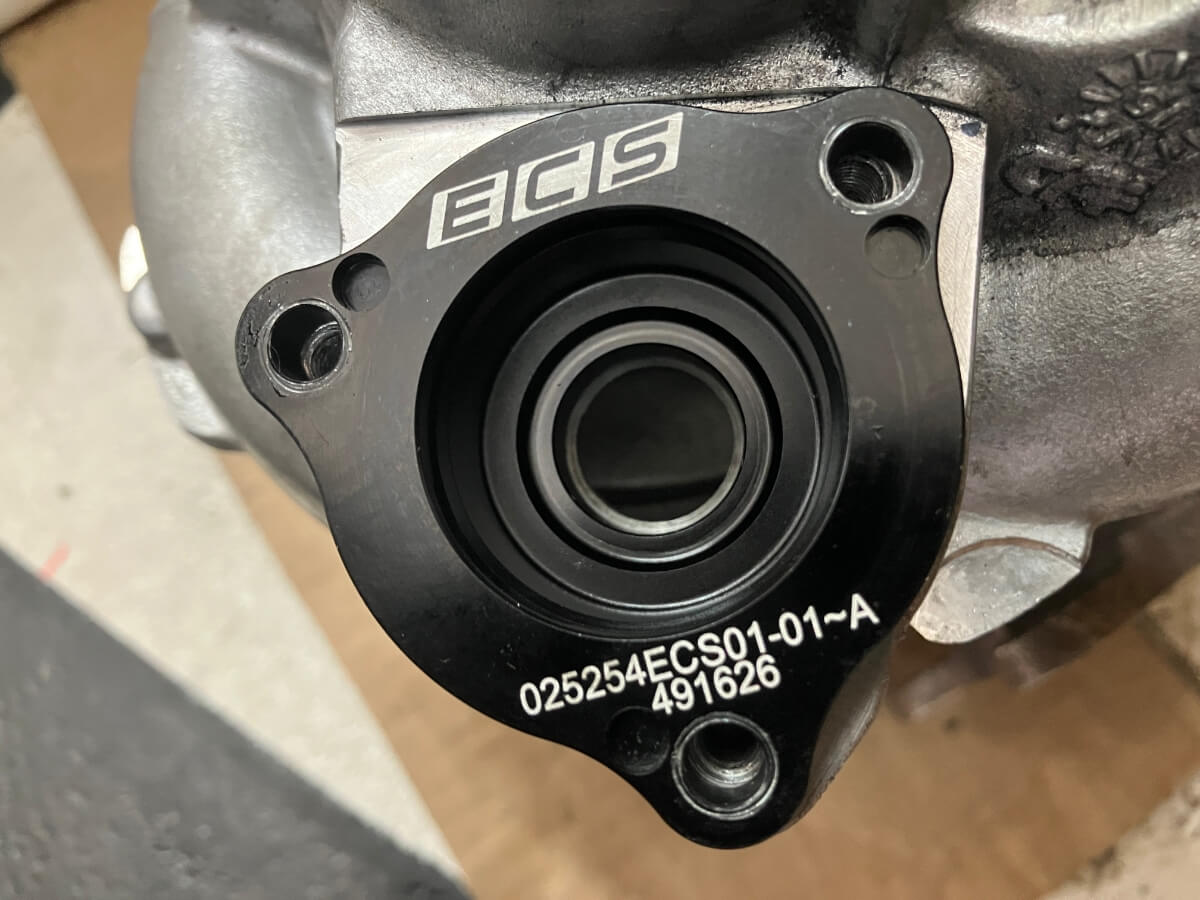
Despite lacking any design feature that could cause this problem, owners claim the part routinely causes problems.
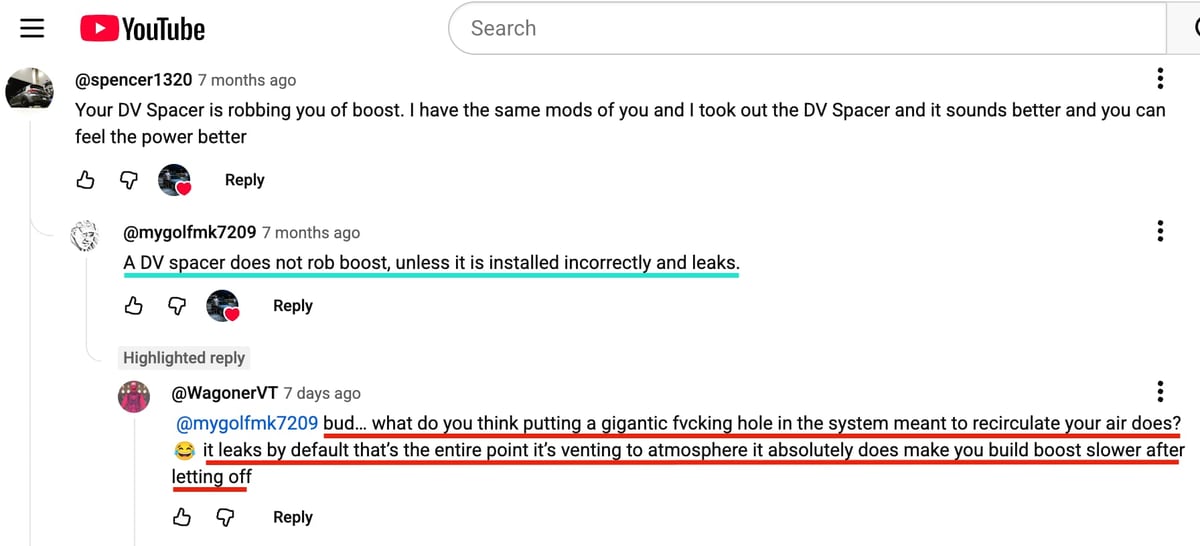
I was part of a recent exchange where a pair of owners reiterated the claimed problems this part causes.
“it absolutely does make you build boost slower after letting off.“
YouTube User – WagonerVT
I’ve already addressed the reason why this is not the case from a conceptual standpoint in a post titled “DV vs BOV Analogy.”
Motivation to conduct a test can come from several sources, and providing evidence to confirm or refute information spread by an auto enthusiast is a common one.

This is an easy test to make, and the video below gives a rundown of the procedure and results, but skips some interesting details that I delve into with this post.
Test Setup:
The GTI is currently outfitted with a Shuenk IS48 turbocharger and a stock diverter valve. The intake is a Racingline R600, and the exhaust is a Trackslag catless downpipe, a Baun Performance midpipe, and an AWE-Tuning exhaust. The tune is from Russell Road & Racing, and the fuel is 93 octane gasoline with 10% ethanol.
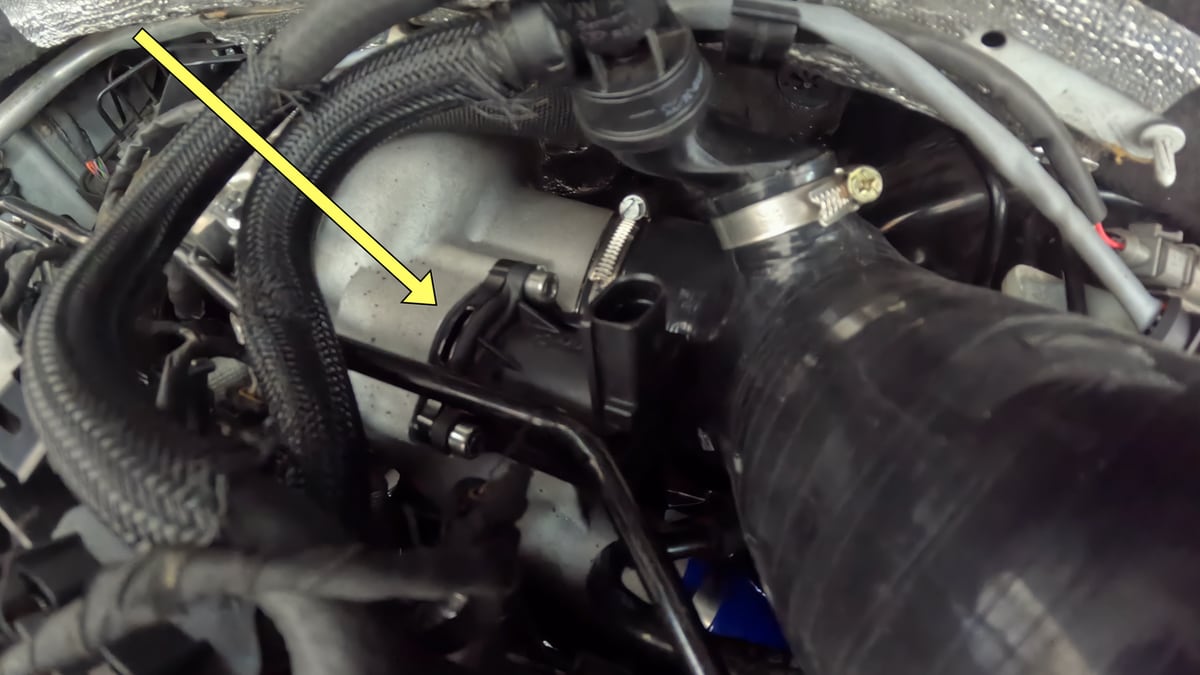
Baseline data is recorded with this setup, and then the ECS Tuning DV spacer is installed between the turbocharger and the stock diverter valve.
The data of interest is the rate at which boost pressure builds after reapplying the accelerator pedal, following the accelerator pedal’s release and allowing boost pressure to drop. This information is being recorded while the transmission is in third gear and the engine speed is between approximately 3,000 and 4,000 RPM.
Test Results:
This first chart shows a comparison of the rate at which the boost curve rises (Red lines) with only the stock DV and then the DV spacer installed.
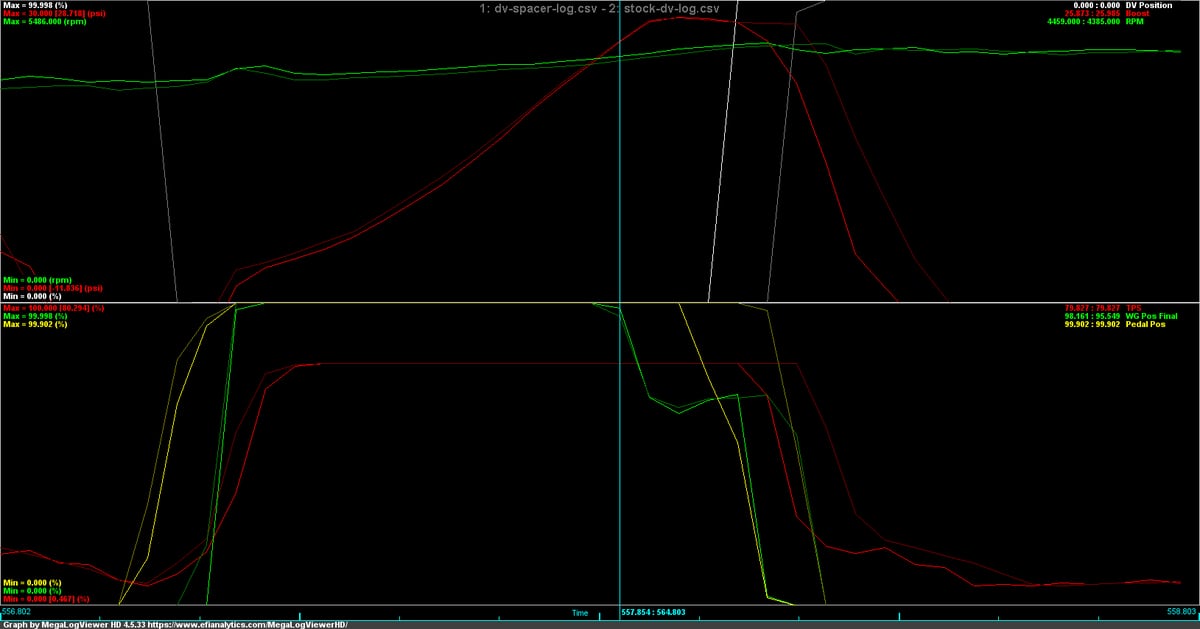
There is a negligible difference, which is explained by small differences in the starting conditions, i.e., engine speed.
In order to check for possible differences that might be shown when comparing larger datasets I plotted the time for the boost to rise from 0 to 25 psi versus the engine speed (RPM) when the wastegate fully closes.
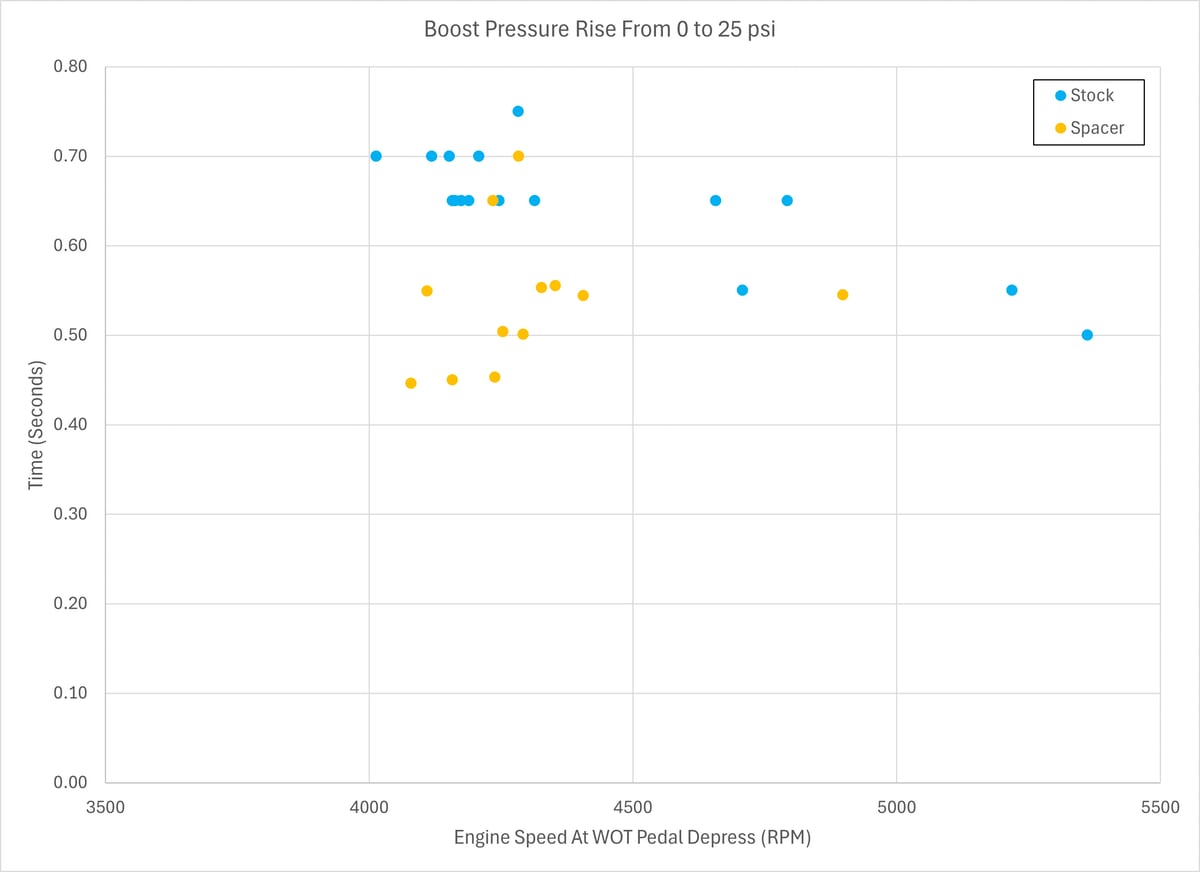
This is interesting, the boost pressure is increasing to 25 psi faster with the DV spacer installed. The opposite of what the YouTube commenters claimed, and different from my expectation of no change.
To get a better idea of the extent of the average difference I looked at the data as box plots.
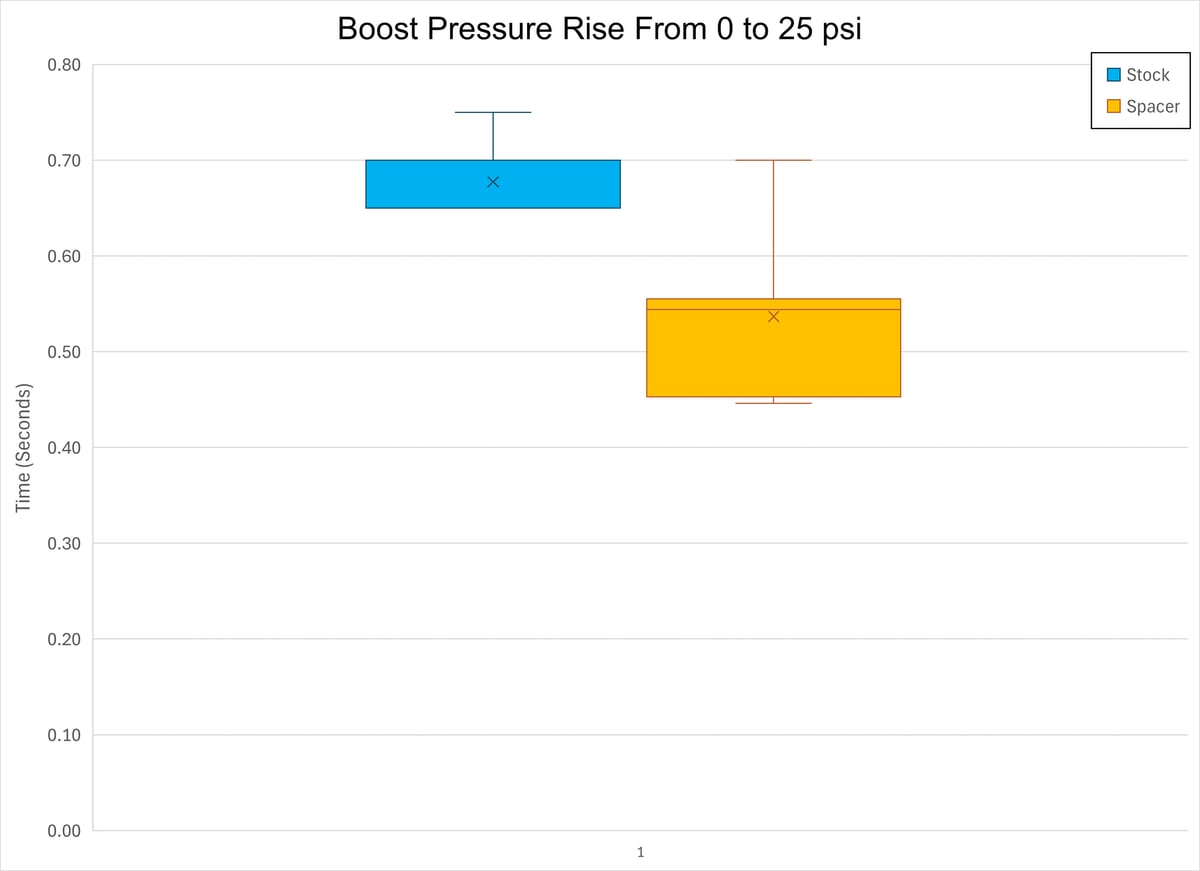
Although the time difference is small, approximately 0.14 seconds on average, it is still an unexpected outcome from a part swap that should not affect the rate at which boost pressure increases.
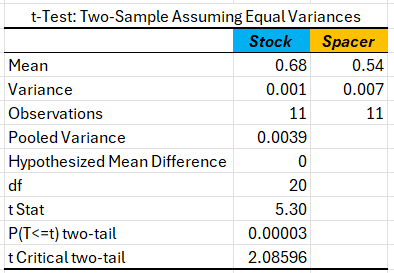
I checked the outcome using a t-test to assess whether the variance in the data points might be large enough to have led to a random result, but there is a statistically significant difference in the mean times of boost pressure rise.
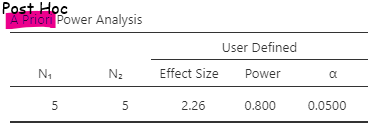
Next, I conducted a power analysis to determine whether there was enough data collected to support a high-confidence (80% probability of detecting a “true” effect when it exists) conclusion.
Power Analysis:
Power Chart
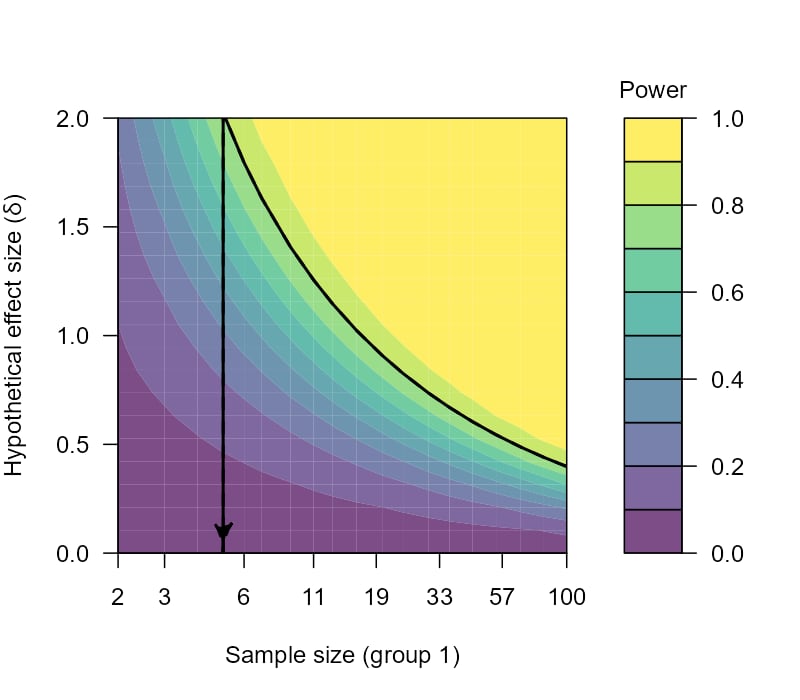
The number of data points recorded was 11 per case, and 5 are needed to reliably detect the observed difference; there was sufficient data.
Factor Analysis:
Okay, so there’s enough logged data, and it shows an improvement when using the DV spacer. But was the DV spacer the cause of the difference?
I started to look at other factors that could have contributed to the outcome.
The first hypothesis I made was that the openings on the DV spacer are smaller than the opening inside the compressor housing. This might reduce the rate at which pressurized air escapes when using the DV spacer.
If this is the case, after the DV is commanded open, the boost pressure might take longer to drop with the DV spacer installed, which would make the boost pressure higher if the DV closes at the same time in both test cases. If the boost pressure is higher when the throttle is applied, that would shorten the time for the boost pressure to rise.
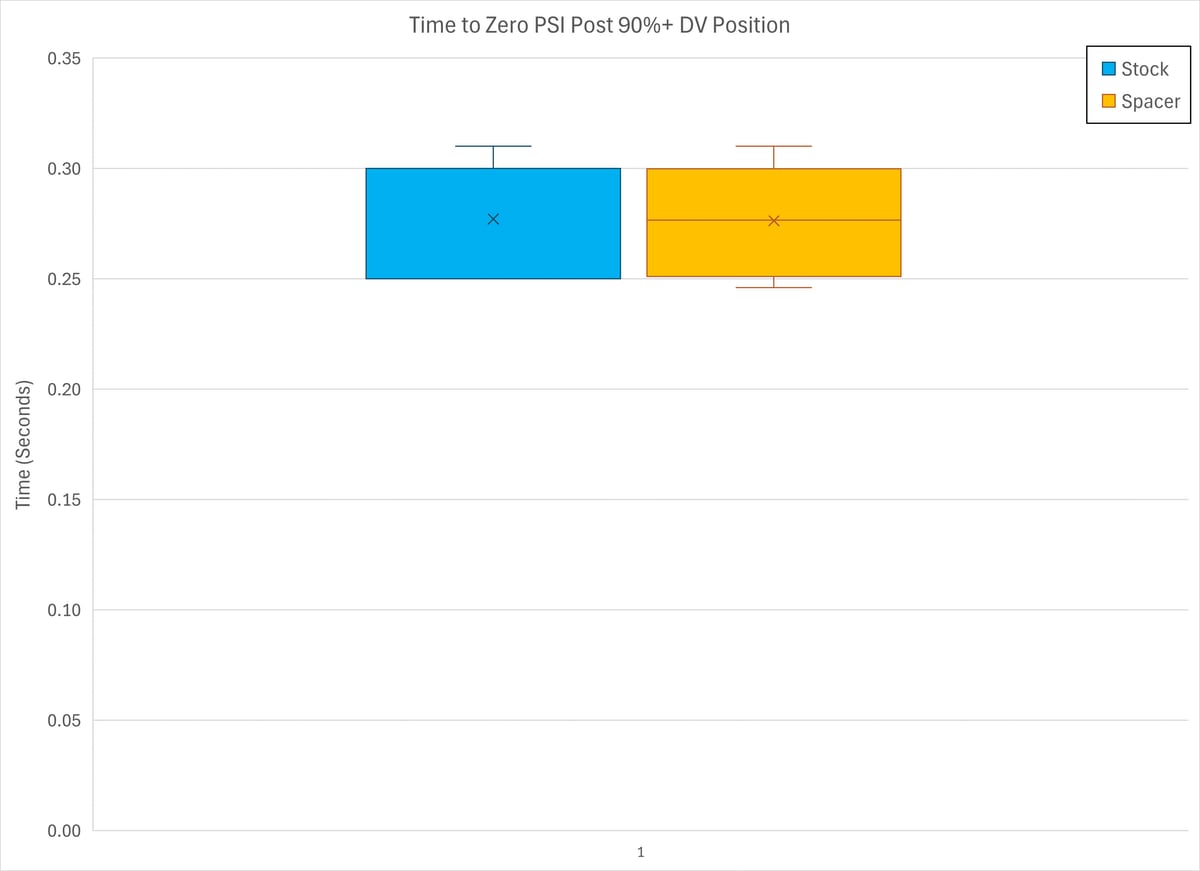
Comparing the time for boost pressure to drop to zero psi following the DV position opening, there was no significant difference in the mean times.
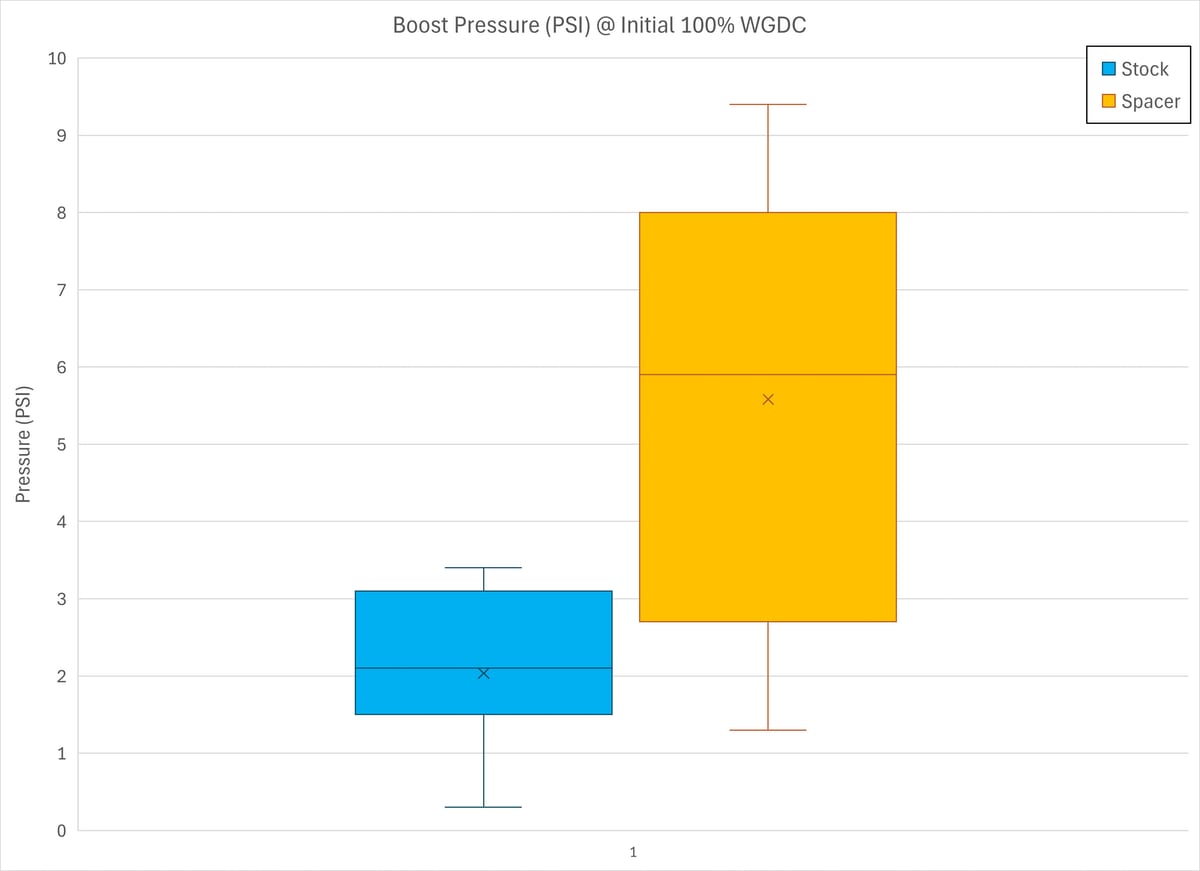
The next check was to determine the boost pressure when the turbochargers’ wastegate fully closes, which is when boost pressure begins to build rapidly.
With the DV spacer installed, the average boost pressure is significantly higher than without the spacer. This correlates with the shorter time required for boost pressure to rise with the DV spacer installed; the boost pressure builds sooner.
This still doesn’t explain why the pressure is higher.
I began looking at multiple factors that were changing to identify indicators of a possible cause. One comparison between the cases that showed a potential was the boost pressure at wide-open-throttle versus the time between the DV opening and the next acceleration application that passed the 50% position.
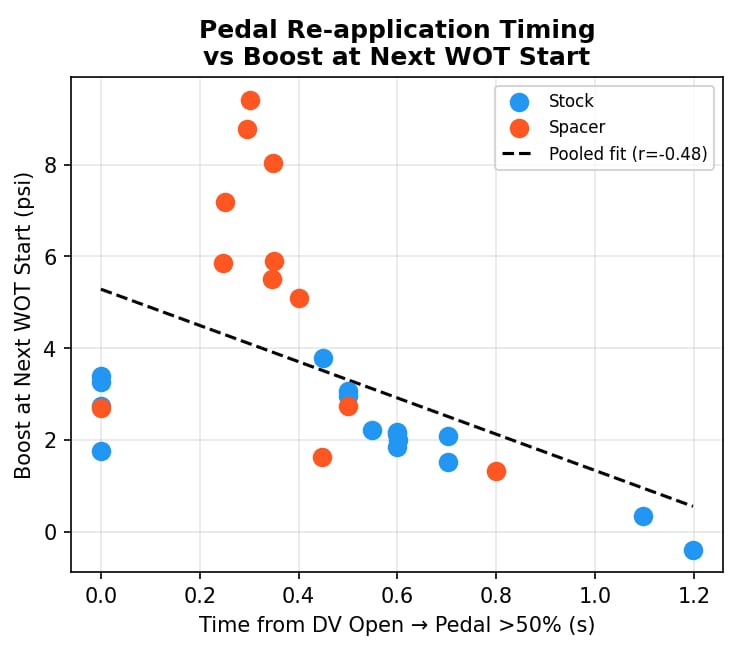
The case with the DV spacer installed was noticeably different from the one without the DV spacer. Pedal position was a candidate factor.
I began looking at outcomes that depended on the time since the DV opened, filtering out results that took longer than 2.5 seconds and where the boost drop was less than 10 psi.
Note: This filtering was done to eliminate data that wasn’t relevant to the comparison test.
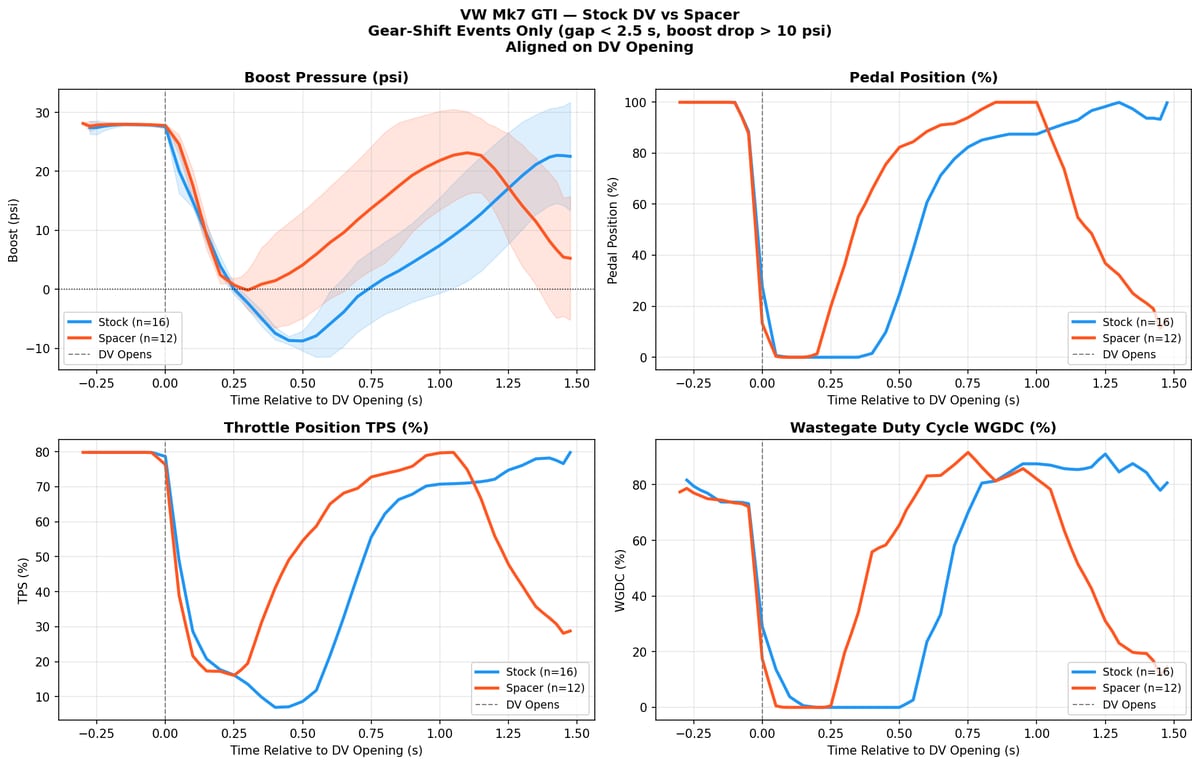
Things began to become clearer now.
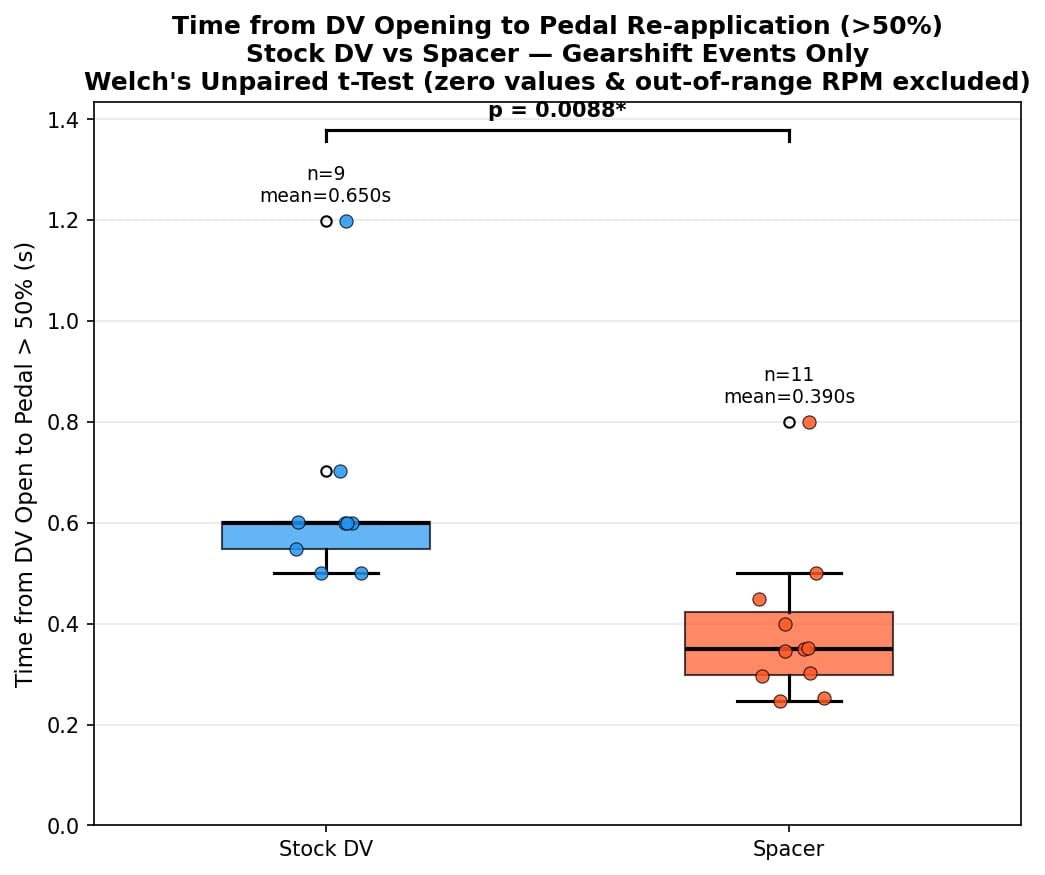
Looking at the Pedal Position chart, it was evident that during the DV spacer test case, the accelerator pedal was depressed approximately 0.25 seconds sooner on average. Performing a T-test on the data confirmed a statistically significant difference in mean times, with the DV spacer test case occurring sooner.
This would then affect the Throttle Position, which is also shown to begin opening sooner. Importantly, in the stock DV case, the throttle plate continues to close, causing the vacuum inside the intake manifold to drop further than in the DV spacer case. (See the Boost Pressure chart above)
At the time that the accelerator pedal is depressed, the boost pressure in the intake manifold (DV spacer case) is higher than without the spacer on account of the pedal having been depressed for a shorter time after the DV opens.
The chain of causation the data supports: During the spacer test case, the driver reapplies the pedal roughly 0.25 s earlier → the throttle plate opens sooner → the vacuum excursion is shallower → boost recovers to a higher level before the next WOT event begins.
The boost minimum is the proximate cause of the difference in initial boost, and pedal timing is a strong upstream contributor to that minimum.
Conclusion:
The conclusion is that the observed boost pressure difference between configurations is attributable to the driver applying the accelerator pedal more promptly in the DV spacer session, rather than to any effect of the DV spacer itself.
This is a logical outcome; the stock session shows a wider spread of pedal re-application times, suggesting less consistent technique, while the spacer session is more tightly clustered.
This is a test bias, specifically a learning bias, and is a systematic error rather than a random error; there was consistent skewing in one direction. With more practice, the driver is able to reapply the accelerator pedal more quickly and consistently.
In the end, there was no difference in the rate of boost pressure increase attributable to the DV spacer. There is no evidence found in this test to support the claims made by the commenters referenced in the introduction of this post.