

Background:
The Majesty Competition (MajC) intercooler (IC) and do88 IC are both stock location tube and fin core intercoolers utilizing 2.5″ end tank inlets and outlets.
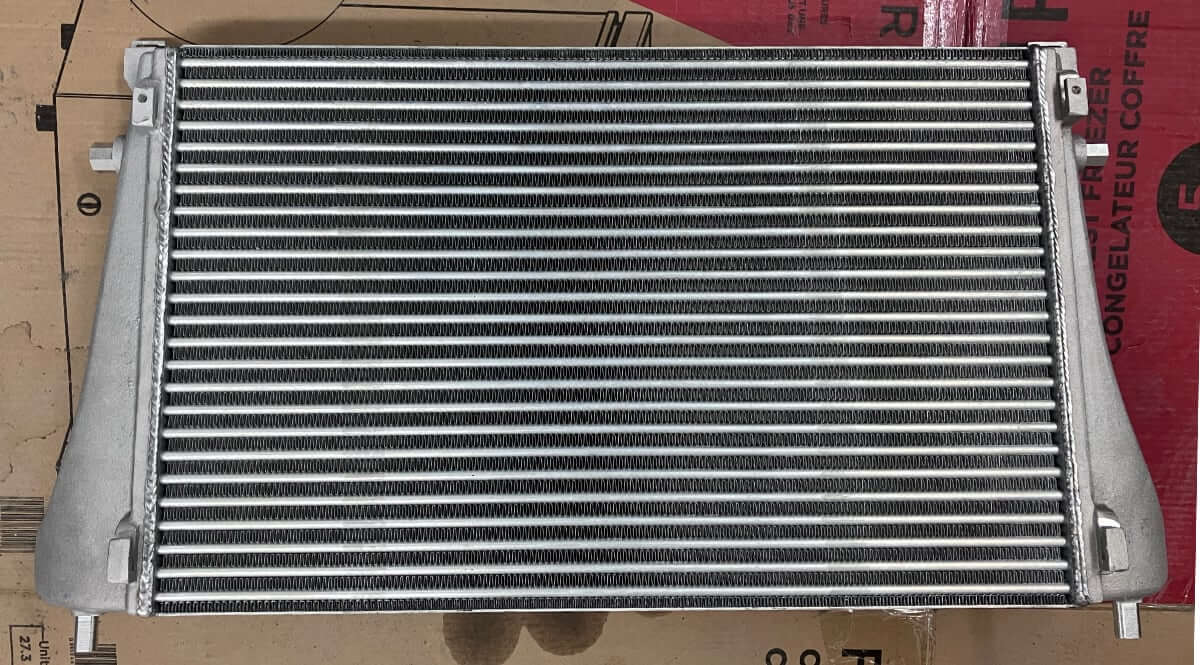
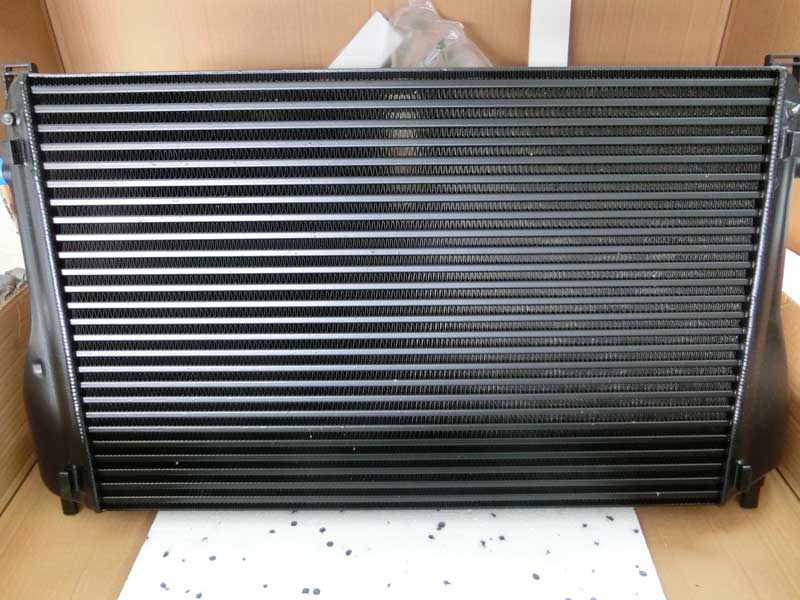
Since both intercoolers have been used on my Mk7 GTI, I analyzed street-logged data for each and compared their pressure drops as measured on a flow bench.
Test procedure:
The intake air temperature measurements are made on the street during full-throttle pulls in third (3rd) gear, starting around 2,500 and concluding around 6,000 RPM.
This full-throttle acceleration is repeated several times with a short recovery interval using each intercooler.
Due to a large time period between data collection sessions, the GTI is equipped with different turbochargers when the data was recorded. The do88 data was recorded using a Shuenk IS38+ turbocharger, and the Majesty Competition data was recorded while using the Shuenk IS48 turbocharger.
Test results:
Note: The Majesty IC is labeled “Tube & Fin” in the charts.
Boost pressure
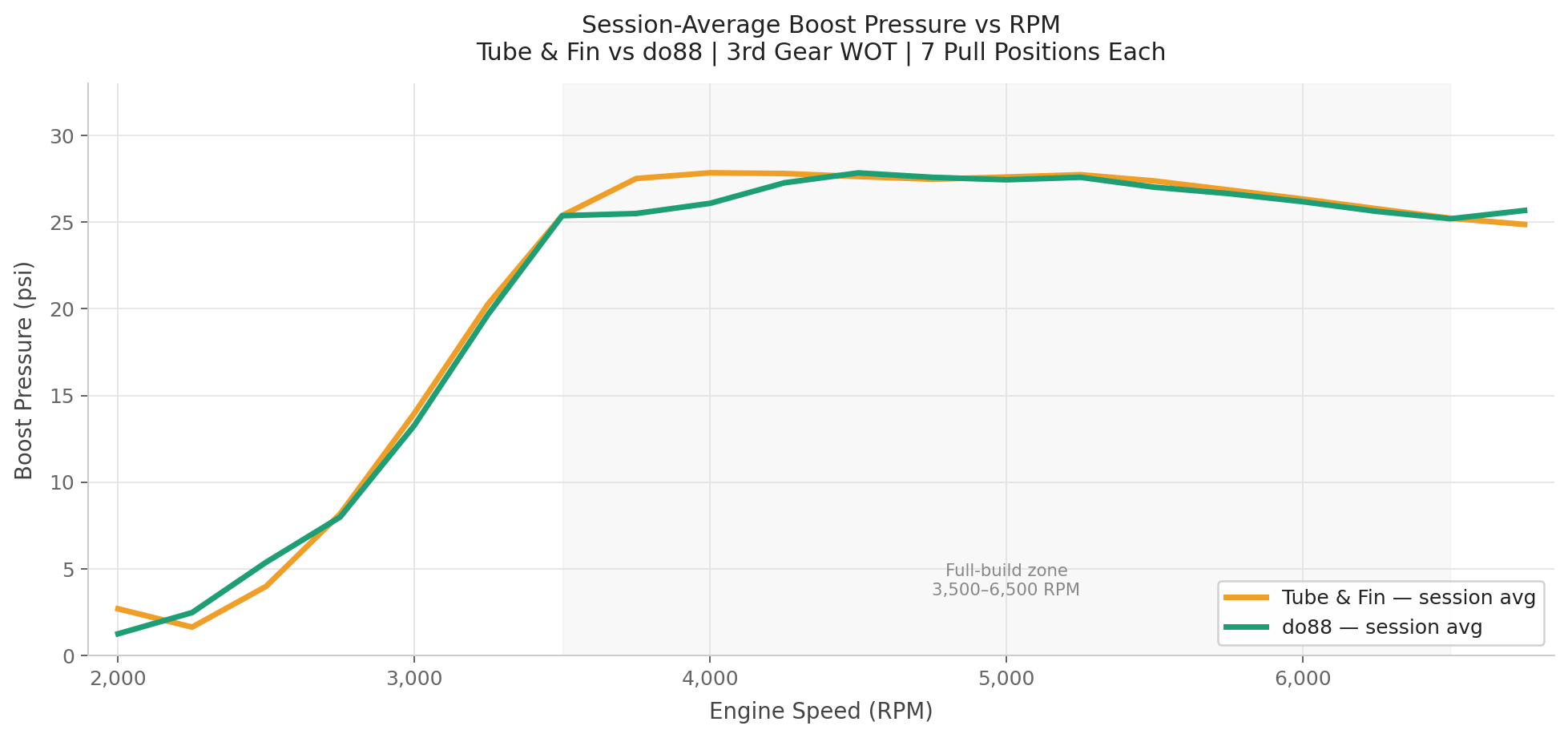
Both sessions show nearly identical boost delivery from 3,500 RPM onward (both holding ~27–28 psi then tapering to 25 psi), confirming that the two intercooler cores are being asked to handle comparable airflow and thermal load. The boost curves diverge slightly below 3,000 RPM, where the IS38+ and IS48 spool differently, but this has no bearing on the IAT comparison in the power band.
In-pull IAT change
The in-pull IAT drop is noisy for both ICs, as expected — it’s highly sensitive to vehicle speed going into each pull and to how fully the intercooler core has recovered.
IAT above ambient vs RPM
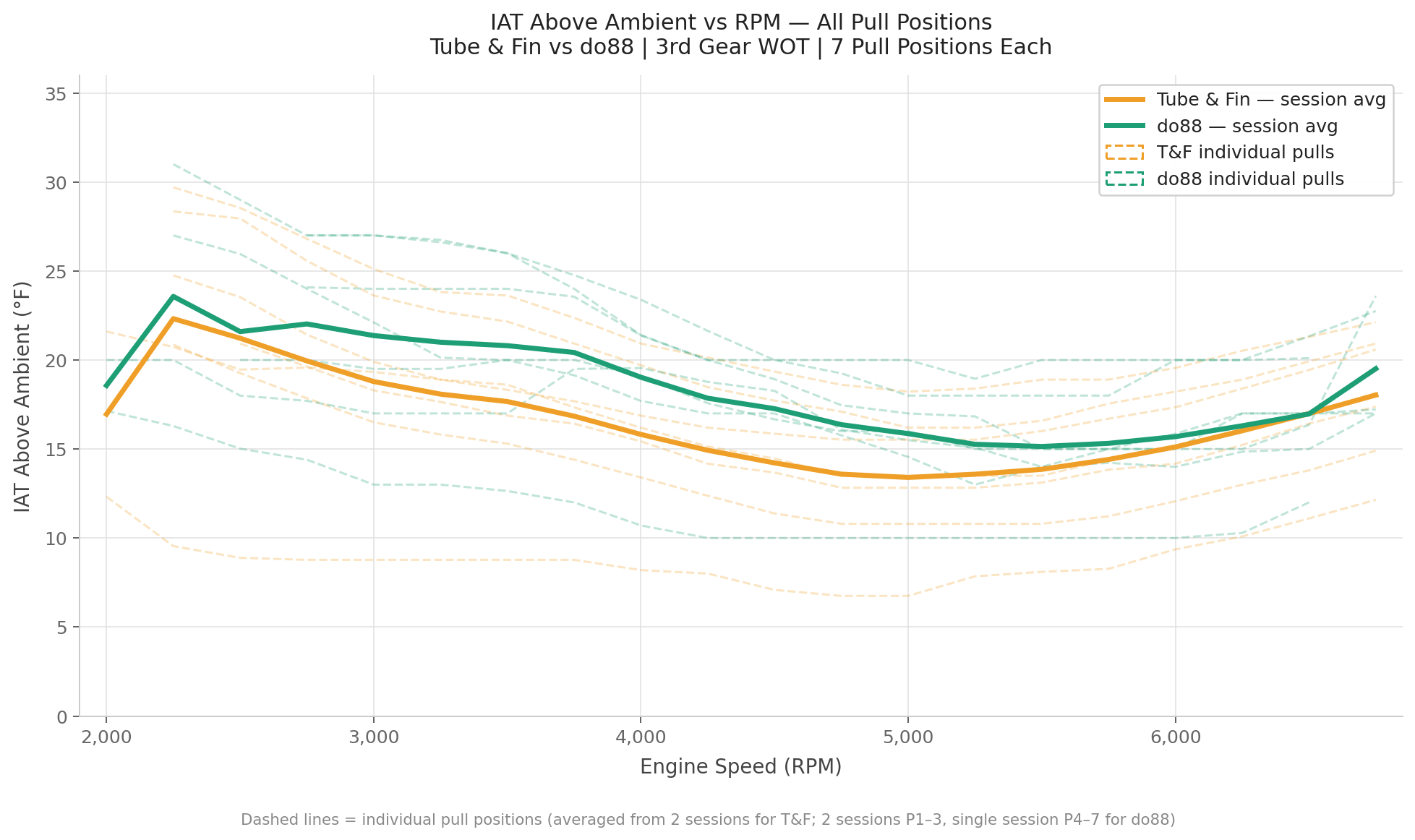
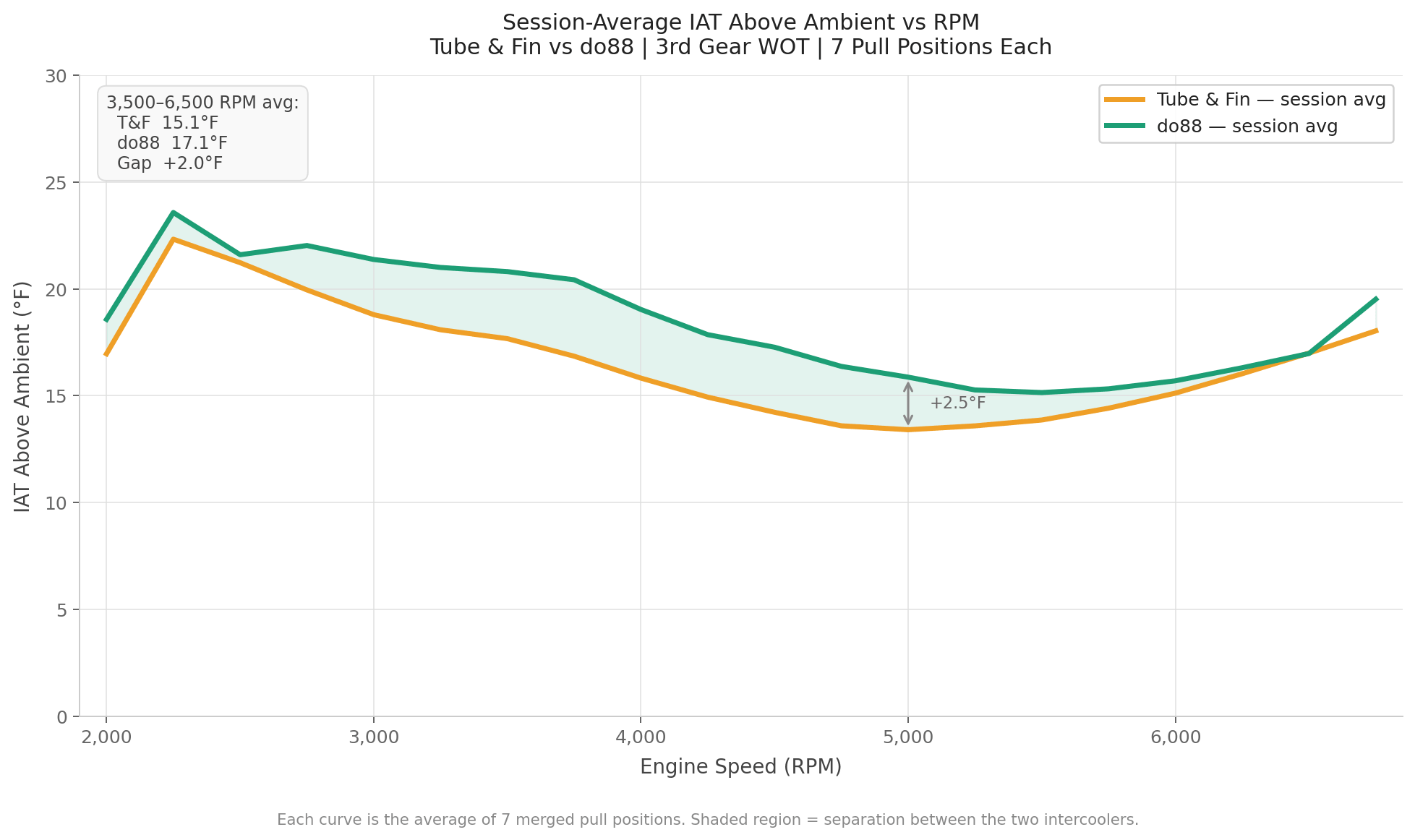
In the full-boost zone from 3,500 to 6,500 RPM, the MajC averages 15.1°F above ambient, and the do88 averages 17.1°F above ambient — a consistent gap of approximately +2°F favoring the MajC. The separation appears across all seven pull positions and is clearly visible in both the individual-pull overlay and the averaged curves.
Flow test:
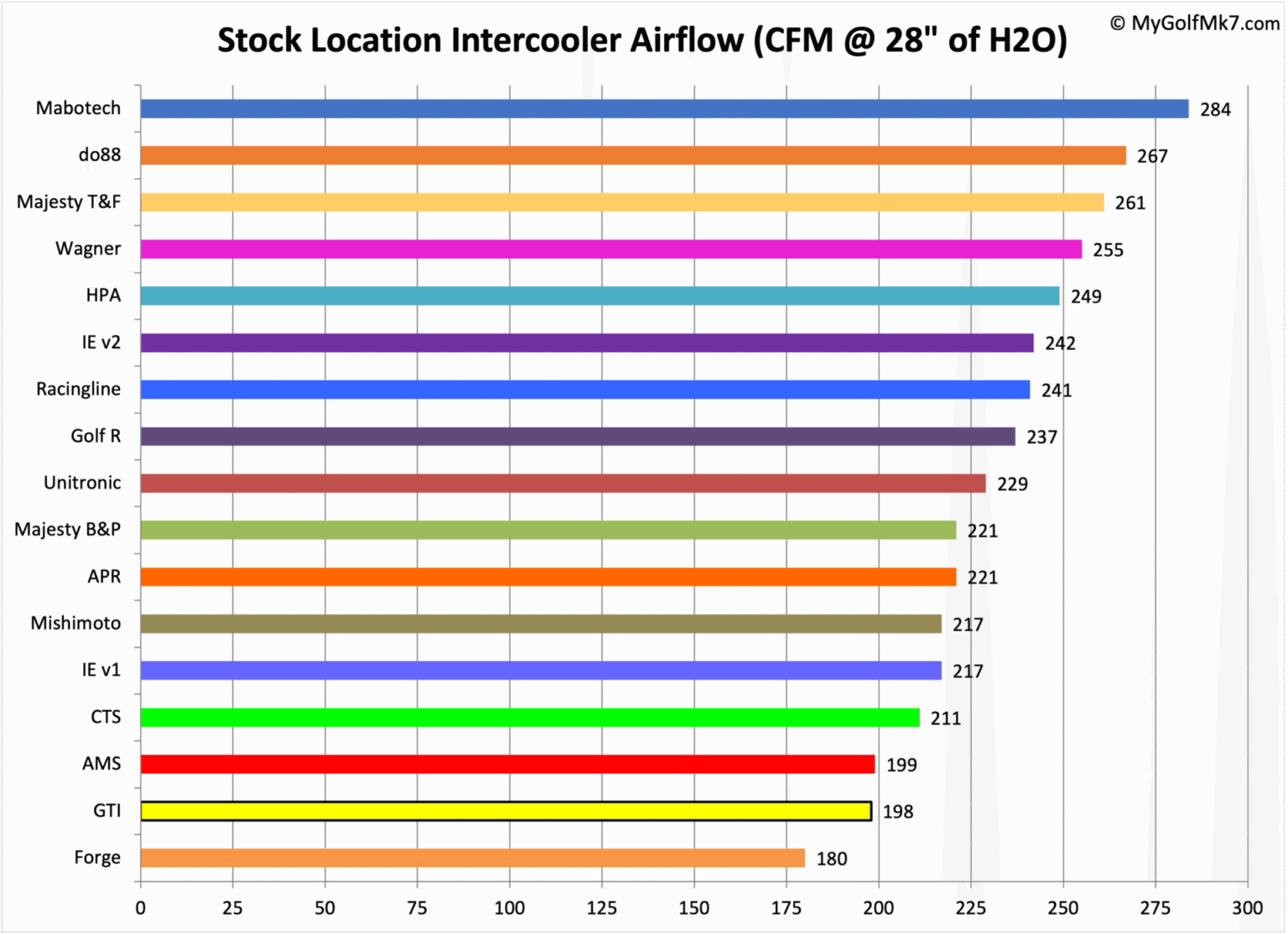
Flow tests with each intercooler produced similar results: the do88 flows 267 CFM @ 28″ of H2O, and the Majesty Competition IC flowed 261 CFM @ 28″ of H2O. A 6 CFM difference is negligible and would not affect the turbocharger wastegate duty cycle.

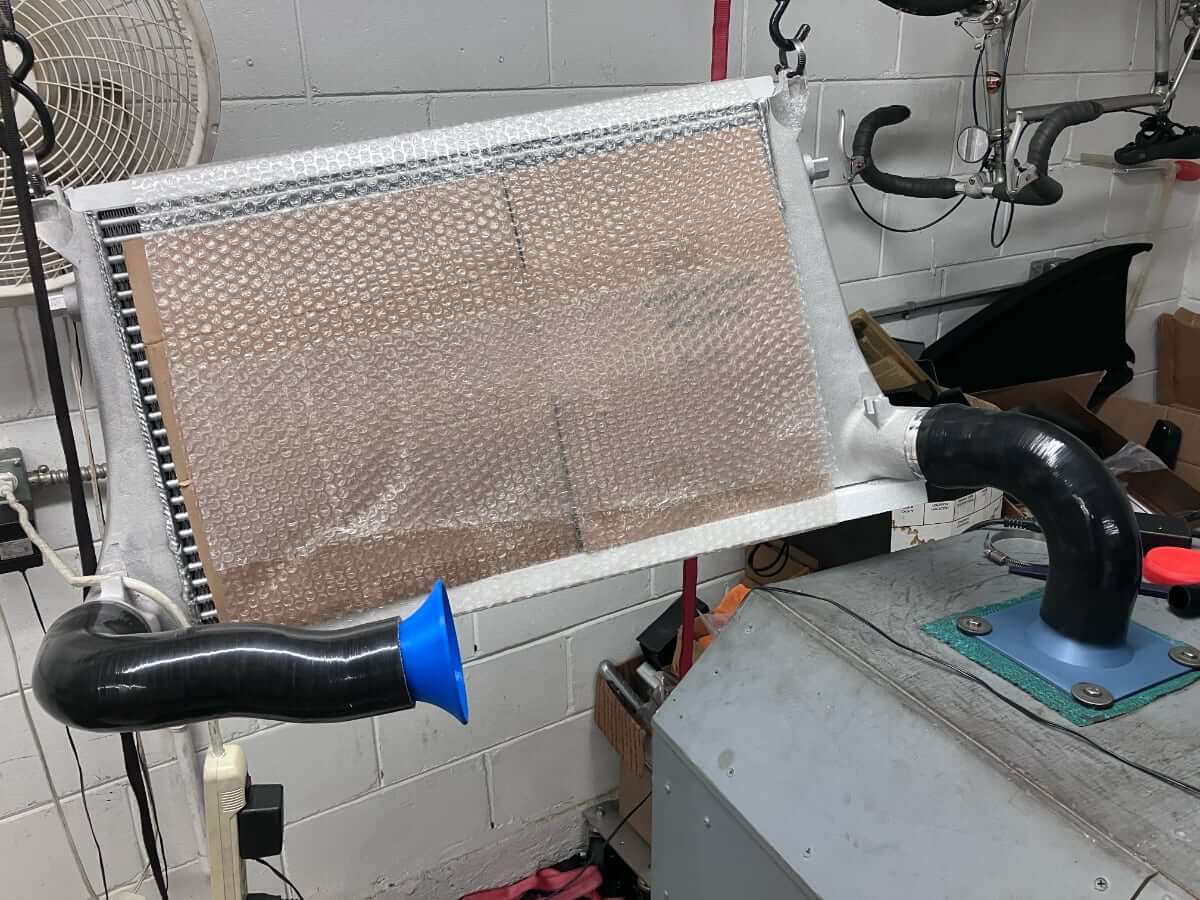
Note: It is possible that the 6 CFM difference could be attributed to the AMS inlet hose used with the Majesty Competition IC. The inlet hose has a slight bend that is absent from the do88 inlet hose. 6 CFM is a small enough difference that this bend could be the source of the difference, not the intercoolers.
Conclusions:
Averaged across two independent sessions each and seven matched pull positions, the Majesty Competition intercooler shows a consistent ~2°F lower IAT above ambient than the do88 in the power band. This is a modest difference — small enough that session-to-session variation in ambient conditions, vehicle speed, and rest intervals could close it.
The data do not support a performance advantage for either the do88 or the Majesty Competition under these test conditions.