
Background:
During comparison testing of Mk7 GTI Stage 2 tunes, it was observed that the tune from Equilibrium Tuning (EQT) had substantially higher knock thresholds than the OEM thresholds and other Cobb-based aftermarket tunes.
Note: More on Noise and Knock can be found on this page.
That finding led me to consider how the custom EQT tune I had purchased for my GTI with an IS38 turbo might compare with the results from the EQT IS20 off-the-shelf (OTS) tune.
During the IS38 custom-tuning, EQT did not communicate any changes to the knock sensor thresholds, so I installed the custom IS38 tune to log the knock sensors and related variables for evaluation.
Test setup:
Because I had installed the IHI IS20 turbocharger on the GTI to compare the Stage 2 tunes, I decided not to swap back to an IS38 turbo for a single logging session. I considered operating the IS20 turbo with the IS38 tune. To assess feasibility, I compared the boost logs from the EQT IS20 OTS tune and the custom IS38 tune.
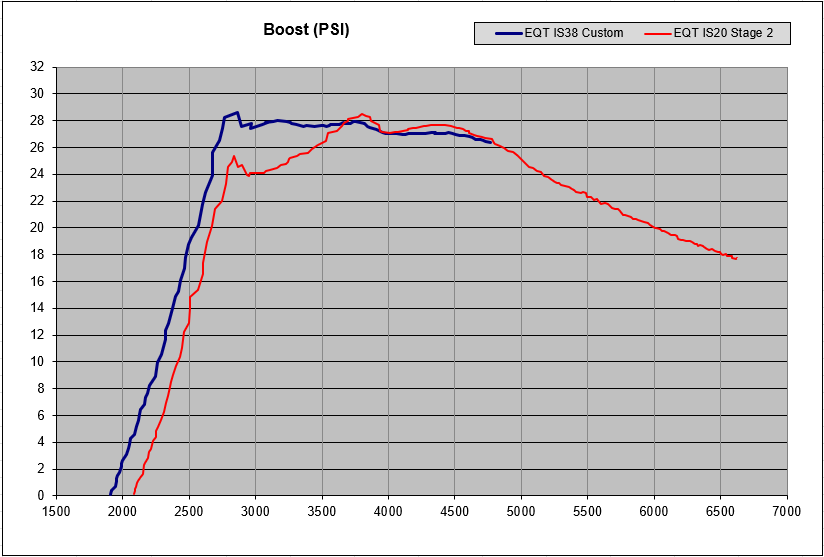
Up to almost 5,000 RPM, the boost curves are similar, with the IS38 tune holding more boost pressure below 3500 RPM – this looked promising.
I planned to make a series of abbreviated full-throttle pulls in third gear, letting off the accelerator around 5,000 RPM, using the EQT IS38 tune. This would enable me to compare the logs across the engine speed range where cylinder pressures should be highest (torque peaking).
Test results:
The overview of the five (5) IS38 tune pulls is shown below:
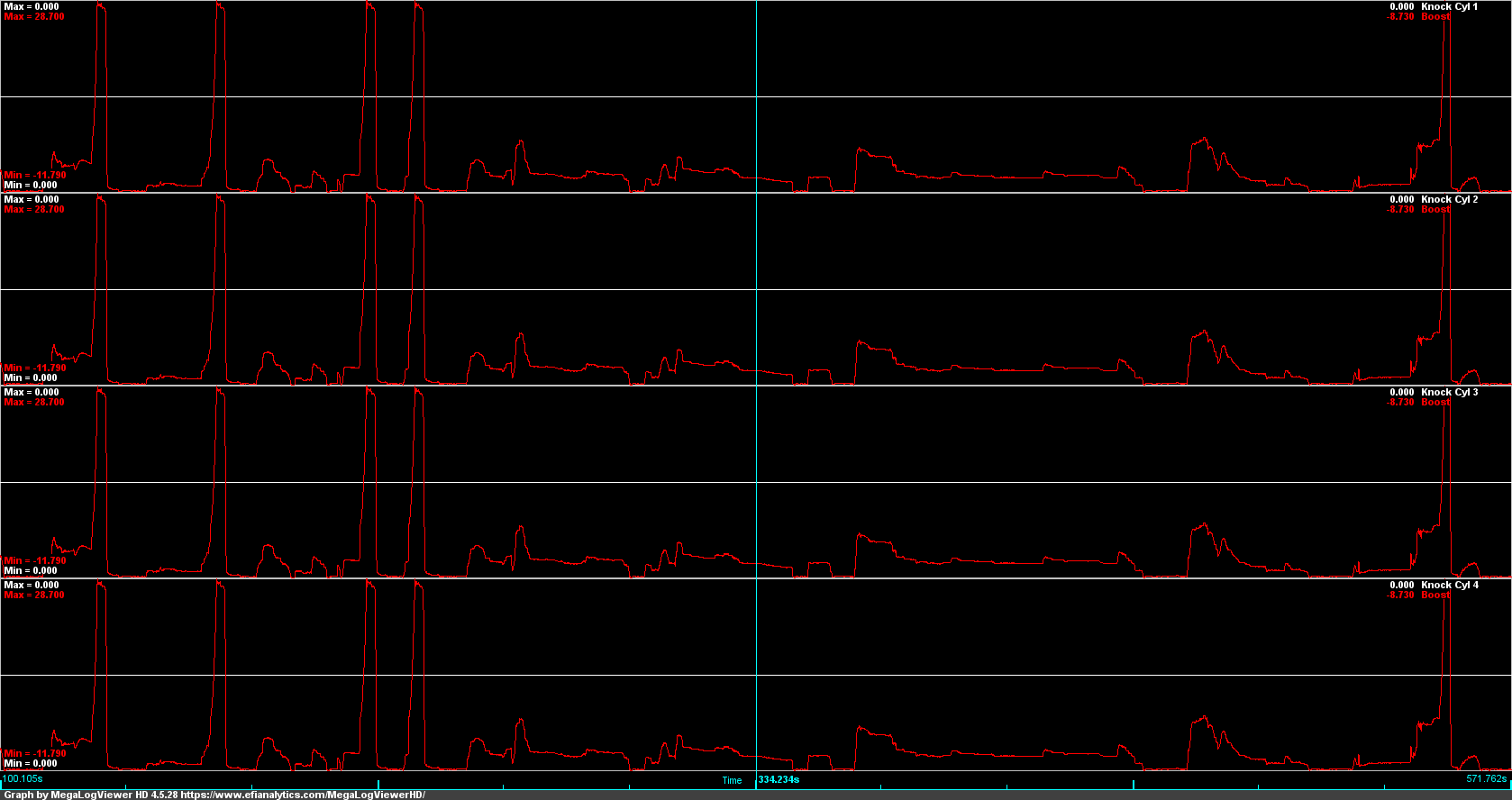
Noticeably absent is a sign of ignition timing retard occurring in any cylinder during any of the pulls. (The flat white line across each data series is the (non) occurrence of ignition retard – a value of zero (0).)
Taking a look at the increase in the knock threshold versus stock (EQT Noise Threshold over EQT Average Noise Level minus Stock Noise Threshold over Stock Average Noise Level divided by the stock reference), there are a couple of interesting results.
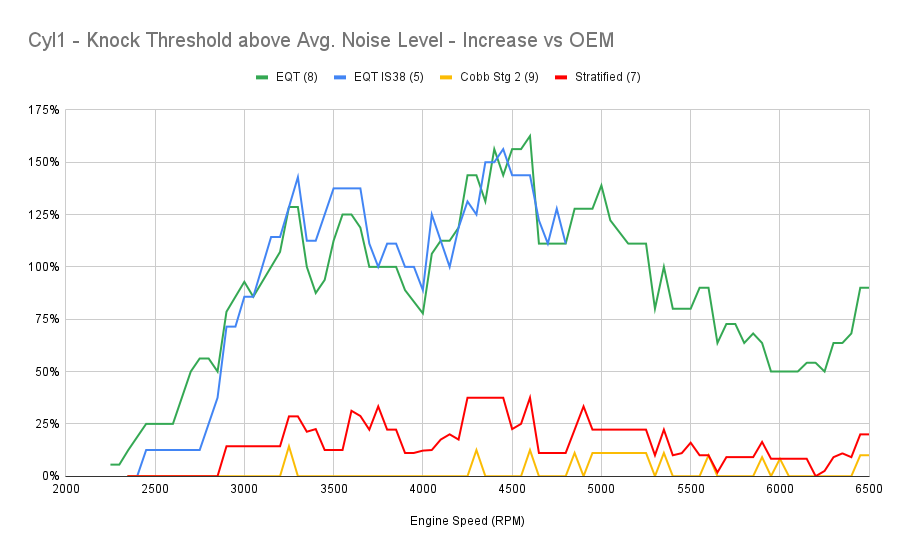
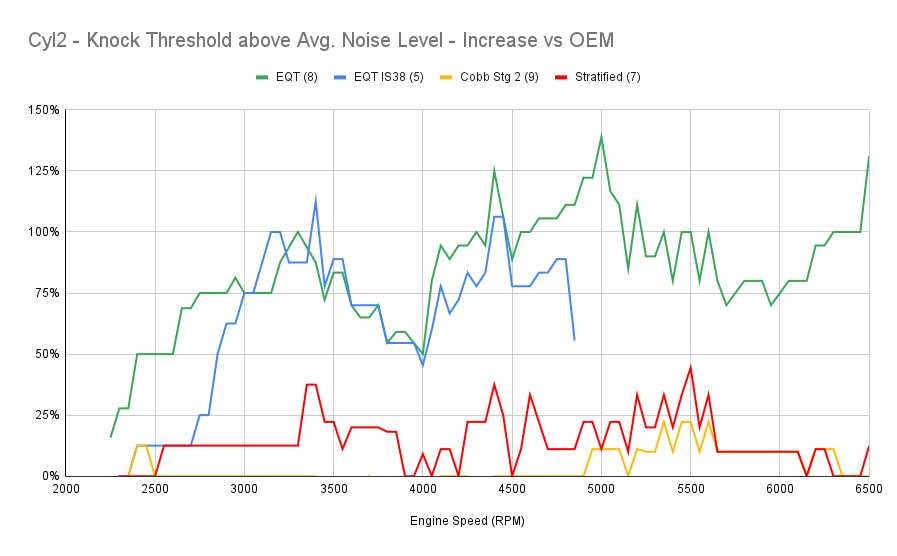
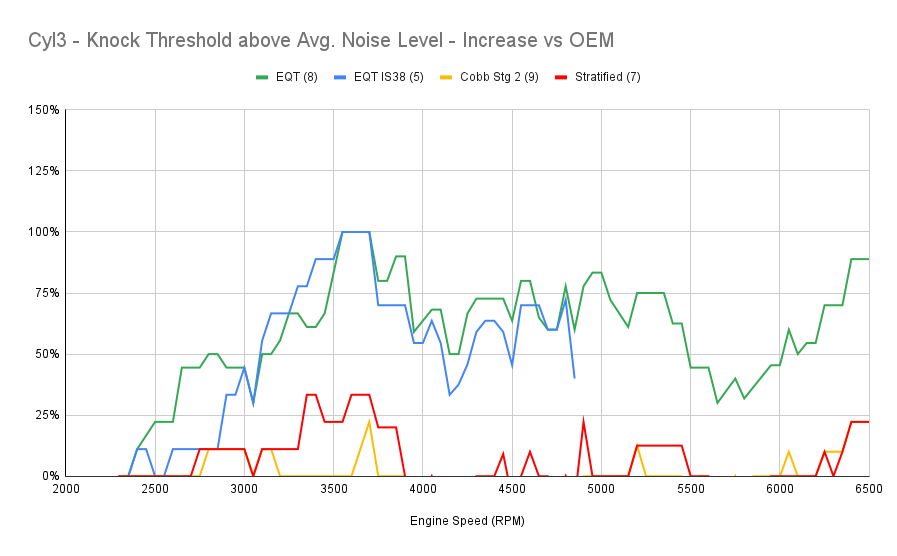
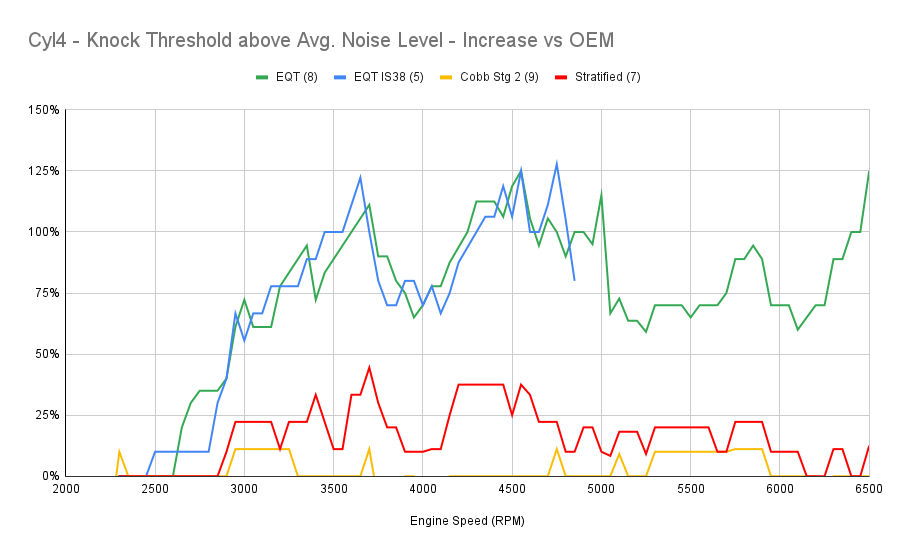
As with the EQT IS20 OTS tune, my IS38 custom tune has raised the knock thresholds substantially over the OEM safety thresholds, reaching 100% greater than OEM on every cylinder and, at times, as much as 150% greater than OEM.
The second noteworthy finding is how similar the elevation of the knock thresholds is for the EQT IS20 and IS38 tunes. Aside from some slight differences likely attributable to run-to-run variation, the curves indicate that EQT raises the knock sensor thresholds sufficiently that, whether the engine is making IS20 or IS38 power levels, pulling timing due to potential knock (and reducing power output) is significantly less likely.
Conclusions:
A custom EQT tune for an IS38 turbocharger-equipped Mk7 GTI was tested to record knock-related variables for comparison with similar data from an IS20 OTS-tuned Mk7 GTI.
Measurements show that the EQT custom tune increases the knock sensor thresholds from 100% to 150% over the VW OEM knock threshold levels.
The measurements also showed that the threshold increases were very similar across the products over the engine speed range tested (2,000 to 5,000 RPM), indicating that EQT’s custom tuning did not include adjusting the knock thresholds for the vehicle being tuned.
The consistency of results between an off-the-shelf (OTS) and a custom-tuned product indicates a tuning approach from Equilibrium Tuning that substantially raises the knock sensor thresholds.