

Background:
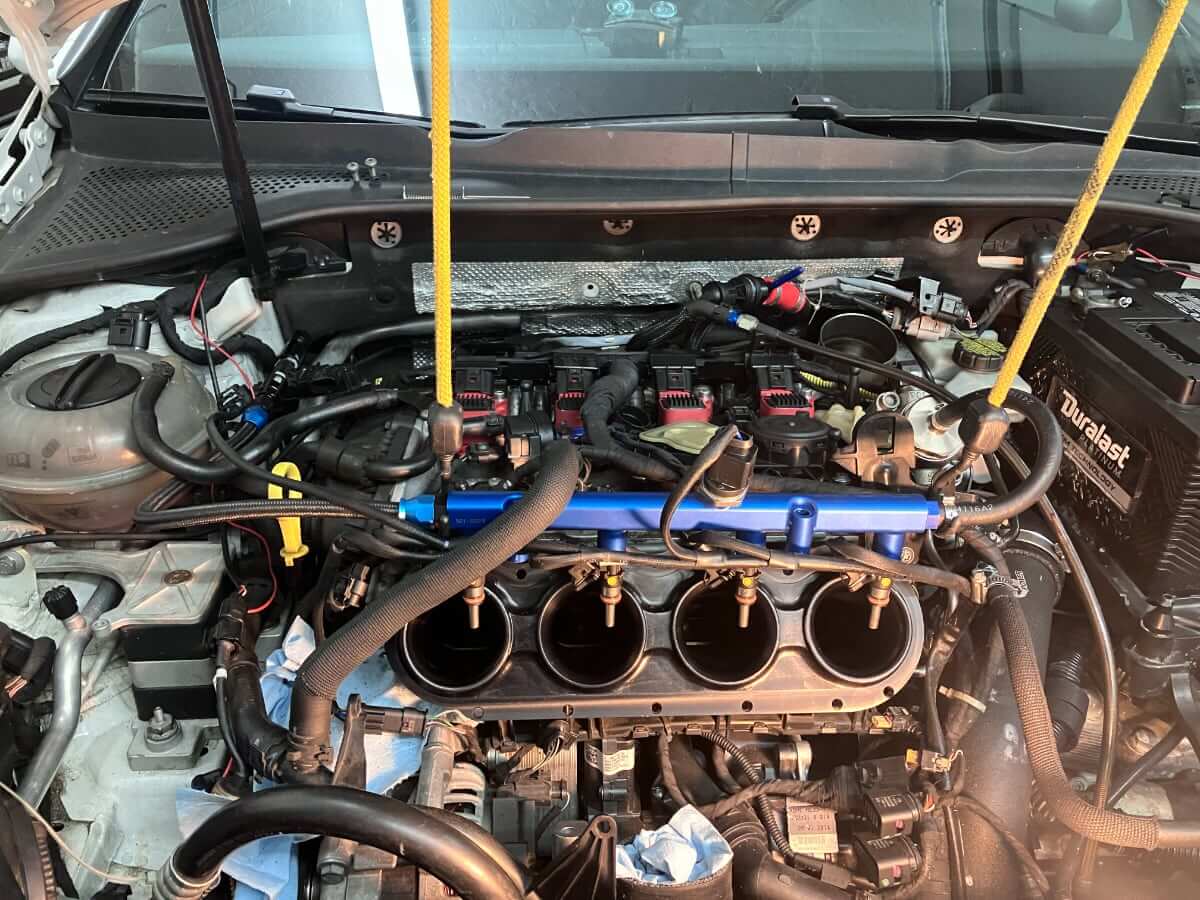
Having done a few flow tests with intake manifolds and considering operating the GTI with larger turbochargers capable of higher boost pressures, I decided to use an aftermarket intake manifold with the Mabotech M520 turbocharger and try to determine whether any changes in vehicle performance resulted.
Test setup:
The GTI was tuned with E30 fuel by Russell Road & Racing, operating with a boost profile shown below:
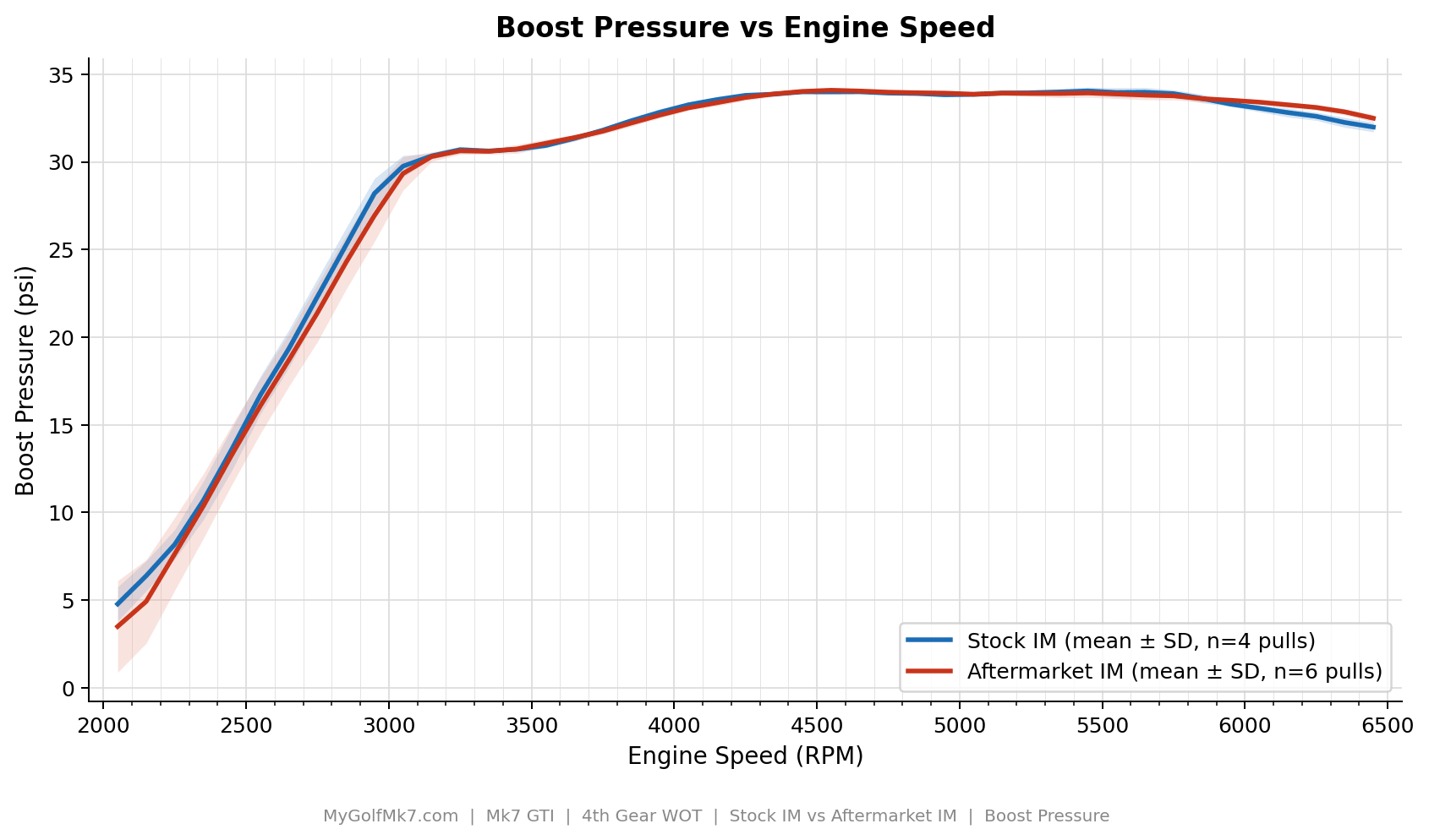
The test is a 4th gear pull starting around 2,000 RPM and concluding around 6,500 RPM.
Four pulls are made with the stock GTI intake manifold, and six pulls are made with the aftermarket Mabotech intake manifold.
Test Results:
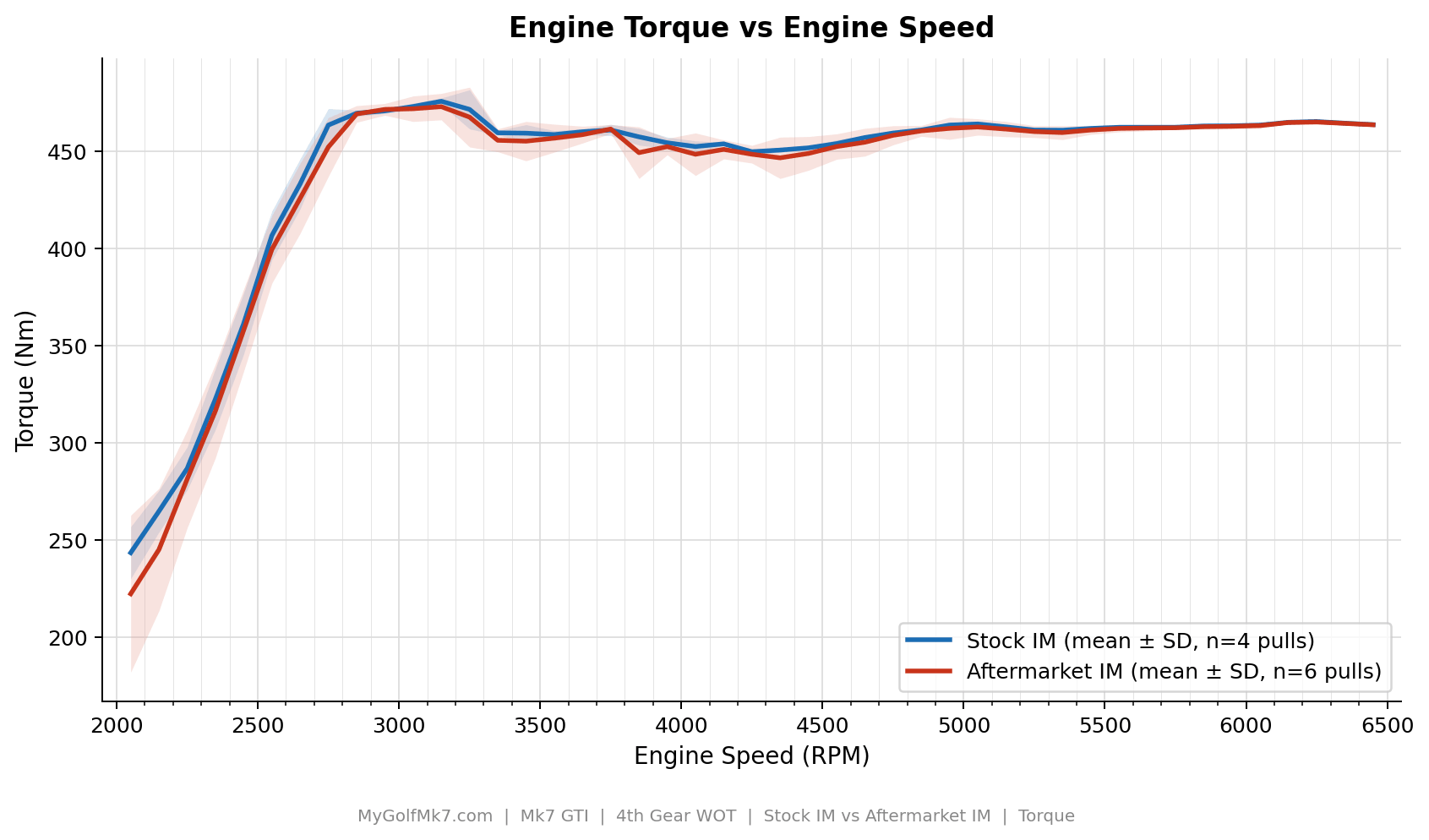
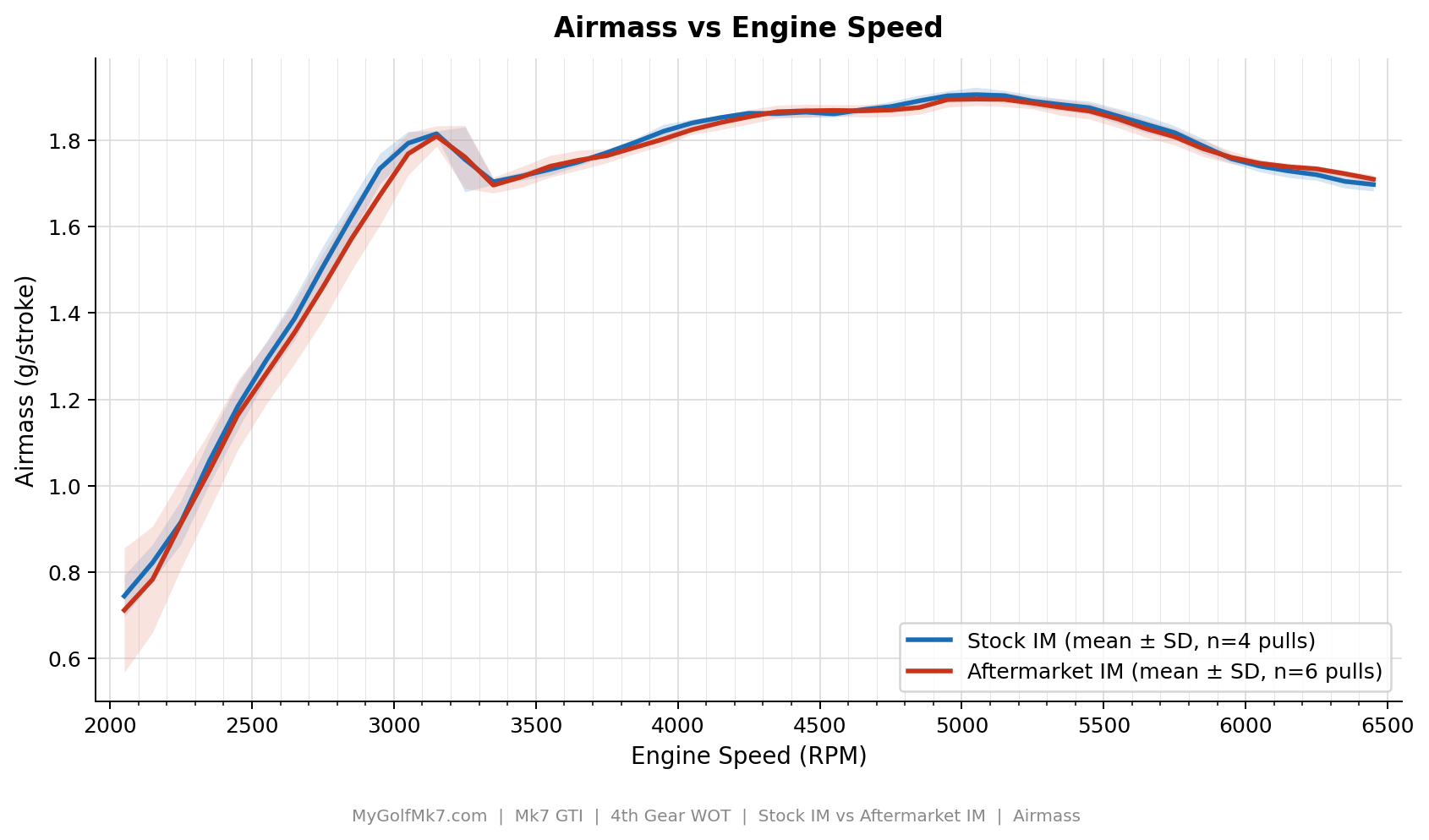
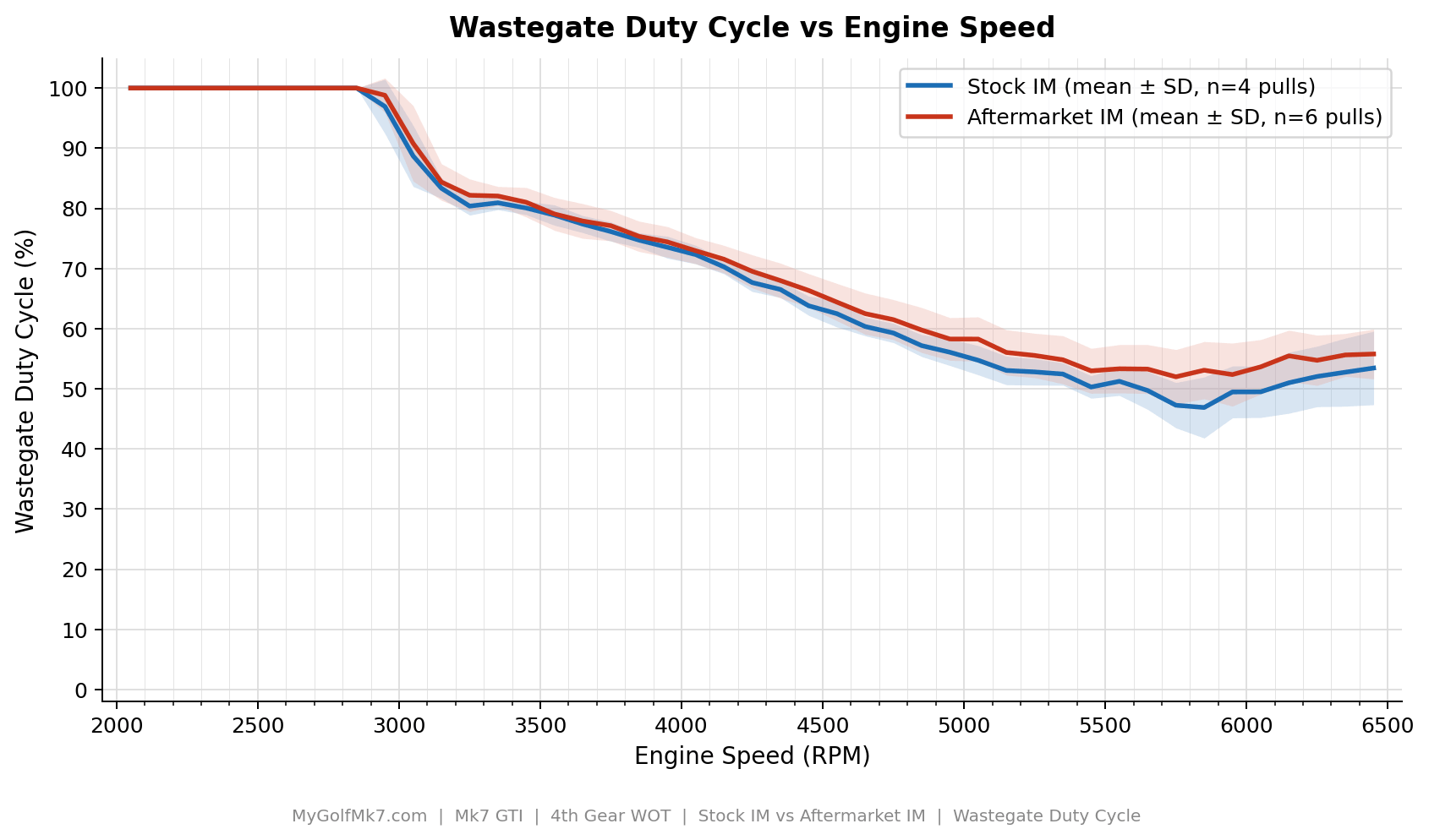
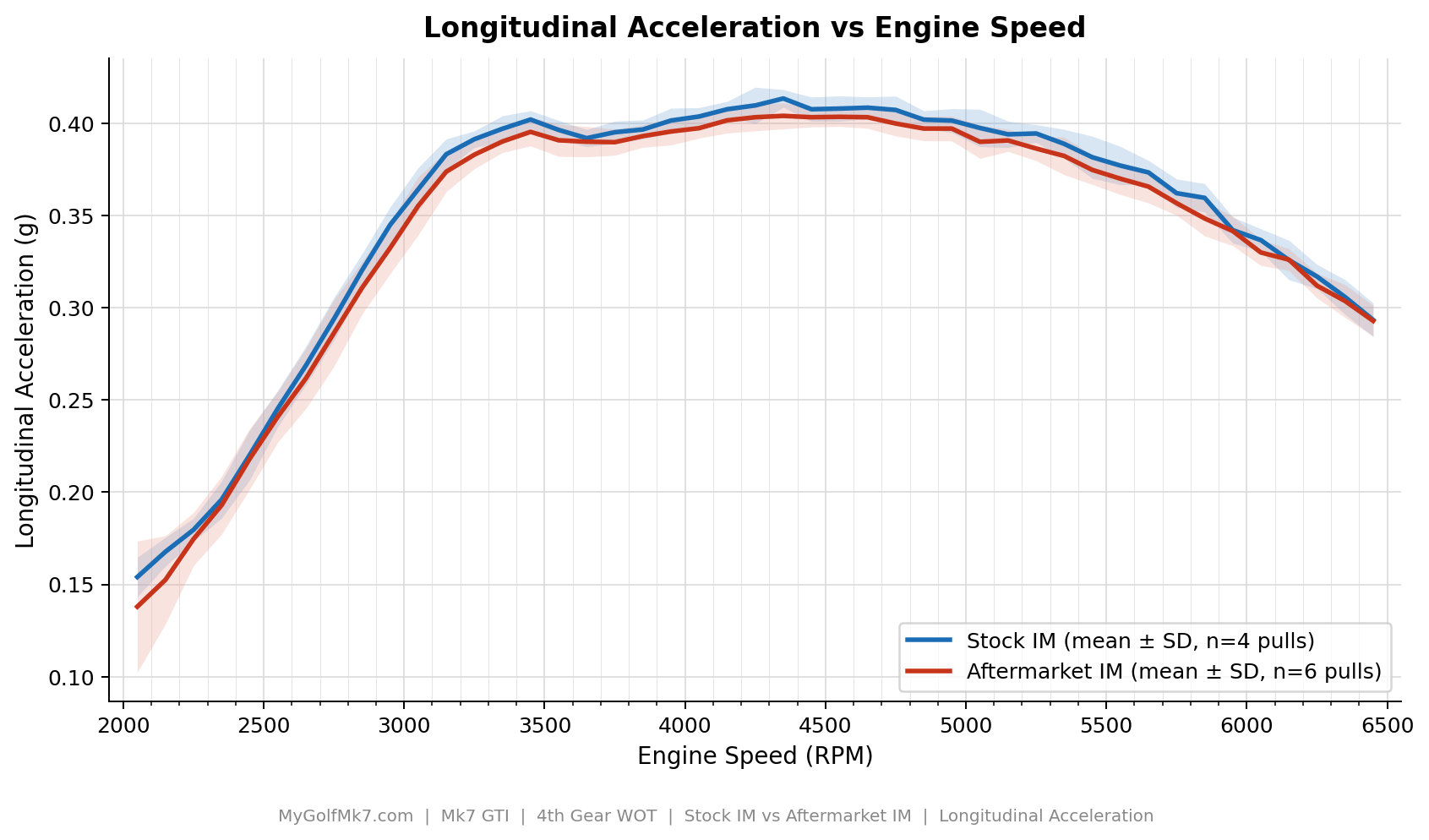
The following charts show a mean value along with bands for the standard deviation (SD) around the mean. Run-to-run variation determines the size of the SD bands.
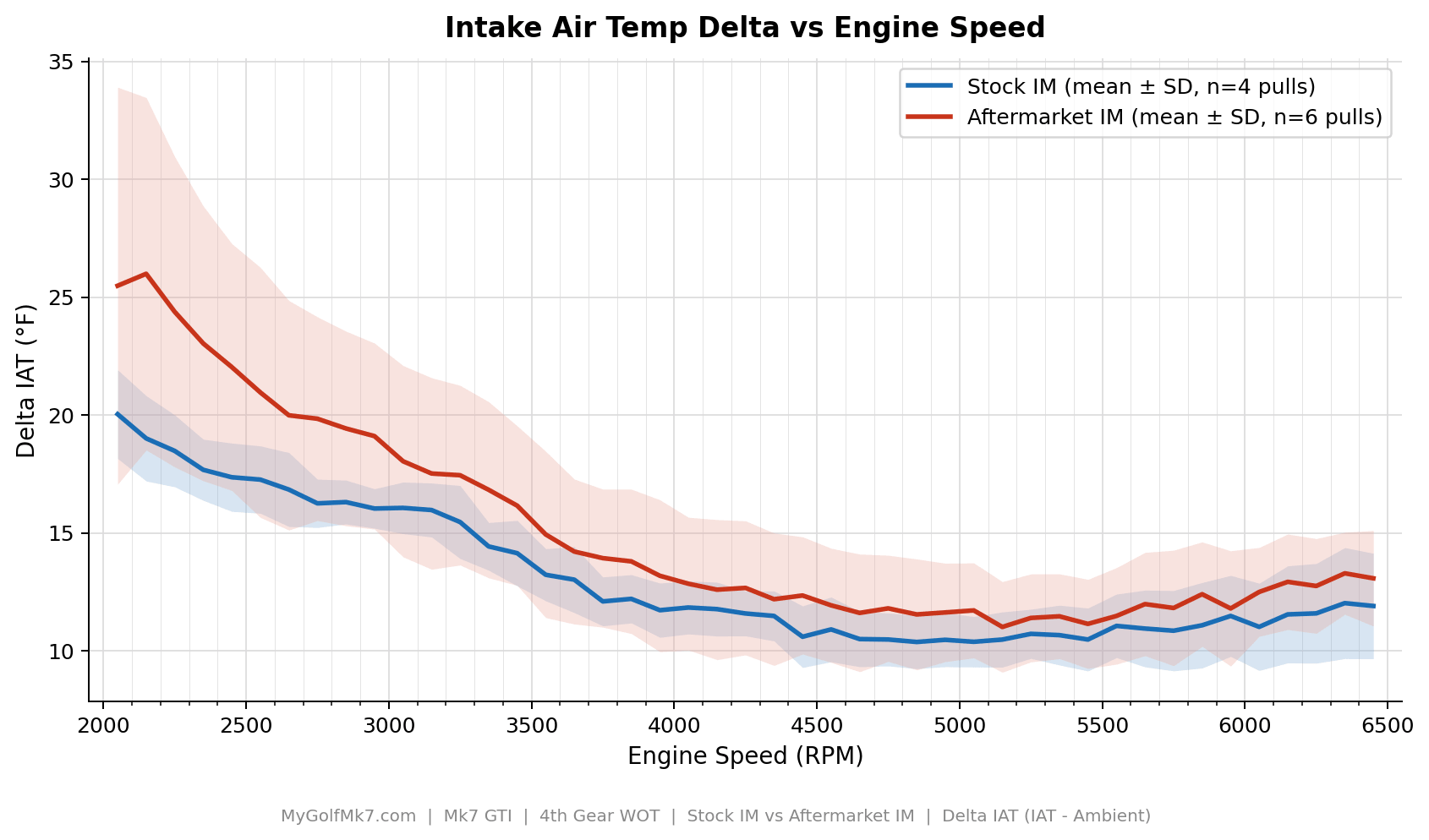
The temperature conditions during testing are represented by the Intake Air Temperature above the Ambient Air Temperature (Delta IAT), with the two test cases showing fairly similar conditions. It is unlikely that a difference of 2-3 degrees Fahreheniet will meaningfully affect vehicle performance.
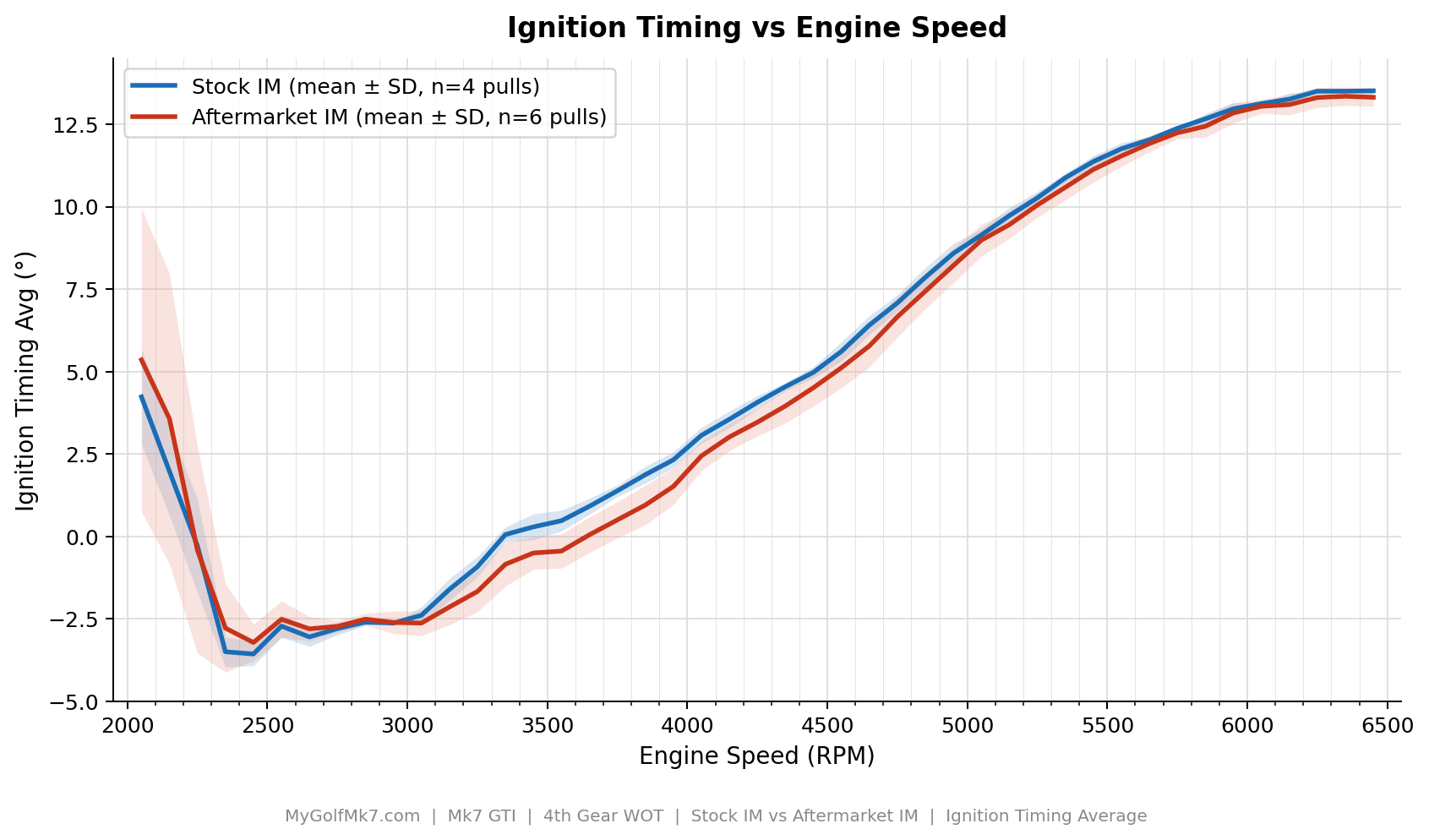
The ignition timing is very similar, with the aftermarket case having a fractionally lower timing, which correlates with the slightly higher Delta IAT.
There is no indication from the ECU-calculated engine torque that the aftermarket intake manifold causes a change.
Similarly, the ECU-calculated air mass flowing through the engine doesn’t reveal any difference resulting from the change of intake manifolds. This is consistent with previously shown boost pressure curves.
There is an approximate two percentage point difference in the wastegate duty cycle, but this is likely to be related to the Intake Air Temperature difference, given the small difference.
Vehicle acceleration rate is very similar, with the SD bands overlapping at nearly every engine speed across the full pull range.
The difference here also correlates with the Delta IAT and Ignition Timing differences.
Conclusions:
An aftermarket intake manifold was installed on a Mk7 GTI operating with a Mabotech M520 turbocharger, making boost pressure around 34 psi.
Over a series of fourth-gear pulls, the aftermarket intake manifold was compared with a stock GTI intake manifold. There were no engine performance or vehicle acceleration changes detected that would suggest the aftermarket intake manifold made a difference.
References:
Addendum:
A question came up regarding the Delta IAT curves: Was there evidence that the aftermarket intake manifold (IM) made the air hotter?
It would not have surprised me if it had; the aftermarket IM is metal versus the stock plastic, but the available data doesn’t support that conclusion.
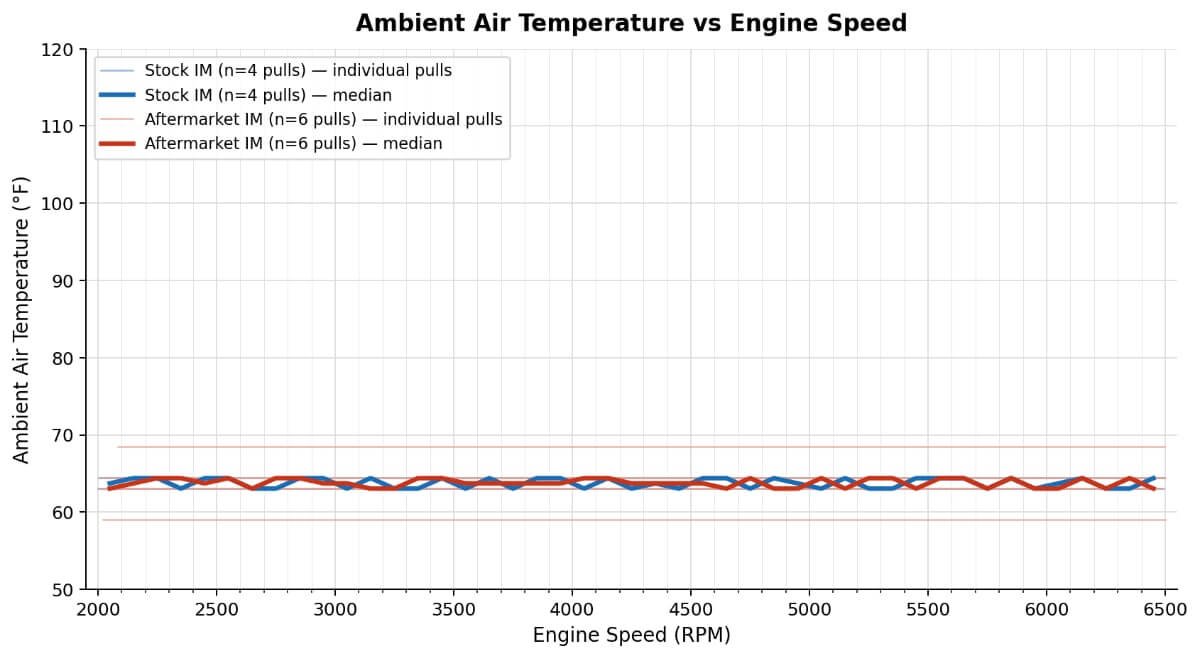
The ambient air temperature across the sessions was well controlled.
The intake air temperature median curves suggest that the aftermarket IM results in higher IAT readings at low airflow, but the individual pull data show that some aftermarket temperatures are lower than those of the stock IM.
As the influence of intake manifold wall heating decreases with increasing engine speed, the Delta IAT difference diminishes. Above 4300 RPM, the difference between the Delta IAT curves averages 1 degree Fahrenheit.
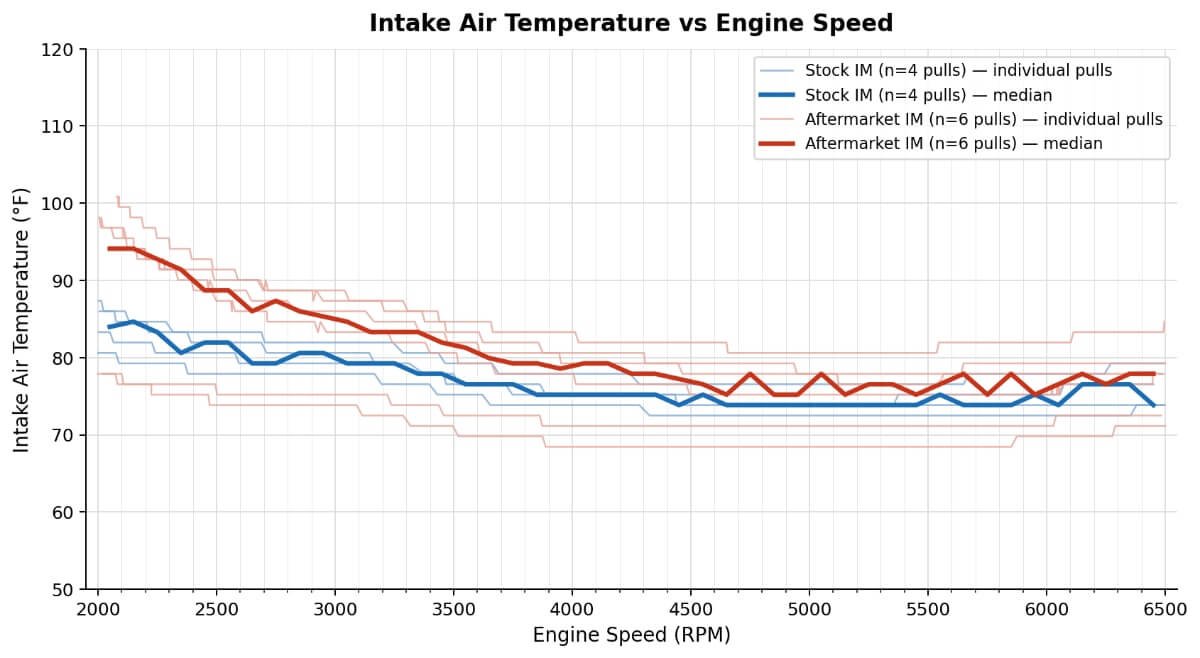
Based on the small difference and variability, much more data would be needed to conclude with confidence whether there is a difference in Delta IAT.
For some perspective on how much additional data would be required to address this question with confidence, a Power Analysis (0.8 power of the test) can indicate the number of pulls needed for each configuration. In this case, 67 pulls with each configuration would be appropriate.
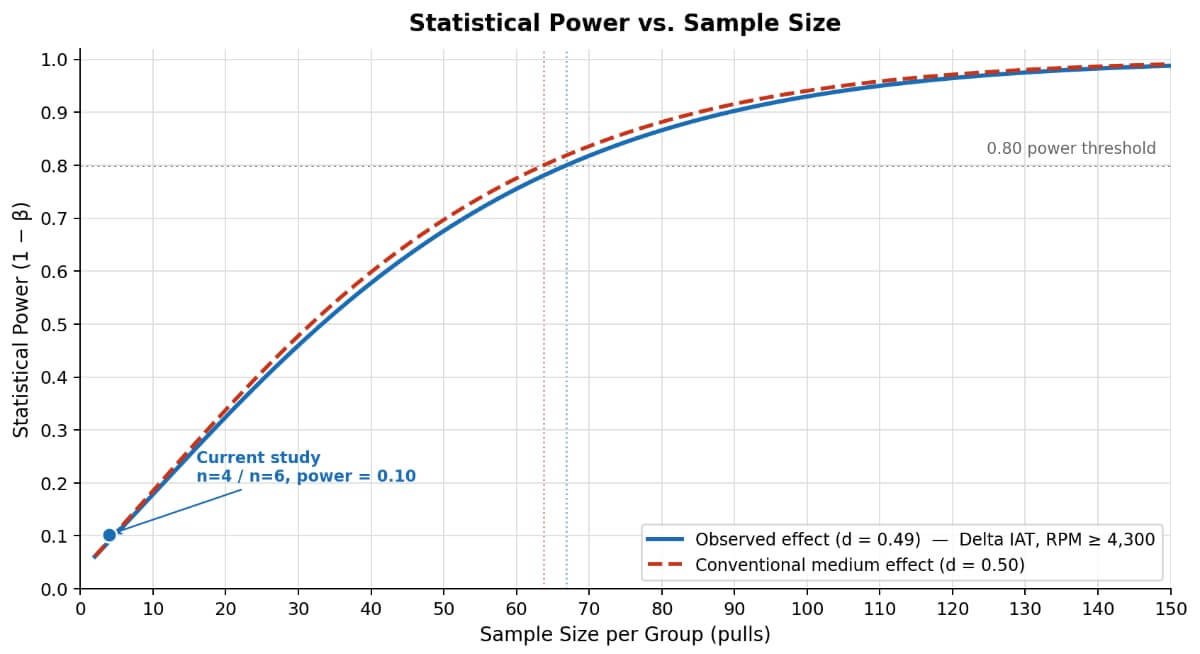
That number is well in excess of the number of pulls I have made for any test. There’s no basis to claim the manifolds differ in Delta IAT, but the test is underpowered, not conclusive.