

Background
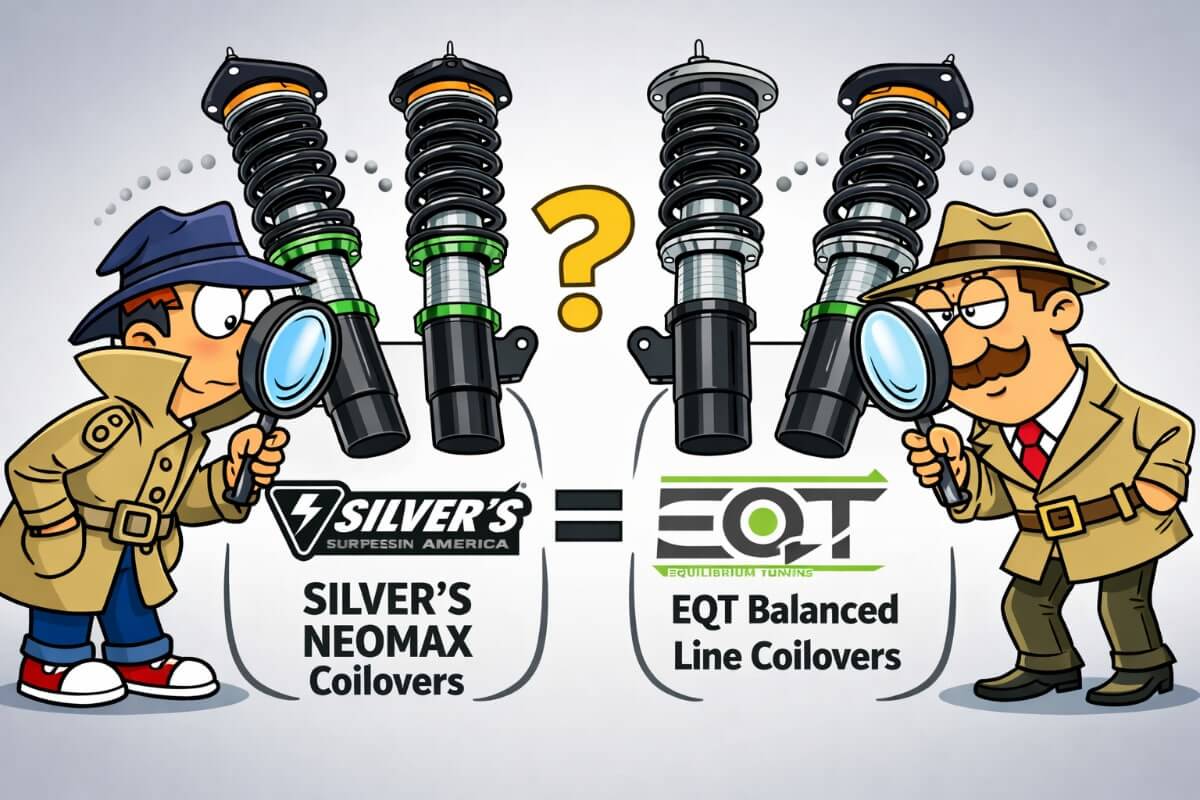
In May 2026, I published a comparison of the EQT Balanced Line Coilover and the Silver’s NEOMAX, documenting that the two products share identical specifications, verbatim warranty language, and a timeline placing the Silver’s product on the market two years before EQT’s launch. The post concluded that EQT’s marketing language creates a false impression of original development and that the warranty terms, reproduced word for word from Silver’s, do not meet disclosure requirements.
The post generated responses in the Reddit thread where it was shared. One came from Ed Susman, EQT’s owner, whose exchange was analyzed in the post titled How to Recognize Deflection and Misinformation, and in a second post titled Argument Diagramming: Deflection and Misinformation, in which the Argument Diagramming analysis tool was introduced.
A second lengthy exchange occurred with a commenter I am identifying as Sport.

That second exchange is the subject of this post.
Why Analyze a Consumer Exchange?
Sport is not affiliated with EQT to my knowledge. They are a consumer commenter who engaged with my post and challenged its conclusions.
What Sport’s exchange illustrates is something that comes up regularly when documented findings are shared in enthusiast communities: the rhetorical patterns people employ when they want to dispute a conclusion they disagree with, without engaging the evidence that supports it.
Those patterns are worth documenting because readers will encounter them in forums, comment sections, and social media threads on many topics, not just this one. Recognizing the structure of a weak argument is a transferable skill.
What the Exchange Covered
Sport raised 24 distinct counterarguments across multiple reply threads, including the assertion that his having engaged the post at length was itself evidence that the conclusion had been refuted (CA-P20).

The exchange covered every major dimension of the post’s conclusion — the definition of product development, the legal standard for advertising claims, the scope of the research, the methodology, and the analyst’s motives. It was a sustained and detailed response, not a dismissive one, which makes it a useful case study.
Of the 24 counterarguments, none directly engage the three Tier 1 evidence boxes that independently support the conclusion.
The timeline — Silver’s 2017, EQT 2019, confirmed by the Director of Operations at Silver’s North America — was implicitly accepted while Sport argued it did not matter. The Mk8 retroactive insertion was never mentioned. The verbatim warranty text received a partial concession in CA-P14, where Sport acknowledged it “could potentially carry weight,” before immediately retreating to a personal characterization and moving on without disputing the specific evidence.
The Rhetorical Patterns
Four techniques account for the majority of Sport’s 24 responses.
Tu quoque — pointing at other companies as a deflection — is the most frequently used, raised in multiple forms across several reply threads and escalating to the production of URLs for competitor product pages.
Ad hominem — redirecting attention from the argument to the person making it — appears repeatedly and escalates in tone throughout the exchange, culminating in a dismissive characterization directed at third parties after Sport announced he was done with the discussion.
Definitional reframing — arguing that words like “develop” can be read broadly enough to cover option selection from a manufacturer’s catalog — is the most substantively engaged technique, including a formal Merriam-Webster citation.
Unsupported assertion — claiming the post fails to articulate any deceptive practice, without addressing any specific evidence — accounts for much of the remainder.
None of these techniques, individually or in combination, constitutes a rebuttal. A rebuttal requires attaching to a specific evidence box and providing a reason to doubt it.
Partial Concession
CA-P14 is the most analytically significant moment in the exchange. Sport states that the warranty point is “the only one that could potentially carry weight” and that “a reasonable consumer would imply EQT is the company to contact with warranty concerns.”
This is the closest the exchange comes to engaging the evidence on its merits, and it is a meaningful acknowledgment. Sport immediately qualifies it with “but this argument is overshadowed by your clear vendetta” — an ad hominem that attempts to diminish the concession — and does not return to the warranty evidence.
The concession stands out in the diagram as the one moment where the evidence was partially acknowledged rather than deflected.
The Argument Diagram
The diagram below maps Sport’s 24 counterarguments against the post’s evidence structure. Each box in the Supporting Analysis section can be clicked to read the full assessment of that argument, including the type of reasoning it uses and why it does or does not engage the evidence.
A full-page version of the diagram is available via the link above the diagram, which opens in a new tab for easier reading.
(click here to open the diagram as a new full page)
What the Diagram Shows
The 24 counterarguments Sport raised represent a comprehensive attempt to challenge the post’s conclusion from every available angle — the definition of words, the scope of the research, the legal standard, the methodology, and the character of the analyst.
That breadth makes the result more significant, not less: a thorough challenge that avoids the evidence entirely is more revealing than a brief one.
The Tier 1 evidence boxes remain unaddressed. The Mk8 insertion — a car that did not exist when EQT launched its product, retroactively added to the development story — was never mentioned in any of the 24 responses. The warranty text, which reproduces Silver’s effective date verbatim, received one partial concession and no rebuttal. The timeline was accepted as given.
Unlike the Susman exchange, Sport makes no admissions. There are no statements that inadvertently confirm the evidence.
What the Sport exchange documents instead is the full range of rhetorical techniques available to someone who wants to dispute a conclusion without engaging the evidence that supports it — and the consistent gap those techniques leave when mapped against a structured argument.
The Vendor Weighs In
Near the end of the exchange, Sport summarised his position by dismissing the responses as AI-generated and asserting that he had dismantled all three main points in the post.
Ed Susman responded directly to that comment, writing:
It sounds like you’ve earned yourself a place on his blog… get ready for some ridiculous attempt at ‘logic’ by breaking down your arguments word by word, arguing over basic semantics while totally disregarding context. Should be a fun read!
Ed Susman – Owner of Equilibrium Tuning
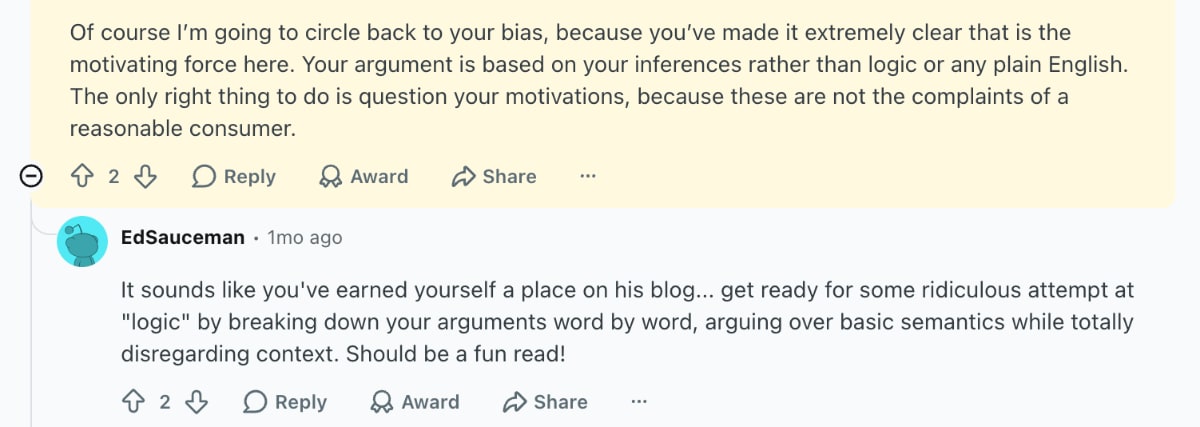
This is a pre-emptive appeal to ridicule — an attempt to discredit the argument diagram methodology before it was published, so that readers would approach it with a dismissive frame before engaging with the content.
Placing “logic” in scare quotes and characterizing systematic argument analysis as arguing over semantics are not rebuttals of the evidence. They are an attempt to shape the reader’s perception of the analysis before the analysis appears. The document you are reading is the post Susman was anticipating.