

Recently, I found myself replying to someone’s comment about data-driven people – tacitly agreeing with them – but still ending up defending my position.

Data-Driven Exchange:
Some discussions in MQB social media groups reveal a mismatch between what people claim to value and how they actually argue. This exchange about APR products illustrates this: someone who positioned themselves as “data‑driven” immediately abandons data the moment evidence is requested.
Dylan began by asserting:
“APR survives on fan boys basically. Most data driven people don’t buy their products.”
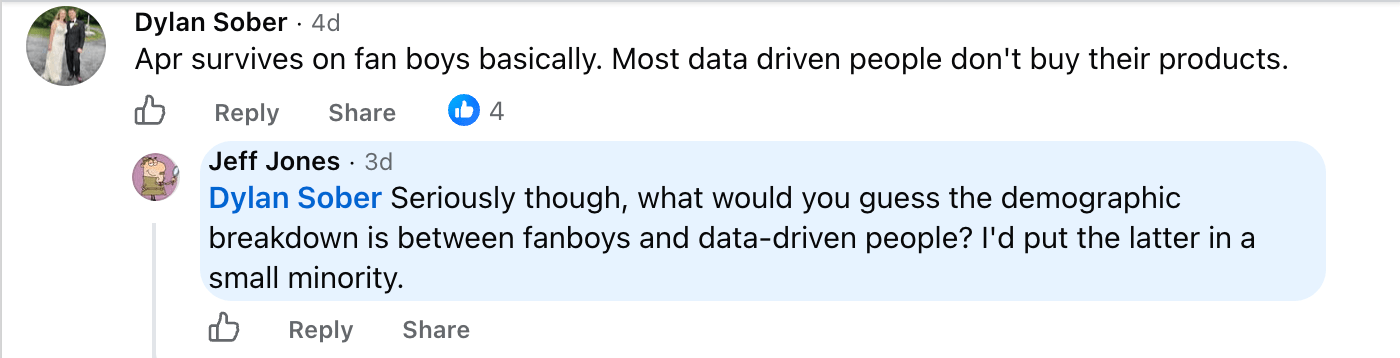
My response was an observation that between fanboys and data-driven people, the latter seem like a much smaller proportion (which would not be the market segment a business trying to maximize profits would want to tap), and I asked what Dylan thought the demographic breakdown looked like.
Importantly, I wasn’t arguing about performance. I was addressing a demographic question based on Dylan’s own framing.
Instead of answering the demographic question, Dylan pivoted:

This is a performance claim, not a demographic one.
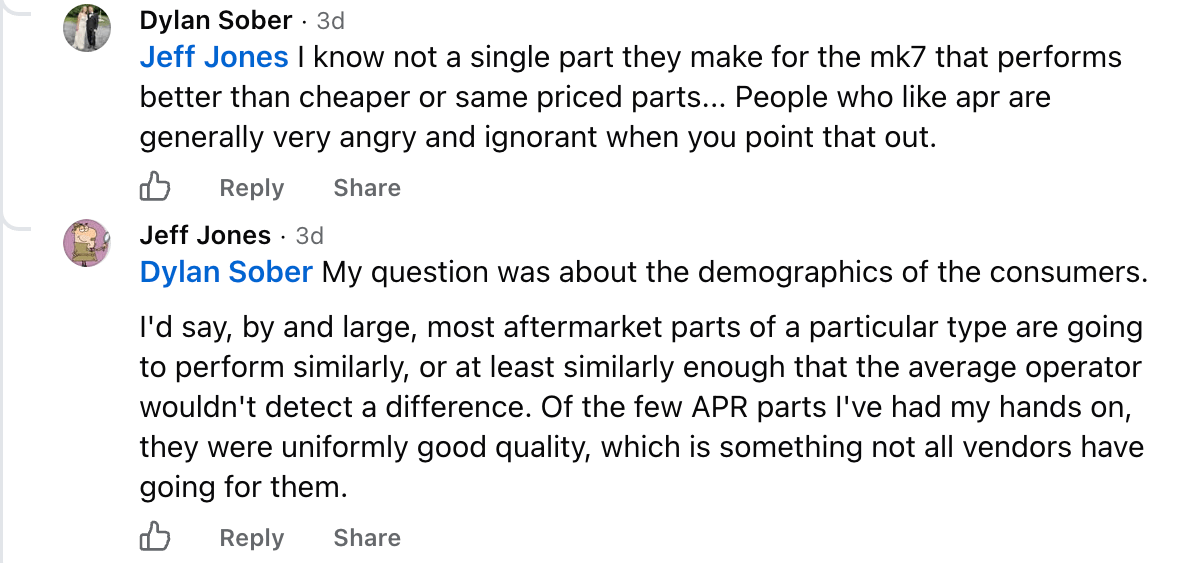
To be fair, as I said to Dylan, by and large most aftermarket parts perform similarly, and certainly below the threshold that a driver would notice — there was no need to roast APR over this point.

Dylan escalated:

This is a measurable claim, and one that finds Dylan wandering into my wheelhouse.


I asked the obvious “data‑driven” question:
How much horsepower does it rob? How was the comparison test made?
This is where the contradiction becomes silly. He claims to be data‑driven, yet avoids data when asked for it.
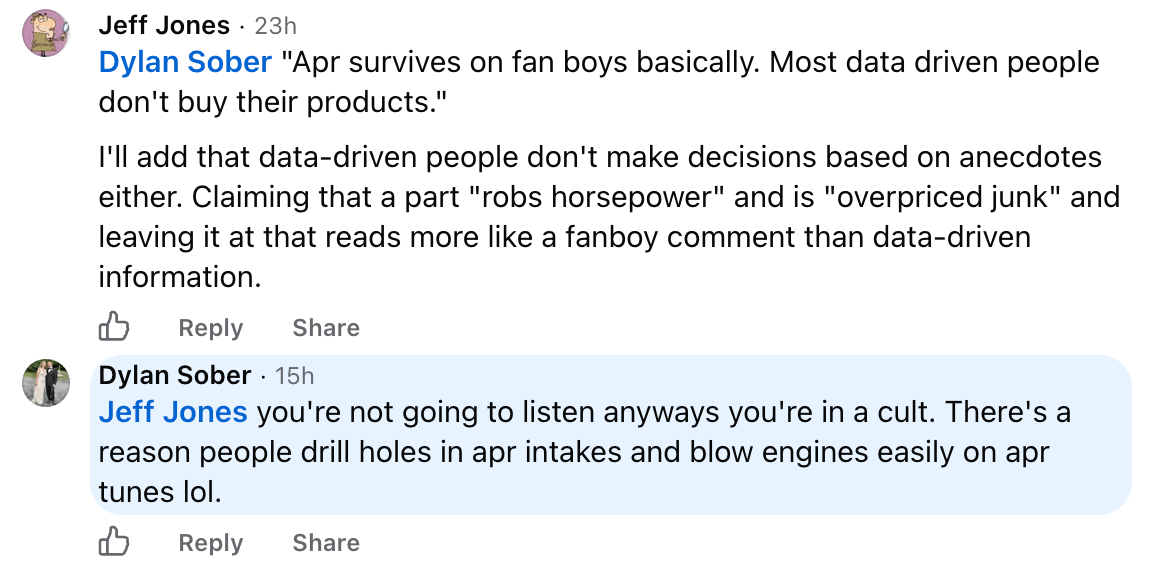
When evidence was requested and not available, Dylan shifted to personal attacks:
“You’re not going to listen anyways, you’re in a cult.”

A data‑driven argument does not require insults to stand on its own.
Note: It’s likely that Dylan is unaware that his assertions about the APR intake are based upon the flow testing I did of the intake eight years (8) ago.
Conclusions:
Spotlighting the behavior of some of your fellow enthusiasts is helpful to remind you to be cautious when taking advice from strangers on the internet.
Dylan opened the conversation by dividing the world into “fanboys” and “data‑driven people,” positioning himself firmly in the latter group. Yet when asked a simple demographic question based on his own framing, he immediately pivoted into unsubstantiated performance claims, unsupported assertions, and eventually personal attacks.
A data‑driven person would have welcomed questions, pointed to evidence, and explained methodology. In the end, the only thing “data‑driven” about Dylan’s argument was the word itself.
Hi Jeff. I’m guessing (and it’s large sample collected anecdotal) the data driven demographic would be 1-3% of the general population. I’m in the health industry, and my own profession is hugely resistant to harming, (let alone slaying) any sacred cows built of easily disproven dogma , which is highly detrimental to positive patient outcomes. The lack of basic critical thinking ability in the general populace is becoming alarming.
That percentage would not surprise me if it turned out to be accurate.
It’s a v. small portion of the community…that actually understand testing and how to interpret the data output. You have focused on the hardware end of things but if you dove into the “coding” changes…that one is bad but also much harder to test e.g. brake coding that is often touted as doing XYZ. Riddled with placebo/expected outcome.