
Background:
After collecting a comprehensive set of data on the street using the Shuenk IS48 turbcharger over roughly nine months, I headed over to a local dyno to gather some more data.
Summer in central Florida is not a time of year to put down numbers that are going to earn bragging rights, and I was curious to see how engine parameters of a stationary car would differ from one operated on the road. In the days leading up to the IS48 dyno, I took to the street to grab a couple of fourth-gear pulls with the vehicle and fuel mix in the same state that they would be on the dyno.
Even this was challenging because temperatures rise quickly in the morning, and my street pulls were made in ambient temperatures of 73 and 78, whereas the dyno shop had time for me around noon, when it was 85.

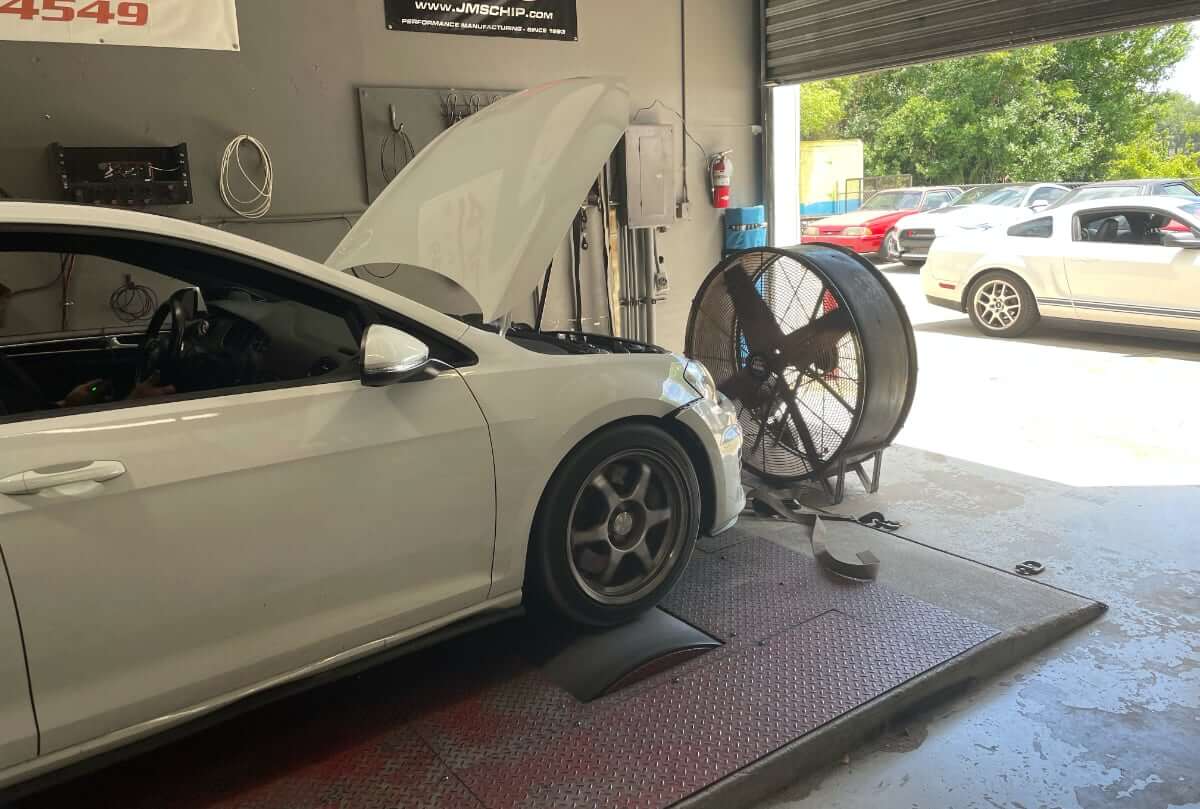
The big fan at the shop and the bicooler setup were what I was counting on to help control the effects of the ambient temperature on intake air temperatures. I’ve had my car dyno’d at this shop a few times, but I’ve never made an effort to try and gauge the cooling effectiveness of the shop fan.
I wasn’t expecting anything that would approach a GTI on the street in fourth gear, but the hot-wire anemometer I brought along to measure the air velocity going into the lower grill showed an alarmingly low value.
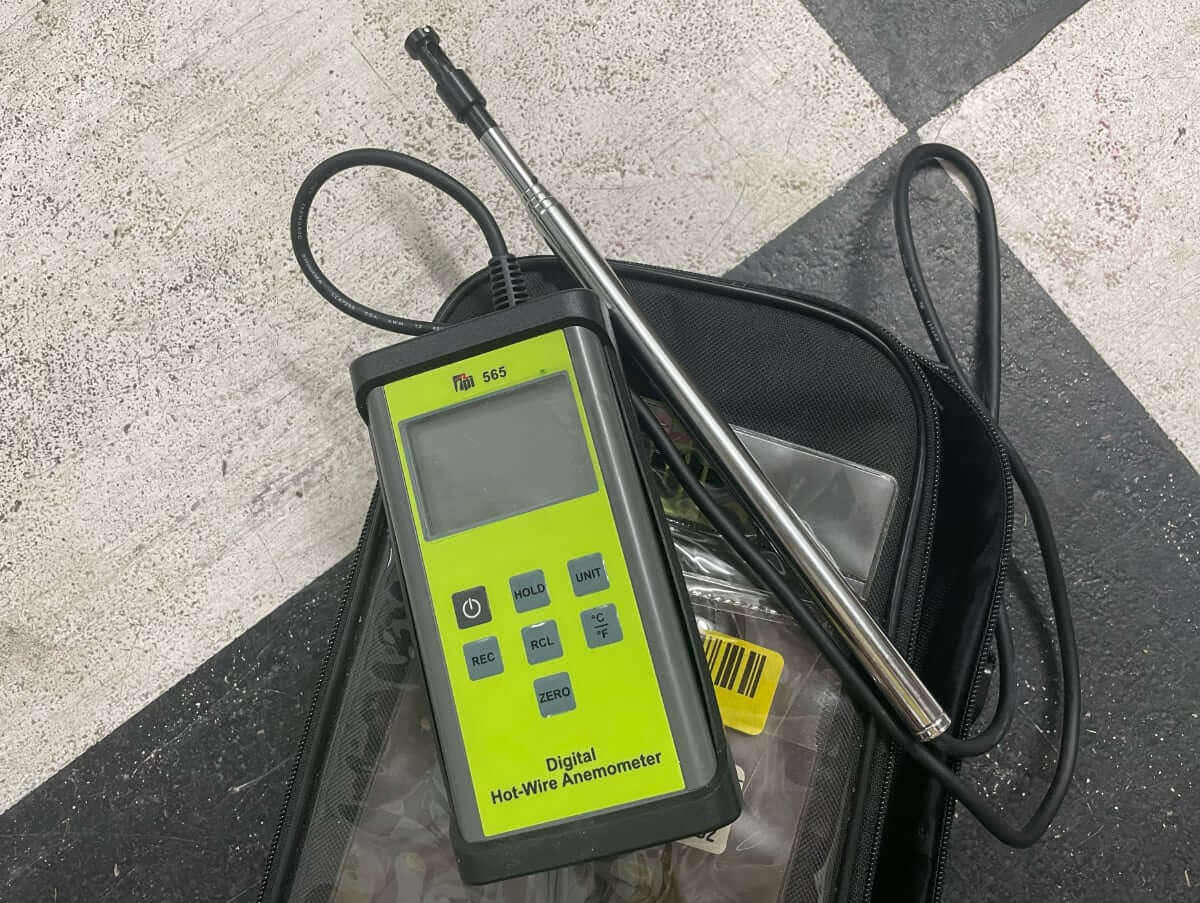
Airflow at the grill was around 10 mph. Day’um – that’s not helpful.
Not much to do about it, so on with the dyno session.
Vehicle setup:
The GTI is equipped with the following equipment during this dyno session and the preceding street pulls.
- MGM7 Intake and Elbow
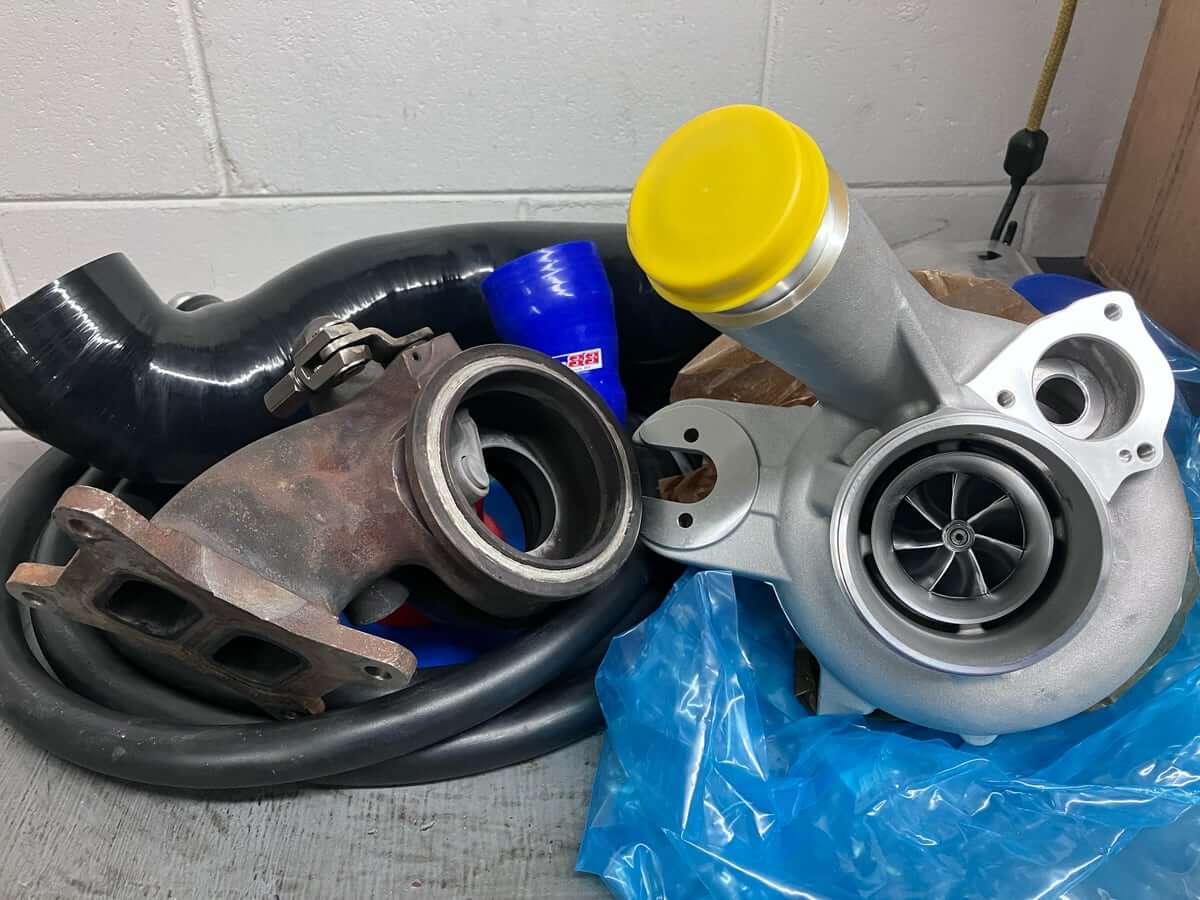
- Shuenk IS48 turbocharger
- aFe Power charge pipes
- Majesty Competition and FMIC intercoolers
- Stock ‘euro’ intake manifold with MPI
- HPA HPFP / RS3 LPFP
- 034 Motorsport coils
- CC Design catless 4″ DP / 3.5″ exhaust
- Russell Road & Racing E40 Tune
Environmental Impact:
Comparing the street pulls (72-78F) with the dyno session (85F) shows that at the start of a pull, the IAT Delta (Intake Air Temperature Above Ambient Air Temperature) is 25 degrees Fahrenheit higher on the dyno than the street. At the top end of the pull, the difference has reduced to 15 degrees Fahrenheit.
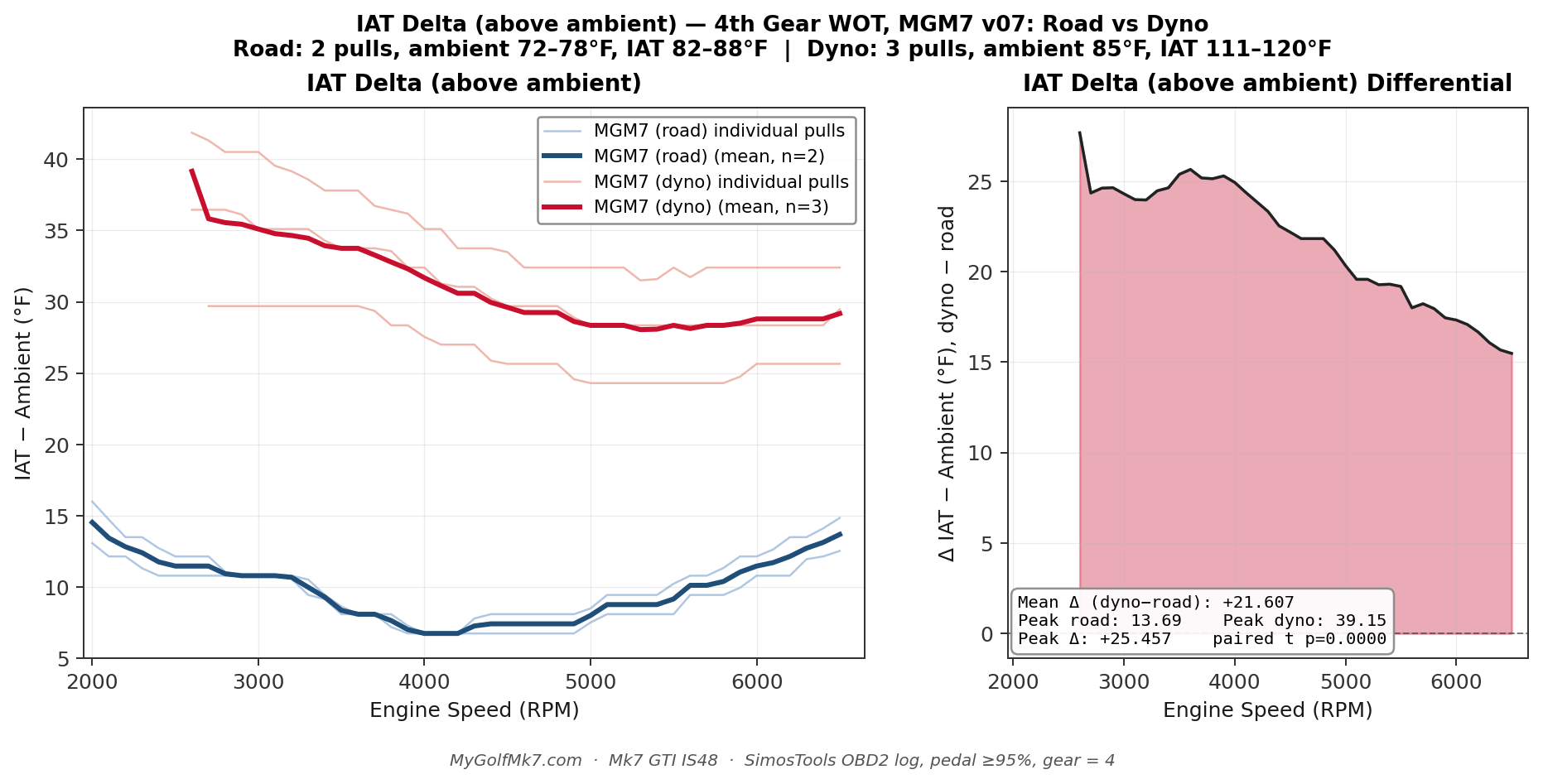
The reduced airflow measured at the grille prior to the pulls is consistent with the elevated IAT observed during testing.
Results:
Note: 3 dyno pulls and 2 street pulls are small sample sizes, and the following charts shouldn’t be taken as being statistically significant.
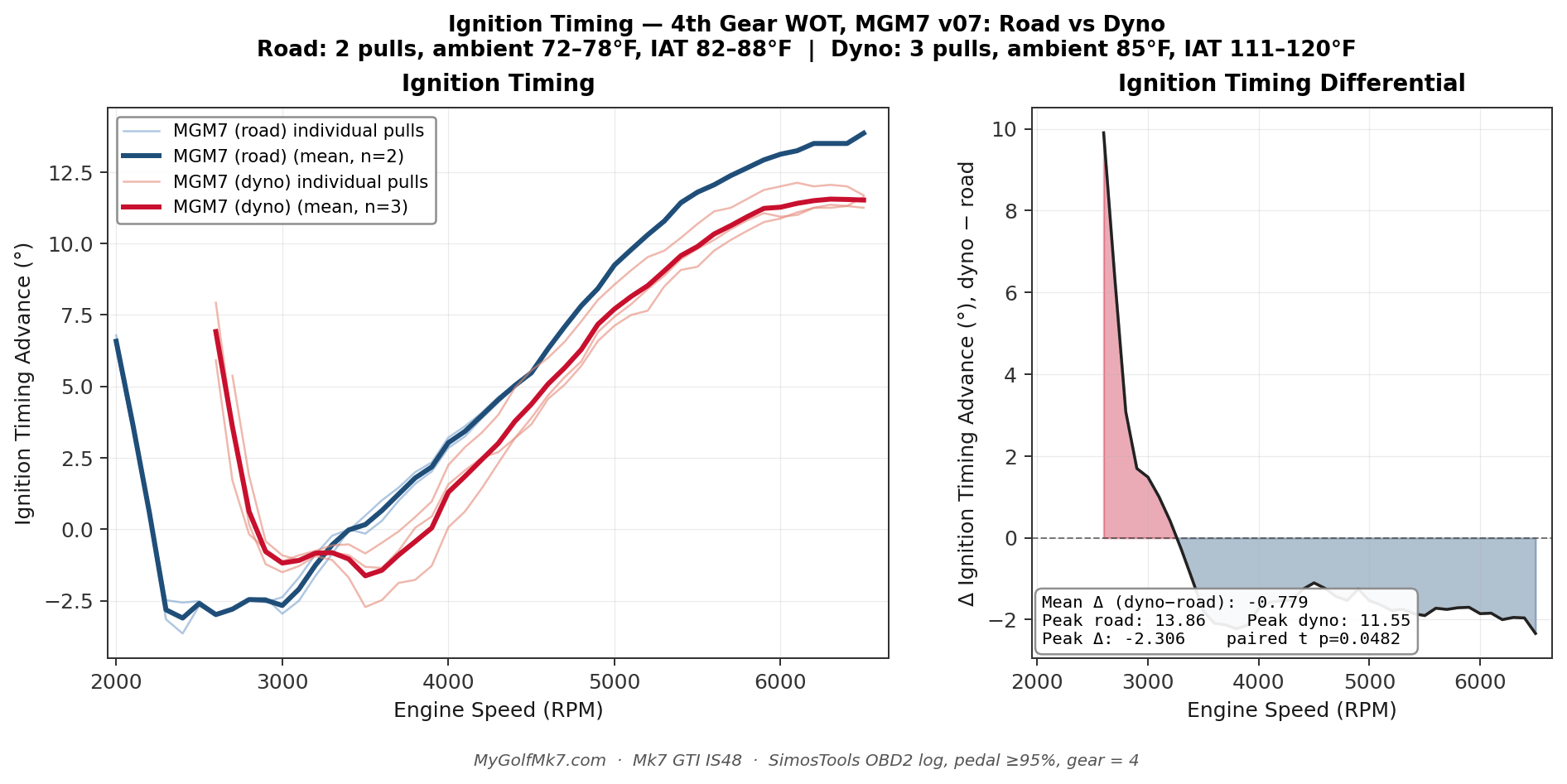
The elevated air temperature at the dyno had a distinct effect on the engine and turbo. The ignition timing dropped by 2 degrees across the entire engine range where boost was at full pressure.
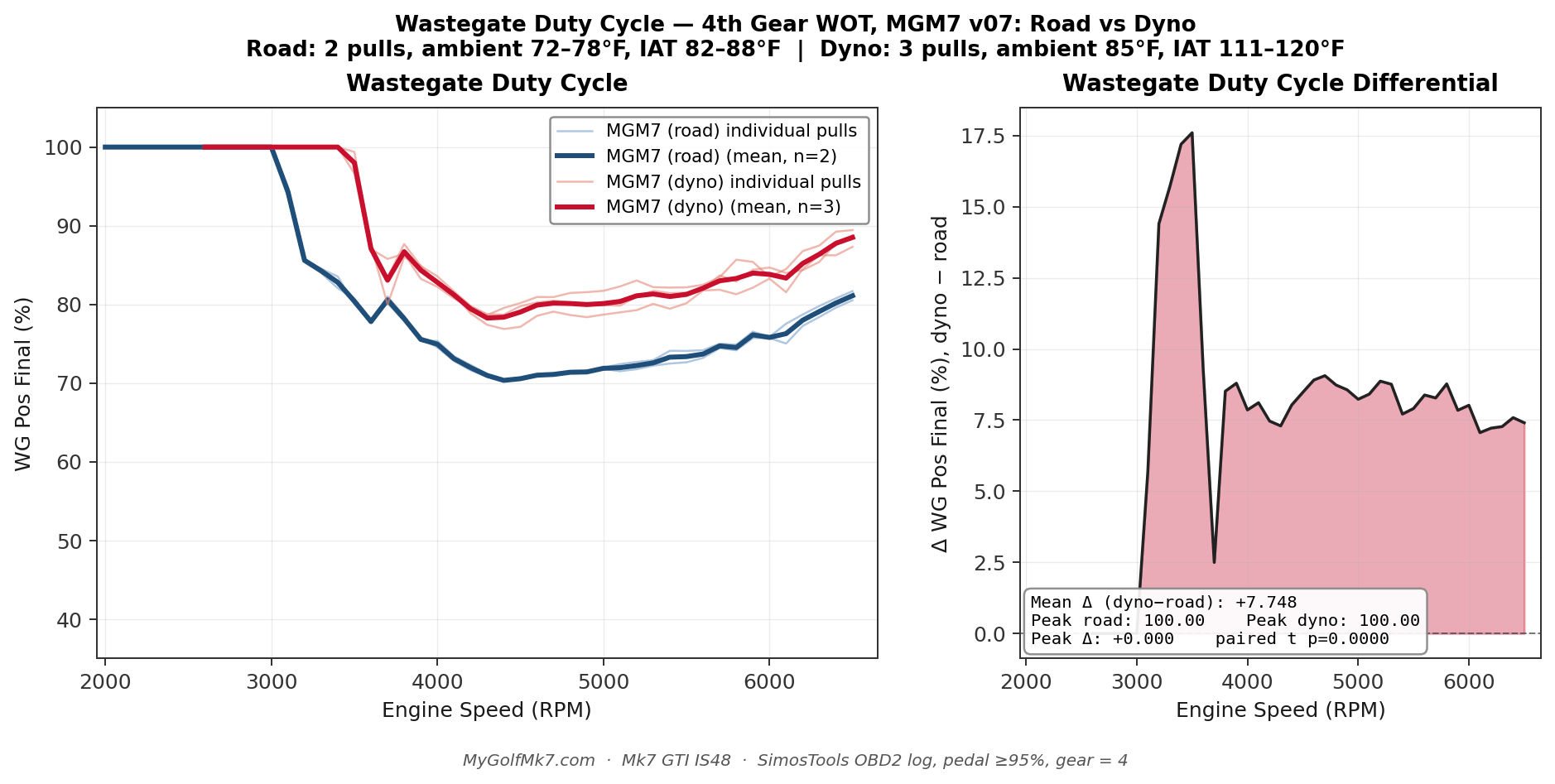
For the turbocharger, the wastegate duty cycle (WGDC) was increased by approximately 8% after boost pressure stabilized.
Boost pressure wasn’t reduced, but the turbocharger was working harder to reach the boost target.
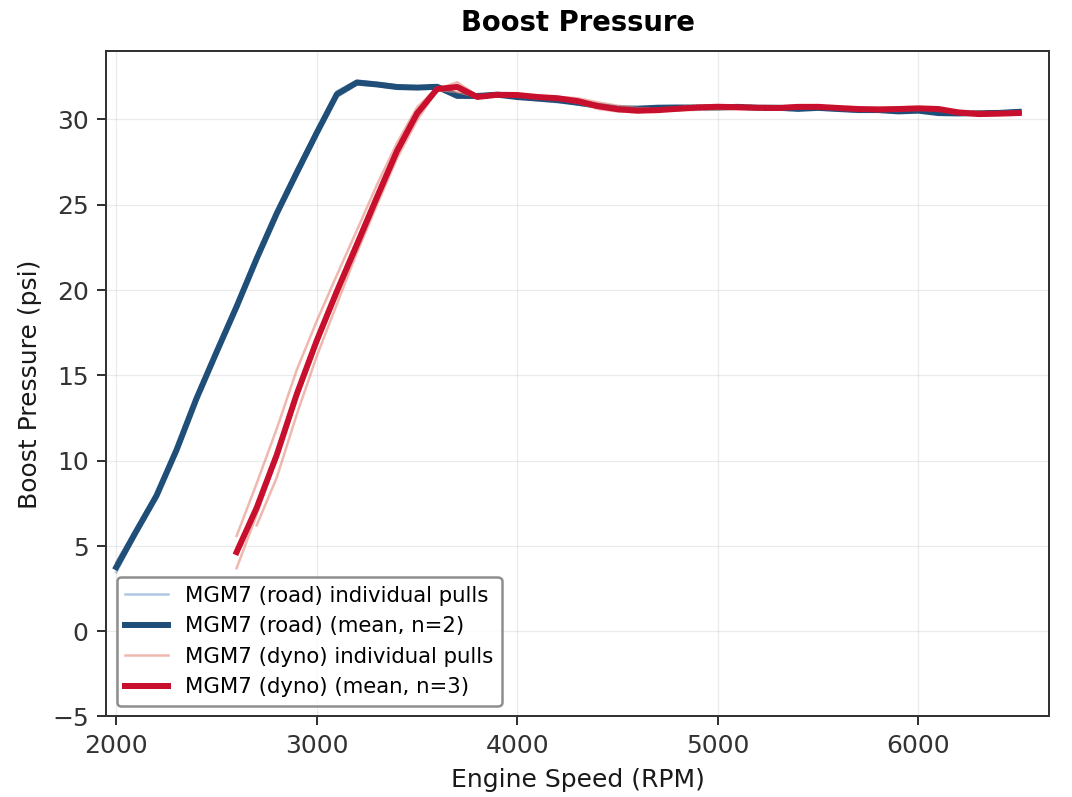
Note: The dyno pulls reach the ~30 psi target several hundred RPM later than the road pulls. This is not a turbo response effect; it reflects the dyno operator starting the pull at a higher engine speed than I use on the street.
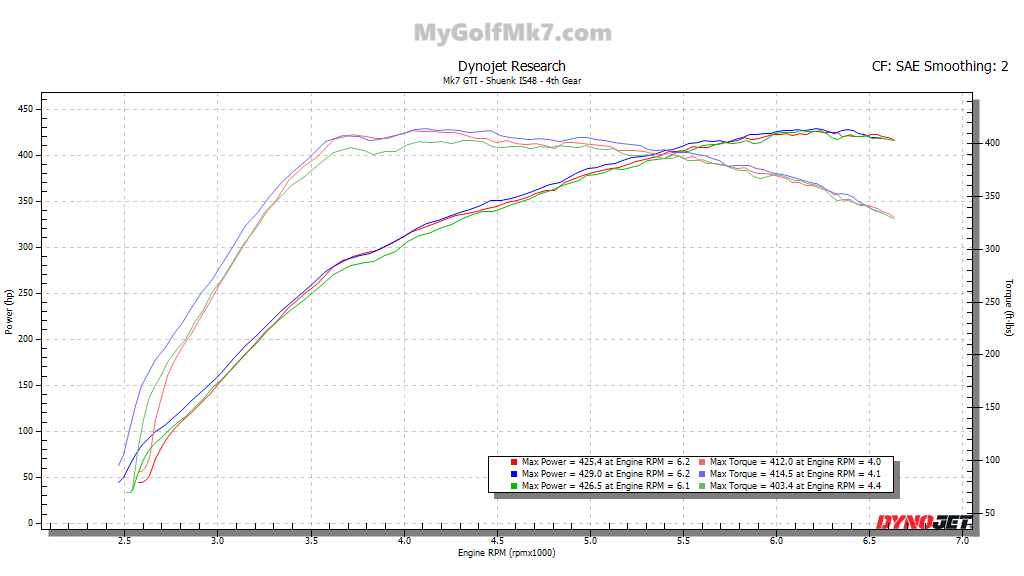
The following chart summarizes the three pulls that were made on the dyno, displaying the wheel horsepower and torque curves using an SAE correction factor.
This table shows the values without a correction factor, compared with the SAE and STD correction factors.
| Attribute | Uncorrected | SAE Correction | STD Correction |
|---|---|---|---|
| WHP | 419/423/419 | 425/429/427 | 434/438/435 |
| WTQ | 406/408/397 | 412/415/403 | 421/423/412 |
The median across the three pulls is shown in this table.
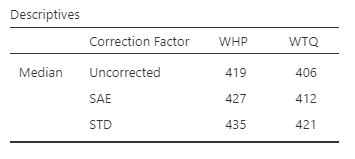
The SAE 1349 correction factor is intended to try to account for the effect that ambient air temperature has on power output. This is a limited correction; for instance, it cannot account for the ECU pulling two degrees of ignition timing.
The Standard Correction (STD) was canceled in 1988 when it was replaced by SAE, but it is nice for inflating dyno numbers since it corrects to more favorable environmental conditions.
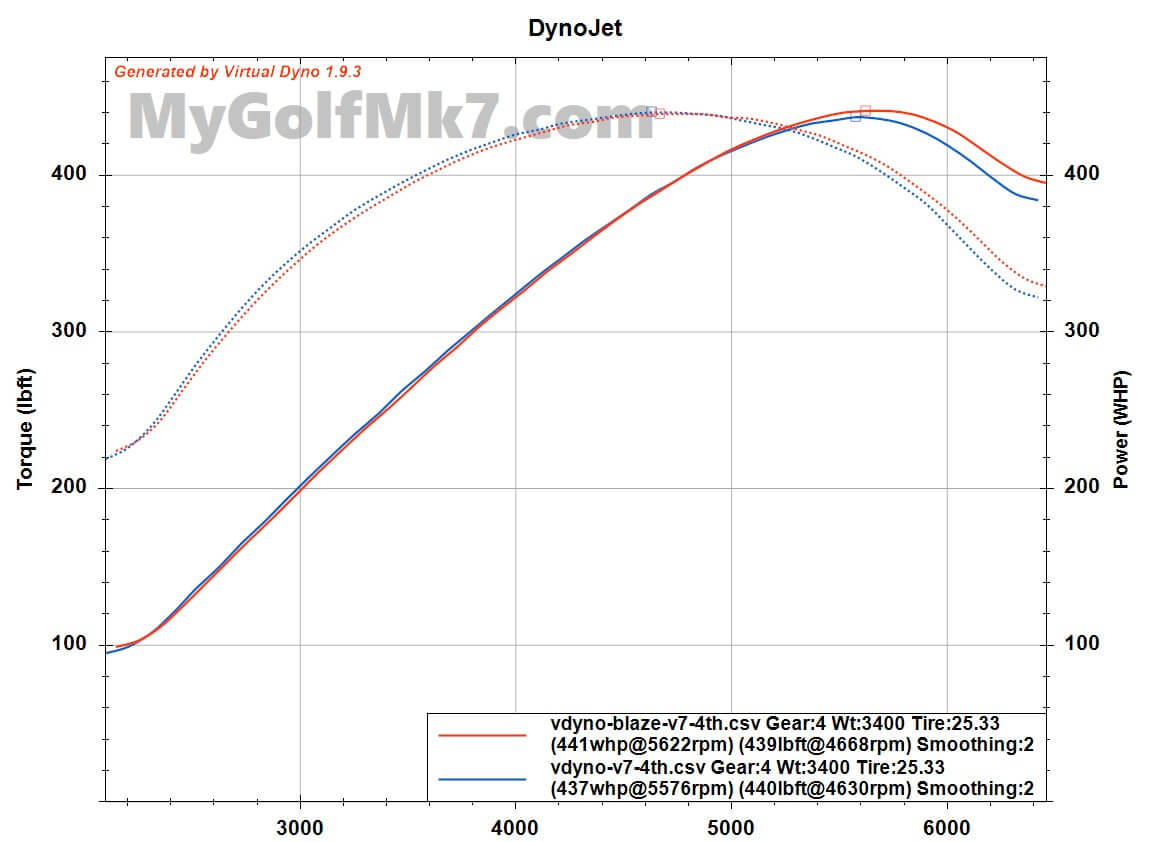
Comparing the DynoJet results with Virtual Dyno estimates derived from street data, the temperature effects at the Dyno trimmed off about 20 whp from what the GTI made on the street under better conditions.
Conclusions:
The Shuenk IS48 performed consistently under both street and dyno environments, but the dyno’s elevated temperatures and limited airflow created measurable penalties. Intake air temperatures started 25°F higher on the dyno and remained 15°F higher at the end of the pulls, which led the ECU to reduce ignition timing by roughly 2 degrees across the boost range.
To maintain the same boost pressure on the dyno, the turbocharger required an additional 8% wastegate duty cycle under higher-temperature conditions.
Despite the conditions, boost pressure remained stable, and the IS48 delivered repeatable results, with SAE‑corrected output averaging 427 whp and 412 wtq across the three pulls. When compared with street logs collected in cooler conditions, the dyno environment cut roughly 15- 20 whp.
Overall, the IS48 demonstrated strong performance, and the dyno session highlighted the importance of heat management when evaluating turbocharger behavior in high‑temperature environments.