

1. Introduction:
On September 14th, I published a post regarding R-Tech’s claims that the IHI IS38 turbocharger “likes” exhaust back pressure and low back pressure exhausts were linked to “huge” failure rates amongst IS38 turbochargers.
Prior to making the post, I emailed R-Tech to clarify what was meant, but I didn’t get an answer, so I published the post describing what I observed.
With the post live, Niki Gower, R-Tech’s tuner, then responded on Facebook rather than by email. This article evaluates whether his responses addressed the original questions I had.
2. The claims:
Reviewing the original R-Tech claims:
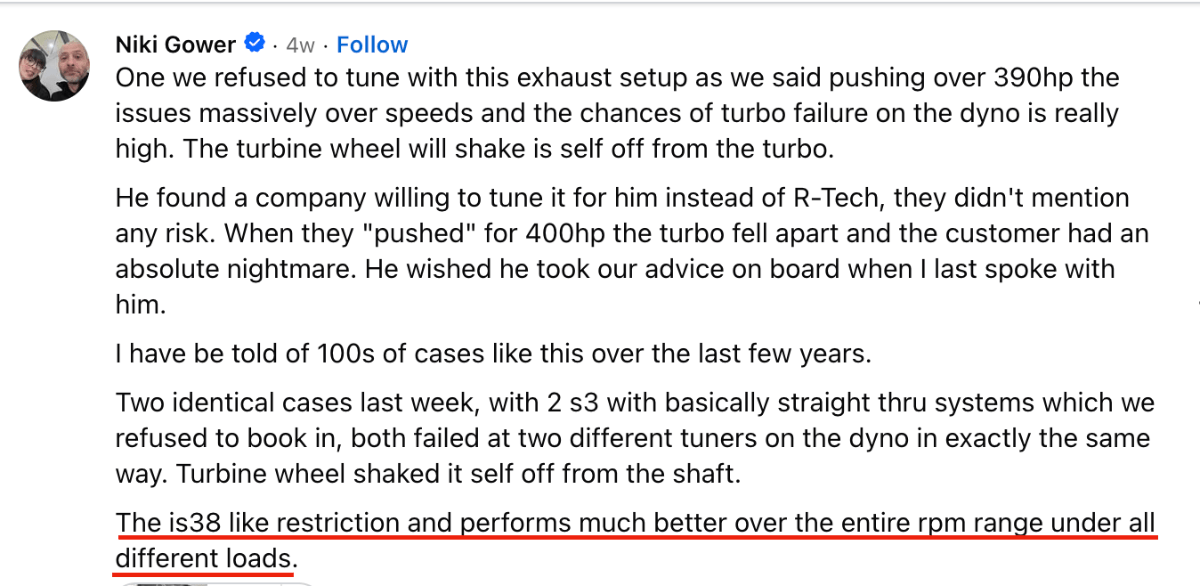
Claim 1
The is38 like restriction and performs much better over the entire rpm range under all different loads
Niki Gower – R-Tech Tuner
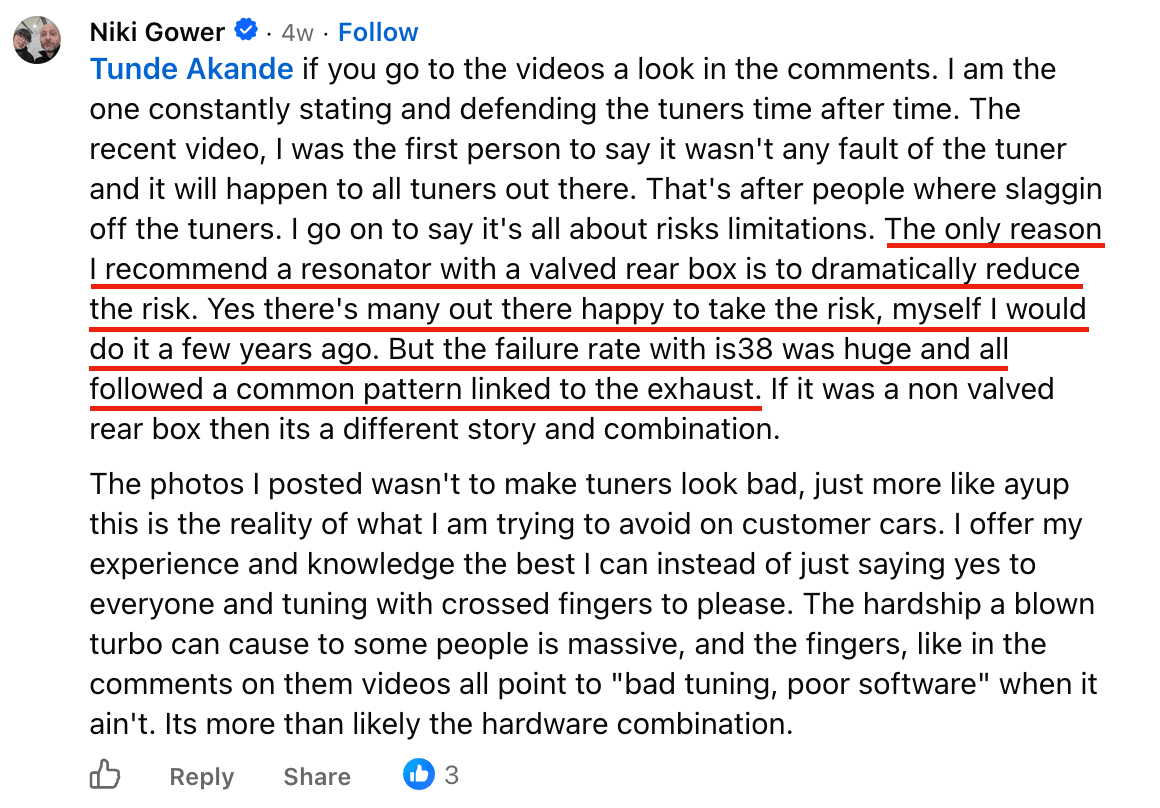
Claim 2
Low-backpressure exhaust systems contribute to IS38 turbo failures.
… the failure rate with is38 was huge and all followed a common pattern linked to the exhaust.
Niki Gower – R-Tech Tuner
3. What Questions Were Asked?
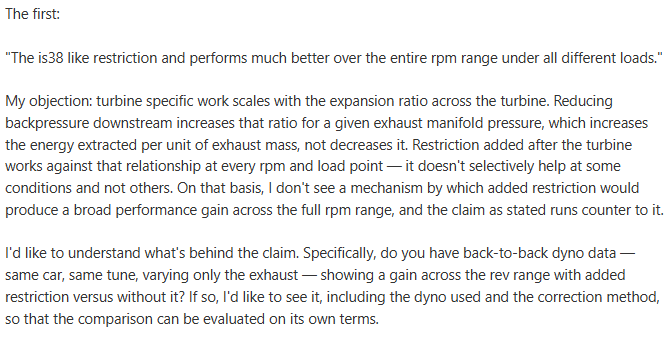
Question 1
What mechanism causes additional post-turbine restriction to improve turbine operation?
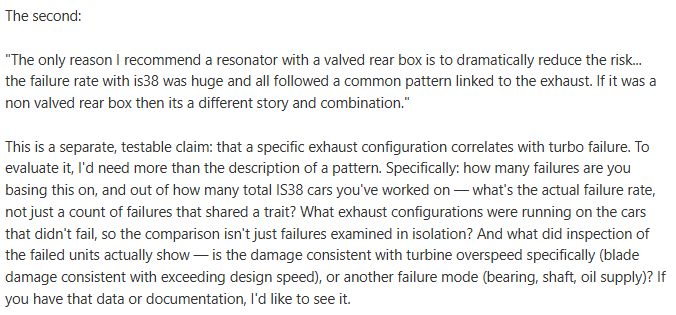
Question 2
How was low backpressure determined to be the cause of the IS38 failures?
4. How did Gower respond on Facebook?
Reframing the Discussion: “Real World Testing vs Theory”
One of the first things readers encountered in Gower’s response was the title:
“Real world testing vs theory”
This framing is problematic because it mischaracterizes what I was concerned with from the outset. The actual disagreement was much simpler:
One party (Gower) made specific technical claims.
The other party (myself) asked for the evidence supporting them.
The dispute was never “testing versus theory.” The dispute was “claims versus evidence.”
What theory would Niki discuss?
None.
What real-world testing would Niki present?
None.
What evidence would Niki present?
The supporting evidence amounts to:
- “4+ years”
- “1000s of customers”
- “real world feedback”
- “real world results”
The response’s title suggests that readers are about to see a comparison between theory and evidence. Instead, readers are given neither. The theory is not addressed, and the testing is not presented.
What follows is primarily a restatement of the original claim, supported by appeals to experience, customer feedback, and reputation. Readers are asked to accept the conclusion, but are not shown the evidence needed to independently evaluate it.
About that “Theory”
R-Tech’s post is titled “Real world testing vs theory.” In everyday use theory means an idea that hasn’t been checked. What my email and post cited isn’t that.
It’s the first law of thermodynamics applied to a turbine: the work a turbine extracts depends on the pressure ratio across it, so restriction after the turbine reduces the work available from the exhaust.
Principle and testing aren’t opposing positions. What’s missing from Gower’s statements is data supporting the claim that the IS38 is an exception to turbocharger fundamentals.
5. Statement-by-statement
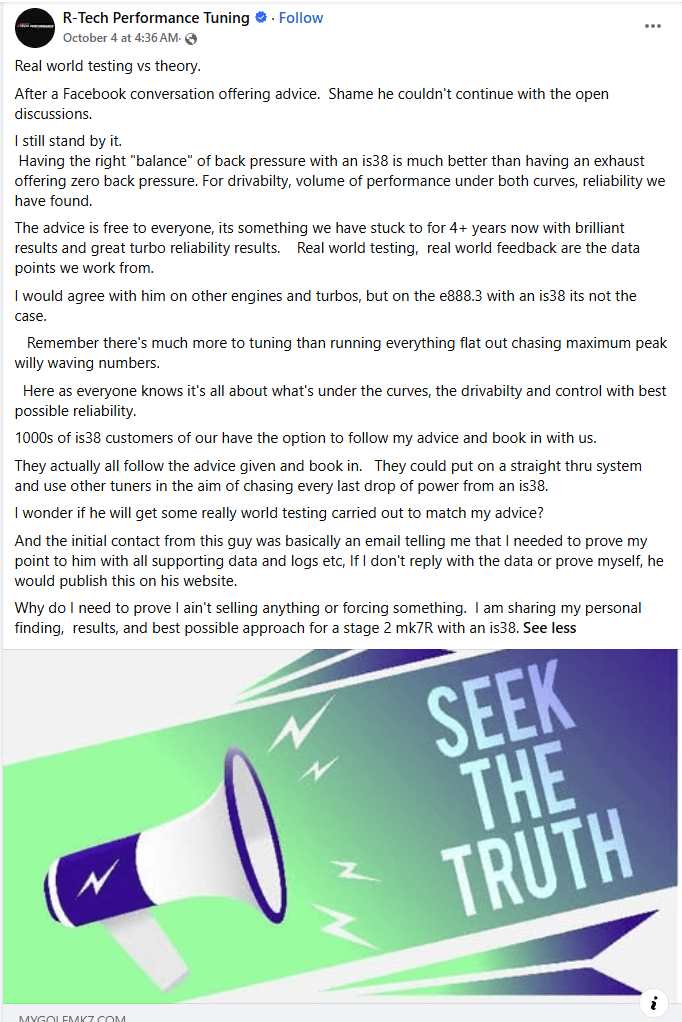
In this section, I will analyze Gower’s entire response to point out how this “professional” tuner responded when asked to explain his position.
Framing the exchange
1. “Shame he couldn’t continue with the open discussions“
That’s backward relative to the actual record — I proposed moving to email specifically to keep the exchange precise, offered to work around Niki’s schedule, and sent a closing check-in that explicitly said either a reply or no reply was fine. He never answered either the questions or that check-in. The non-response was his.
2. “the initial contact from this guy was basically an email telling me that I needed to prove my point to him with all supporting data and logs etc, If I don’t reply with the data or prove myself, he would publish this on his website.”
The email is shown in full in my first post. It said the review was already in progress, and offered the chance to add data before publication: ‘I’d rather represent your position accurately, with whatever data supports it.’ Publication never depended on a reply.
3. “Why do I need to prove I ain’t selling anything or forcing something.”
I asked for the data behind two technical claims. Whoever makes a claim is the one who supports it. That holds for me as well, which is why I publish my data.
Technicals Claims
4. “I still stand by it.”
‘It’ has changed. The claim I asked about was ‘much better over the entire rpm range under all different loads.’ Gower has since said too much restriction chokes performance and that the wastegate relationship I described is correct.
5. “Having the right ‘balance’ of back pressure with an is38 is much better than having an exhaust offering zero back pressure.“
What is the ‘right balance‘ as a number: what backpressure, at what flow, measured how?
6. “For drivability, volume of performance under both curves, reliability we have found.“
Performance under both curves is what a back-to-back dyno comparison measures. That’s what I asked for, and it hasn’t been provided. The same goes for reliability: no failure counts.
7. “I would agree with him on other engines and turbos, but on the e888.3 with an is38 its not the case.“
Then the question is what makes the IS38 the exception. The turbine follows the same expansion-ratio relationship as any other. A turbo-specific exception needs a turbo-specific mechanism, and none has been given.
8. “I am sharing my personal finding, results, and best possible approach for a stage 2 mk7R with an is38.”
Calling it a personal finding is fair. ‘Much better‘ and ‘great turbo reliability‘ are claims about results, and those results can be measured.
Evidence Offered
9. “its something we have stuck to for 4+ years now with brilliant results and great turbo reliability results.”
‘Brilliant results‘ and ‘great reliability‘ are conclusions. The numbers behind them, such as failures out of total cars, are what I asked for.
10. “Real world testing, real world feedback are the data points we work from.”
Feedback isn’t a comparison. A data point needs a measurement and something to compare it against.
11. “1000s of is38 customers of our have the option to follow my advice and book in with us. They actually all follow the advice given and book in. They could put on a straight thru system and use other tuners…”
If every customer follows the advice, there’s no group that didn’t. Without that comparison, the results can’t show whether the exhaust is what makes the difference.
12. “I wonder if he will get some really world testing carried out to match my advice?“
I did, prior to this exchange, in August: street pulls with and without the cat, on a turbo using the IS38 turbine. The result matched the physics. Gower describes thousands of IS38 cars and routine dyno sessions, but doesn’t provide a single back-to-back comparison from that work.
Distractions
13. “The advice is free to everyone,“
Free to read, but it also decides which cars he’ll book. That’s why the evidence behind it matters to owners.
14. “much more to tuning than running everything flat out chasing maximum peak willy waving numbers… it’s all about what’s under the curves, the drivability and control with best possible reliability.”
I agree that under the curve matters more than peak numbers, and peak power was never the question. That’s why I asked for back-to-back comparison data.
5. Conclusion
The questions I sent to R-Tech were specific. My first email quoted two statements from Niki Gower: that the IS38 “performs much better over the entire rpm range under all different loads” with restriction, and that IS38 failures “followed a common pattern linked to the exhaust,” and asked for the data behind them.
Across three emails, R-Tech replied twice to arrange a call or explain availability. Neither reply addressed the questions.
A claim about results needs results behind it, and the person making the claim is the one who provides them. The physics says restriction after the turbine costs turbine work; test results tell us by how much.
If R-Tech publishes data, I’ll review it the same way I do my own data. Until then, Niki Gower’s claims remain opinion.