
Background:
With a boost onset test completed using the Mabotech M600 0.71 A/R turbine housing, I met the objective of this test: to compare the M600’s boost onset with that of previously tested Mabotech turbochargers.
During testing of the M600 with the 0.58 A/R turbine housing, I conducted a full-throttle fourth-gear pull but did not do a similar pull with the 0.71 A/R housing. Although this measure was outside the scope of the test, because I was not trying to optimize the ECU tune for maximum power, I believed comparing Turbine Inlet Pressure (TIP) with each turbine housing might provide useful information.
Test Procedure:
The test involved accelerating the GTI at full throttle in fourth gear, starting around 2,000 RPM and ending around 6,500 RPM.
The GTI is set up as follows:
- Mabotech M600 (0.71 A/R turbine housing) turbocharger
- Russell Road and Racing IS48 E40 ECU tune
- Eventuri Intake
- MST Performance turbo inlet hose
- DBV2 turbo inlet elbow
- 034 Motorsport TMD
- aFe Power charge pipes
- Majesty Competition IC & FMIC
- Stock “Euro” intake manifold
- CC Design 4″ catless downpipe
- CC Design 3.5″ catback exhaust
Test Results:
Unexpectedly, boost pressure exceeded the target level at engine speeds over 5,500 RPM, coinciding with a steadily decreasing wastegate duty cycle.
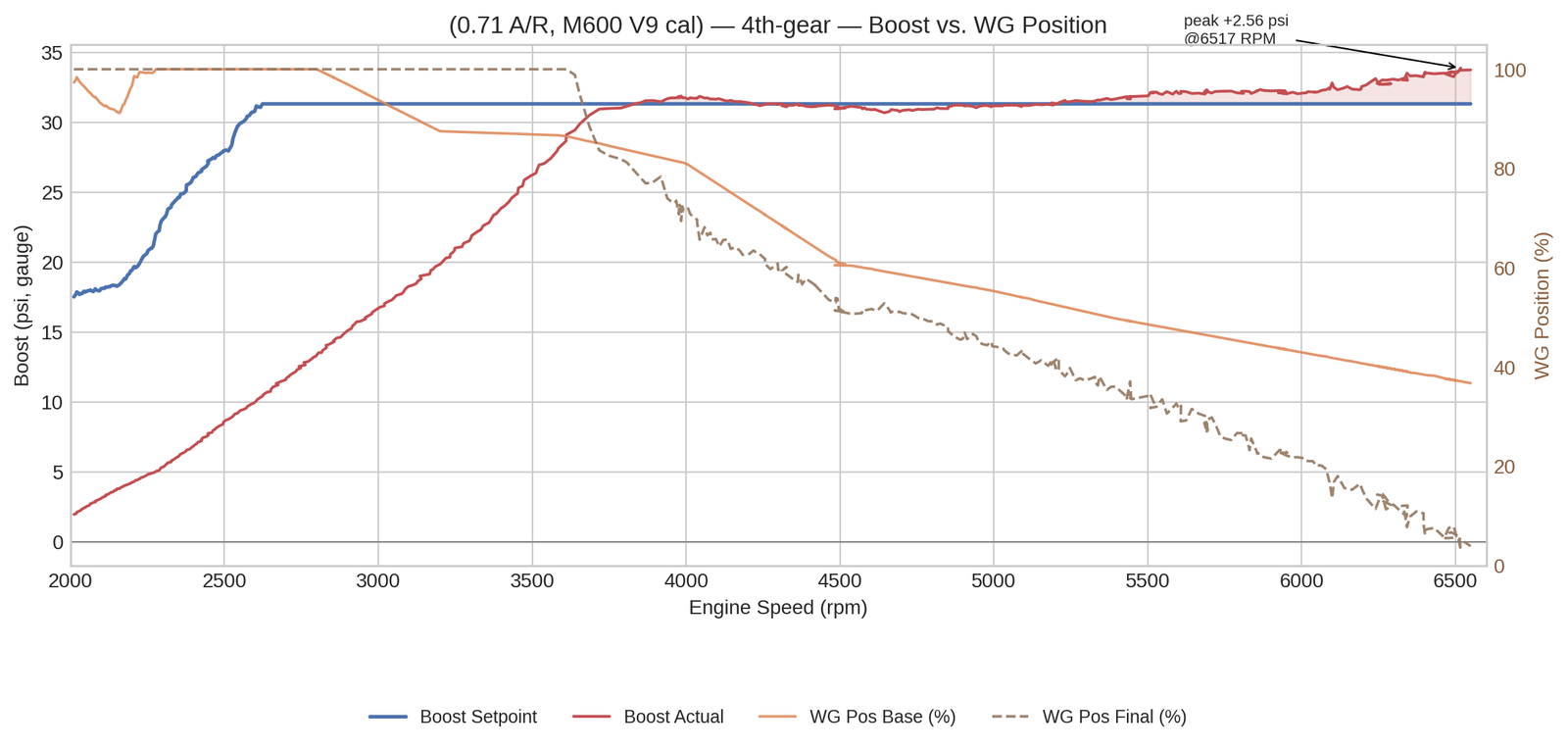
Some investigation ensued to check that the wastegate and actuator were functioning correctly, with no indication that they weren’t.
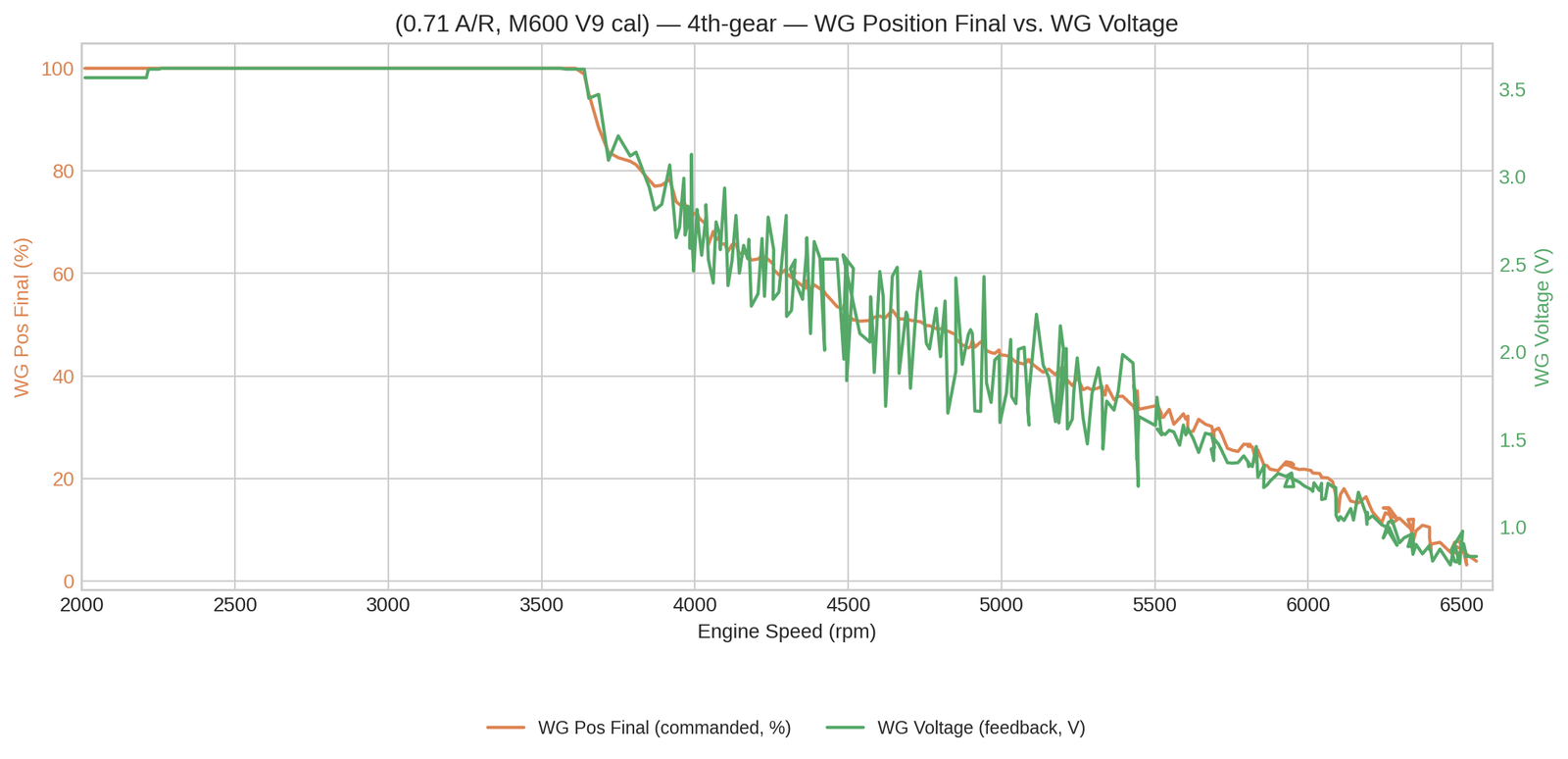
A tune revision lowered the Wastegate Target (Base) Position, but it failed to resolve the small overboost condition.
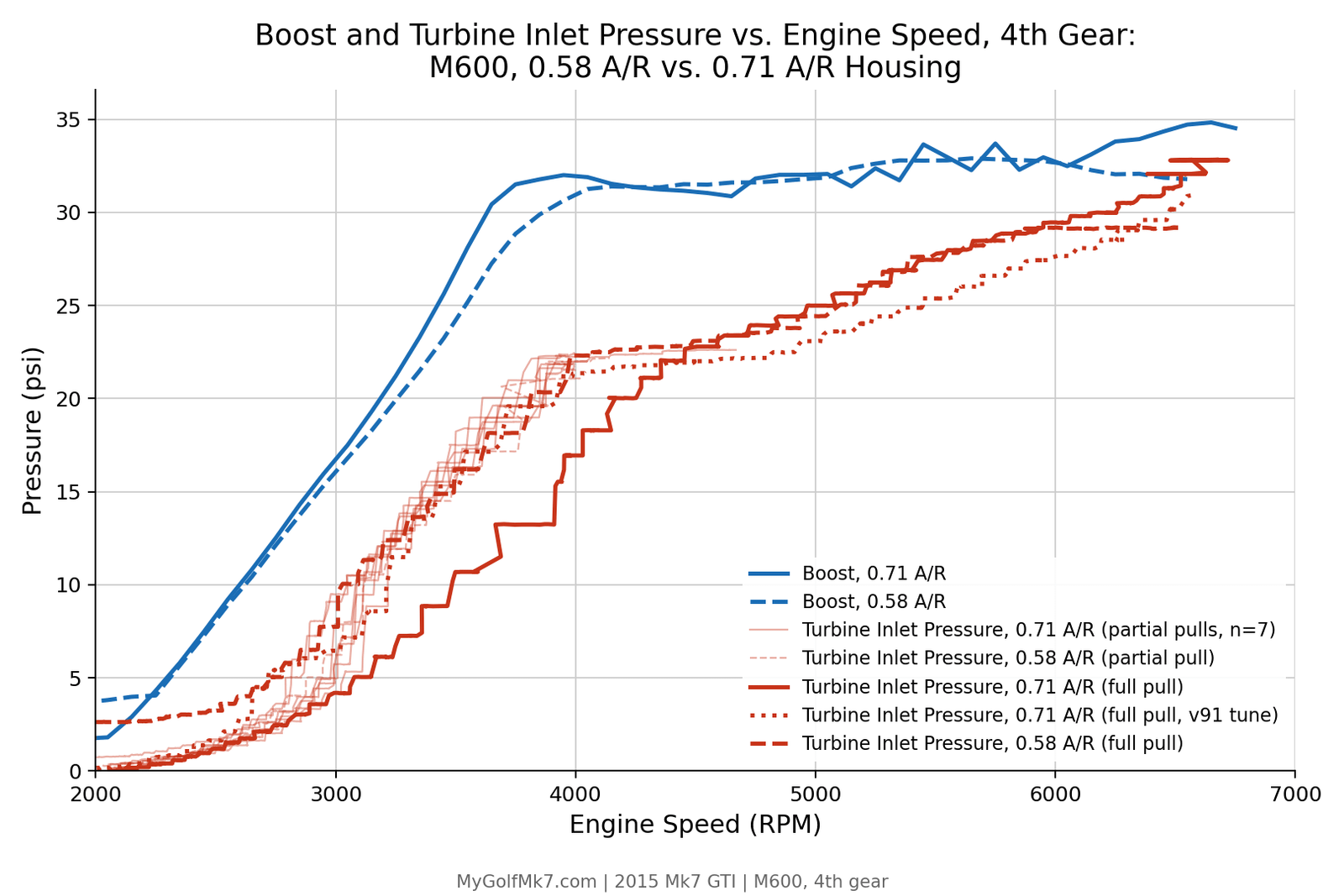
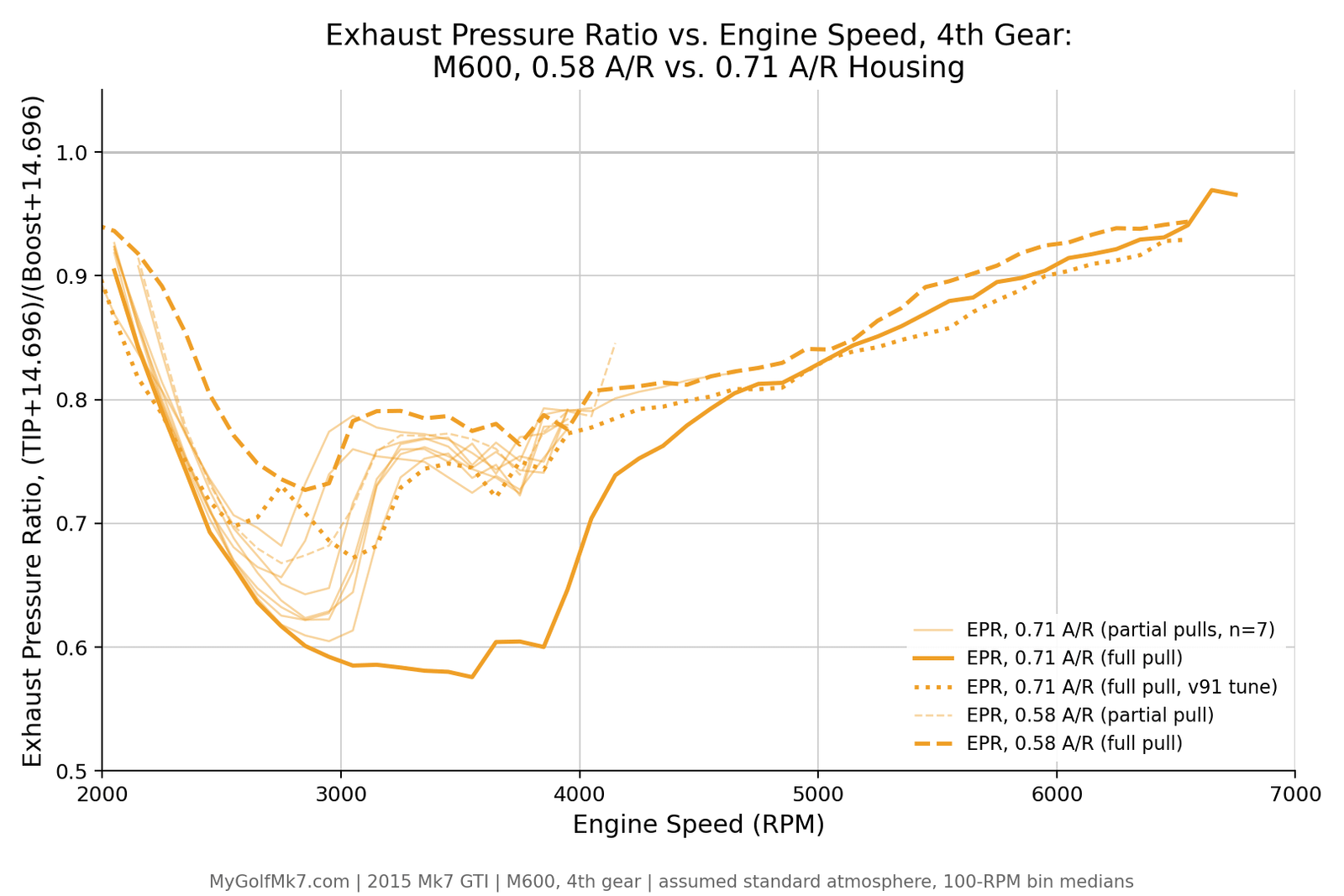
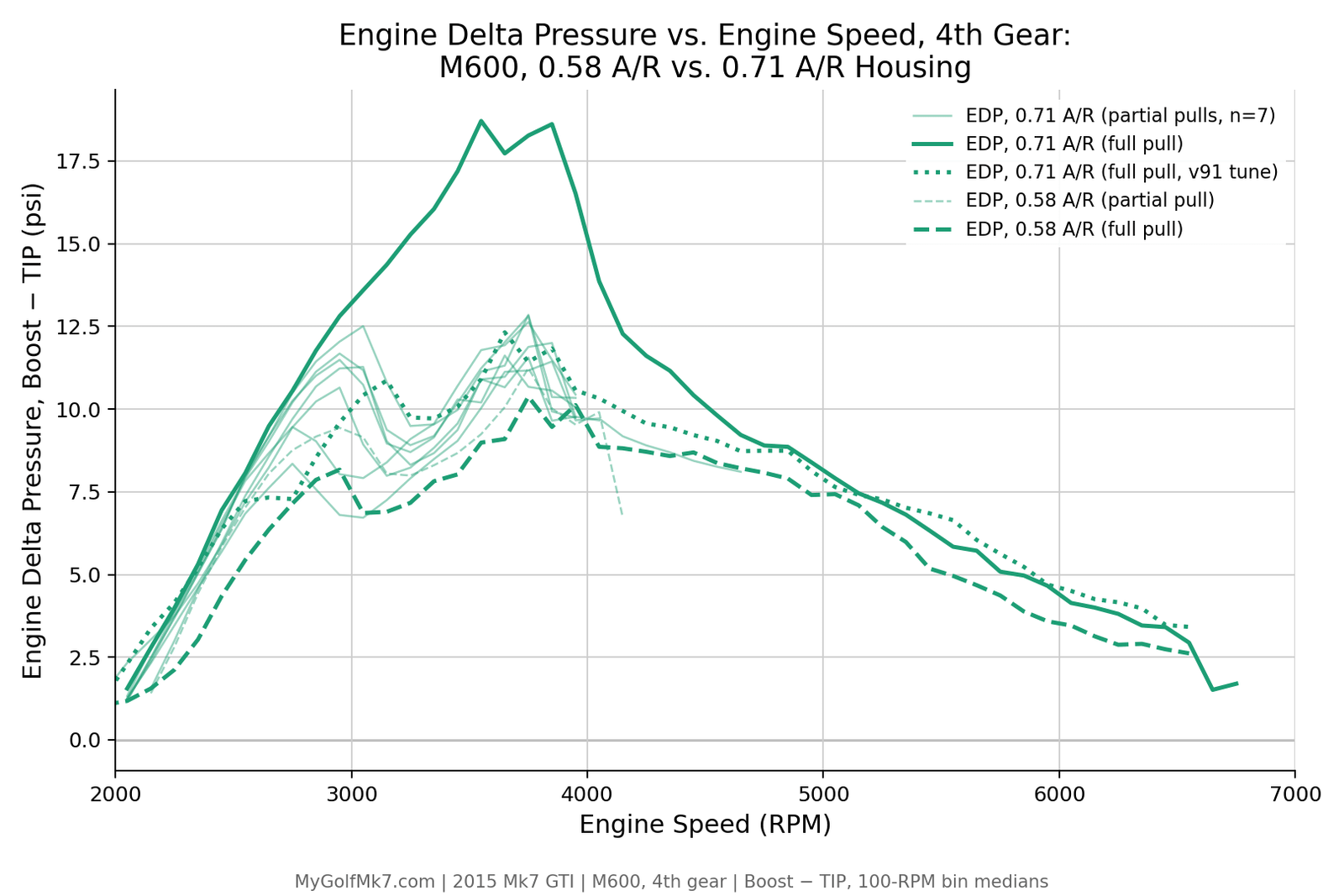
Since this data collection was not important for the M600 boost onset test, I compared the turbine inlet pressure data with the 0.58 A/R housing. Under these conditions, there is no significant difference.
Note: One pull with the 0.71 A/R housing had a lower TIP than any other pull during the boost onset phase. This outlier is retained on the charts, but the cause is unknown.
Exhaust pressure ratio is a different illustration of the same content.
Likewise, Engine Delta Pressure is another way to present the same exhaust pressure data.
Root cause:
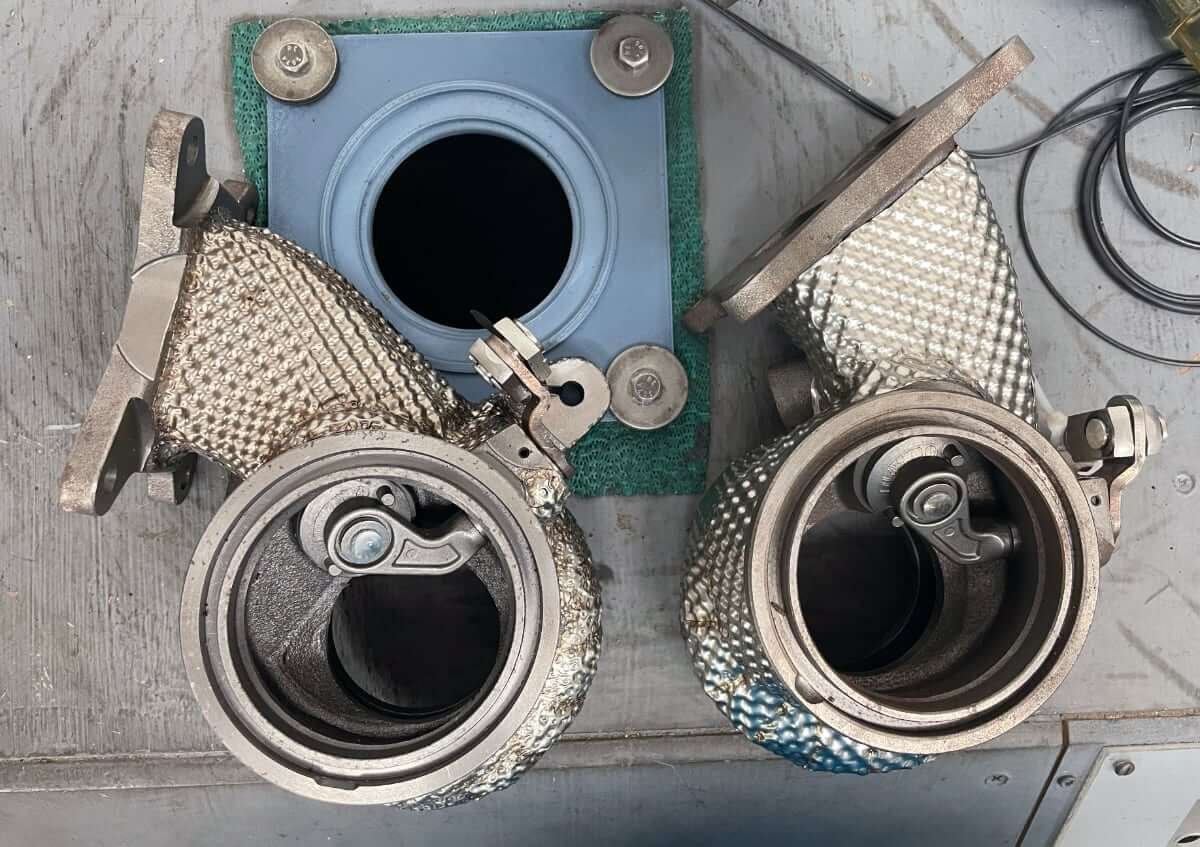
I set about removing the M600 turbo and immediately discovered the cause of the overboost and abnormally low WGDC. The wastegate seat of the 0.71 A/R housing hadn’t been machined to the design specification.
The 0.71 housing was meant to operate with a smaller wastegate seat to see how the turbocharger responded under higher boost, but the work hadn’t been finished; it was supposed to be larger than what was shipped.
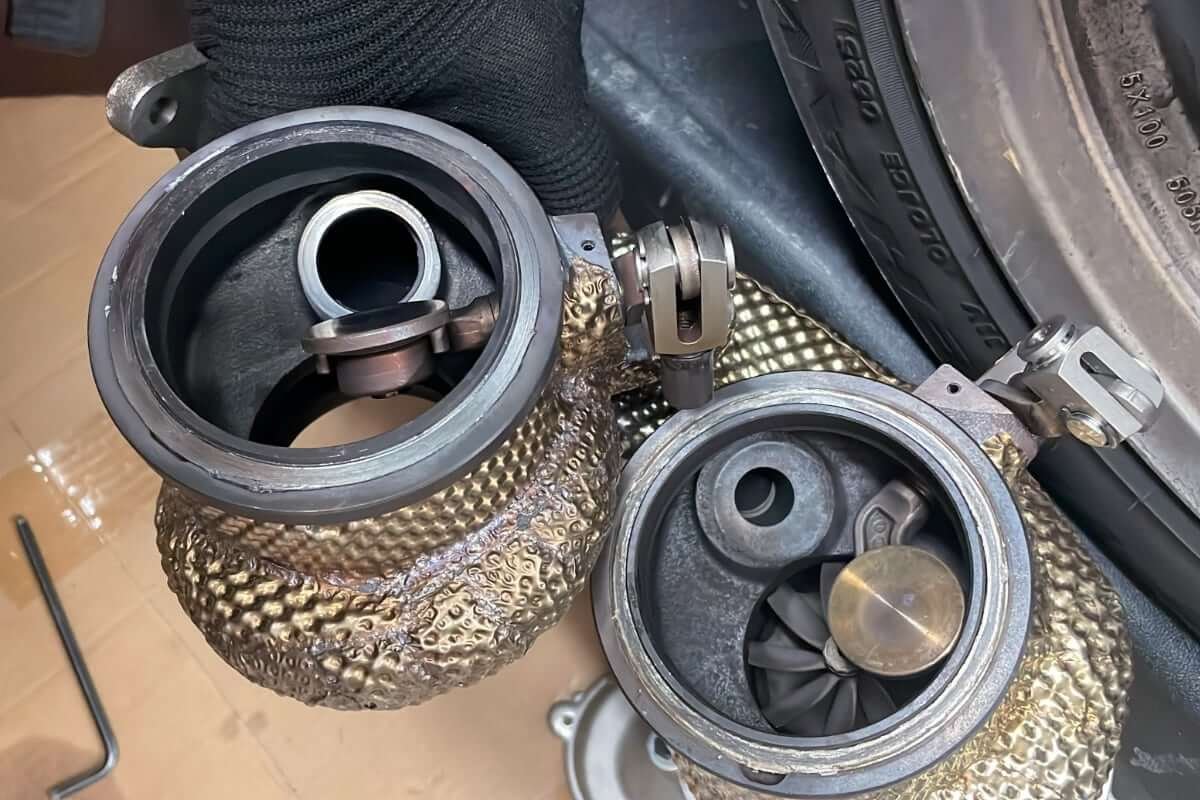
The test results showed that reducing the seat diameter caused insufficient exhaust gas flow to bypass the turbine, leading to overboost.
I previously had performed bench flow testing of the turbine housings with the wastegate door zip-tied closed, as shipped, so I missed an opportunity to catch the discrepancy.
Ultimately, although the 0.71 A/R housing test didn’t go fully as intended, I still collected useful information, and the smaller wastegate seat established a lower bound to adjust from.
Conclusions:
The Mabotech M600 turbocharger with 0.71 A/R turbine housing was street tested to record turbine inlet pressure for comparison with a 0.58 A/R housing.
Boost sits above TIP across the entire logged range, with the gap narrowing toward the top of the pull. Similar to the 0.58 A/R housing, the 0.71 A/R housing never reaches a point where exhaust-side pressure exceeds boost.