

Background:
In late July, a discussion took place about a UK tuner, R‑Tech, who refused to tune a customer’s IS38-equipped MQB unless a resonator was added to increase exhaust backpressure.
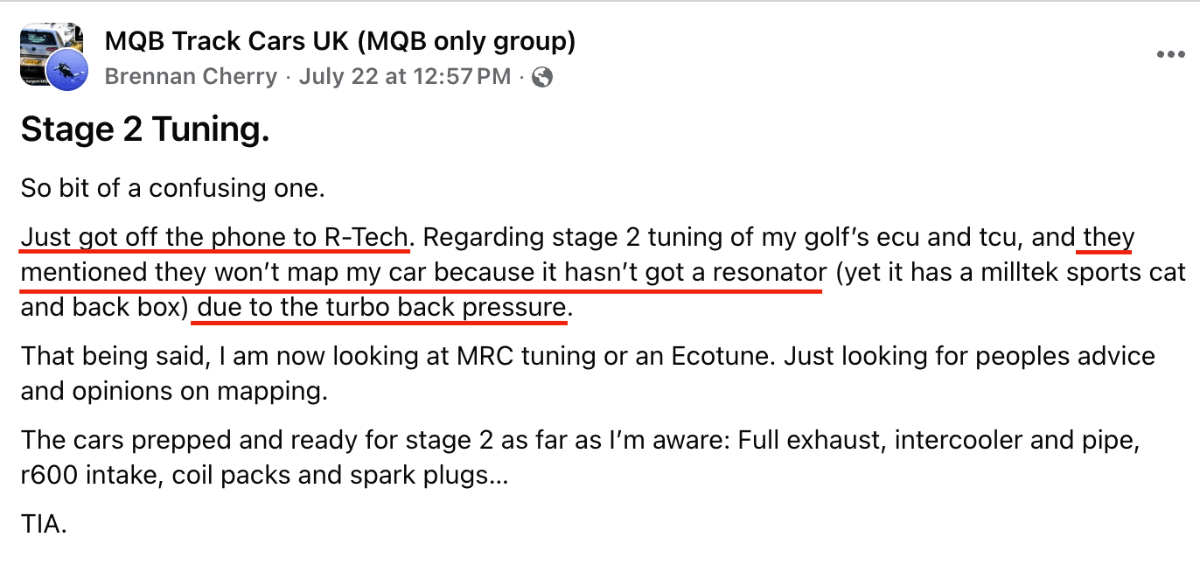
This raised two issues that should matter to Mk7 owners: how misinformation spreads, and how authority bias leads enthusiasts to accept claims that contradict fundamental physics.
- Misinformation propagation
- Authority bias / Appeals to authority
These issues affect tuning decisions, reliability assumptions, and community knowledge.
Backpressure:
A turbine’s specific work — how much energy it extracts from the exhaust per unit of mass flowing through it — scales with the expansion ratio across the turbine: the pressure upstream (in the exhaust manifold) divided by the pressure downstream (everything after the turbine housing, including the downpipe, cat, and rear exhaust).
ER = \frac{P_{\text{exhaust\ manifold}}}{P_{\text{turbine\ outlet}}}
For a given exhaust manifold pressure, lowering the downstream pressure increases that ratio, which increases the energy extracted per unit of exhaust mass. Adding downstream restriction does the opposite: it raises the pressure the turbine expands against, reduces the expansion ratio, and reduces the energy extracted. (See the thermodynamic relationship in the image below.)
P = \dot{m} \, C_p \, T_0 \, \eta_t
\left(
1 - \left( \frac{1}{ER} \right)^{\frac{k-1}{k}}
\right)
This isn’t an IS38-specific property. It’s how a radial turbine works. (For an example of this in action, see the test I conducted with the Shuenk IS48 with a GESi cat and then without the cat.)
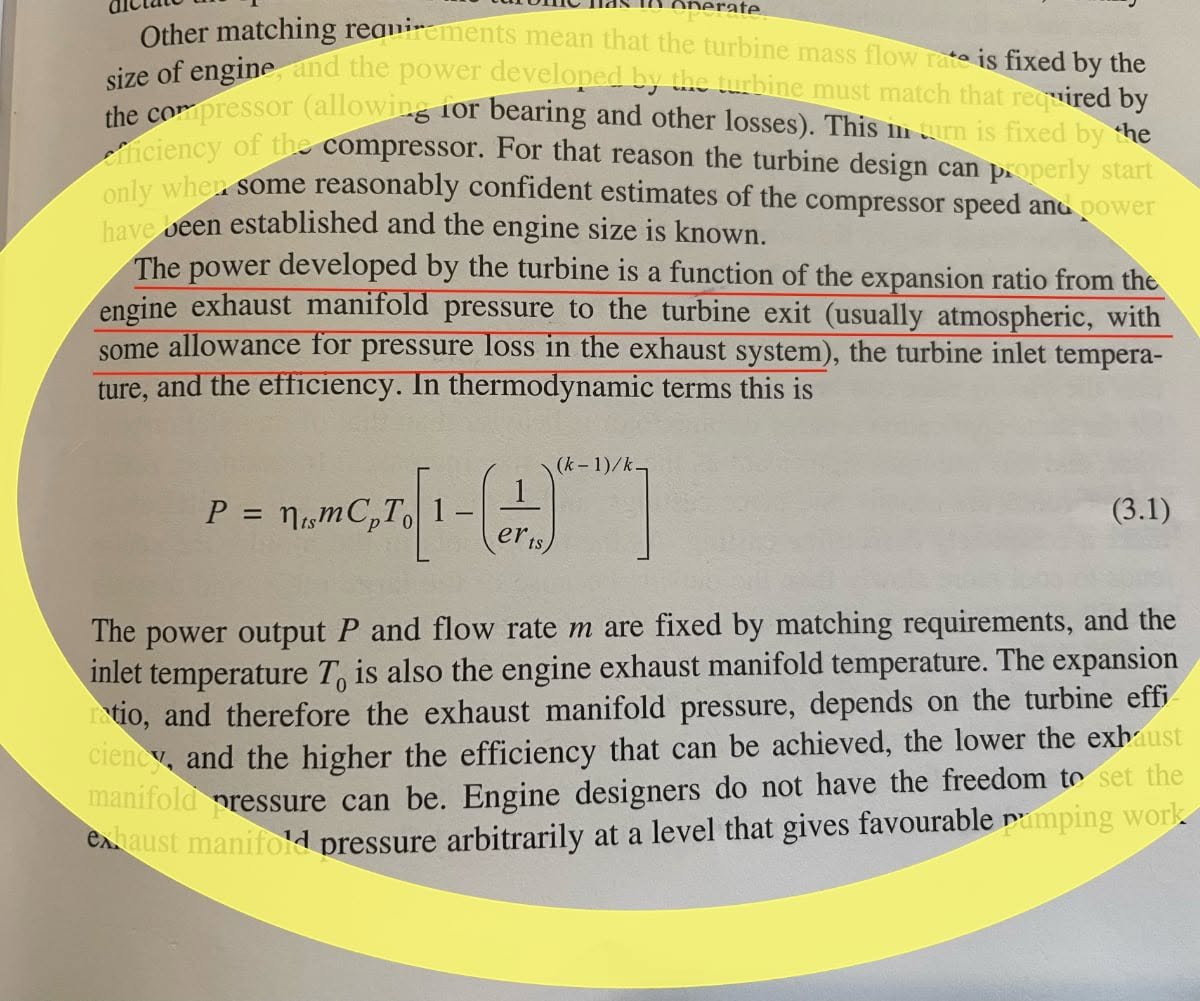
Note: For reference, I embedded content at the bottom of this post from several sources on the relationship between turbochargers and exhaust system backpressure, addressing the thermodynamic relationship described in the image above. The sources include a short video from High Performance Academy, a video from motoIQ, a video from Banks Power, and a motoIQ article by an engineer from Honeywell Turbo Technologies.
The claims
In response, R-Tech tuner Niki Gower explained his position further.
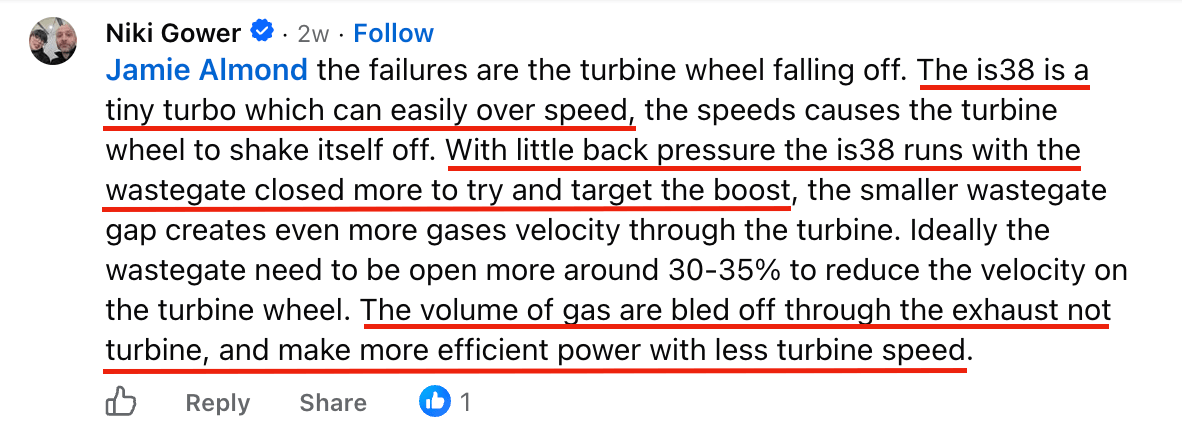
Points that concern me about this were:
- With less backpressure, the turbocharger operates with the wastegate closed further (The wastegate should end up more open, not more closed, with less backpressure)
- Bypassing the exhaust through the wastegate makes more efficient power (The physics are: Lower downstream pressure lets the turbine extract more work, so less mass has to go through it to make the same boost and the turbine can spin slower – higher backpressure reduces efficiency).
Another comment was:
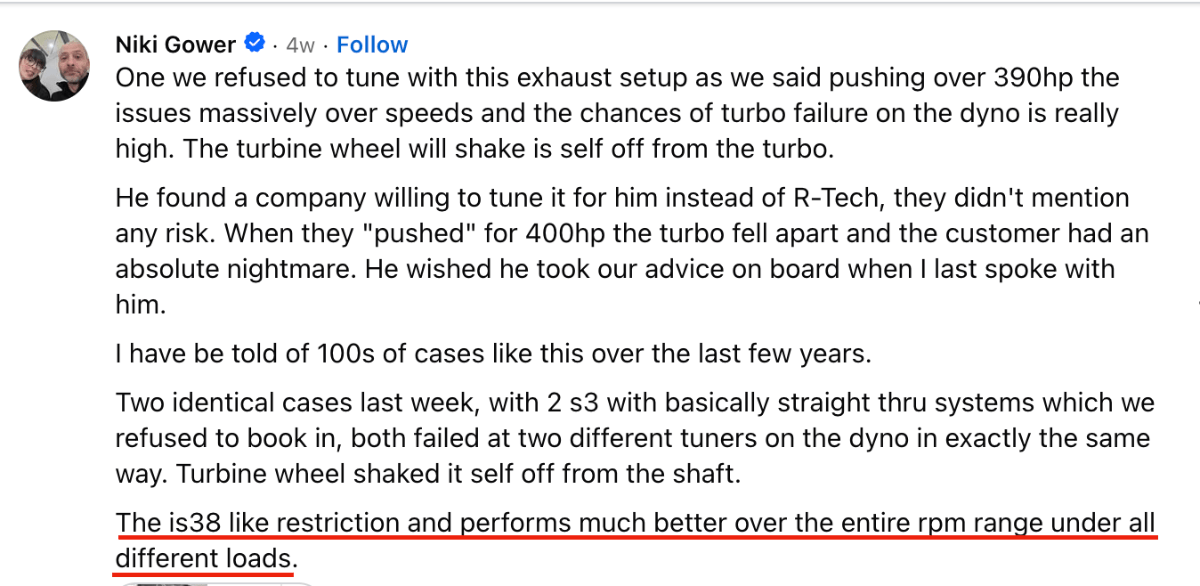
The points of concern with this are:
- The IS38 like restriction – (Contradicts the physics – Reduced turbine work forces the turbo to spin faster, not slower.)
- The IS38 performs much better over the entire RPM range under all different loads with exhaust backpressure (Contradicts the physics – Increasing downstream pressure reduces turbine work.)
Another comment was:
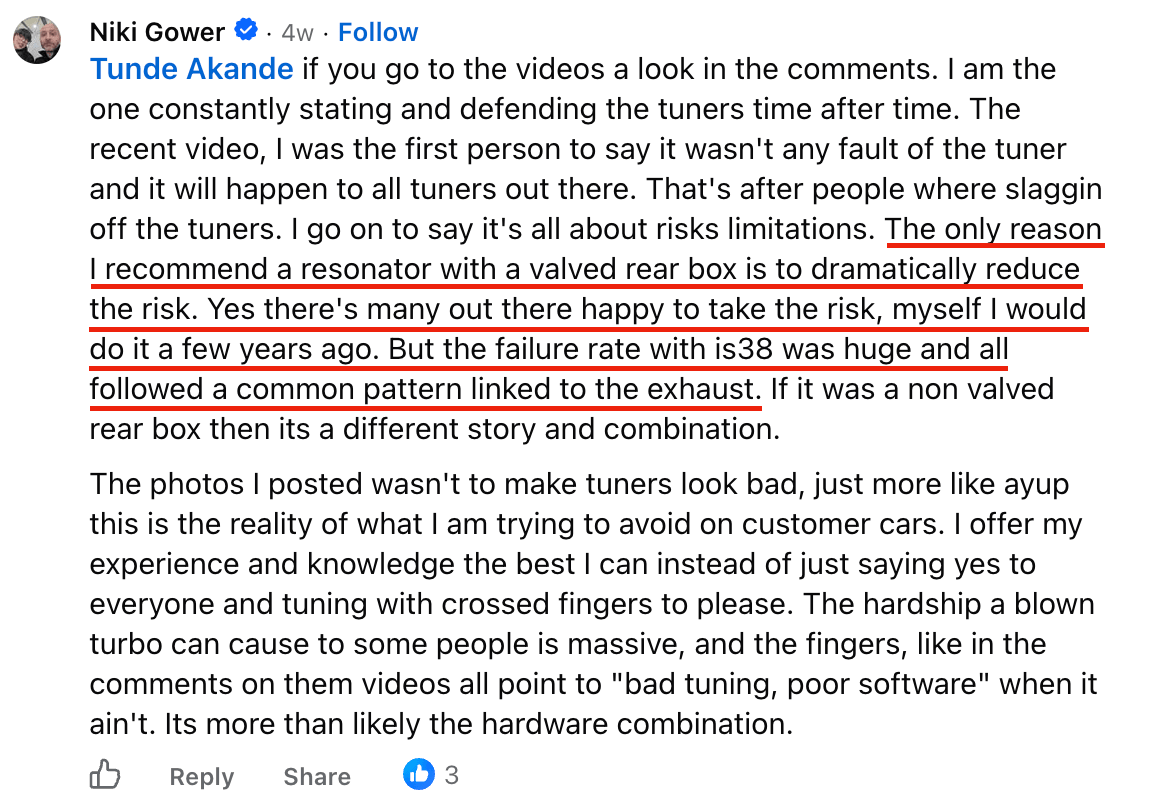
Point of concern:
- Recommend a resonator with a valved exhaust to reduce risk – (Suggesting higher exhaust backpressure reduces risk, but reduced turbine work forces the turbo to spin faster.)
- Failure rate with IS38 was huge … a common pattern linked to the exhaust – (Causal relationship requiring evidence, none provided.)
In a nutshell, the tuner argues that the IS38 performs better with some exhaust system backpressure, and that a lack of backpressure has been linked to many turbocharger failures.
My concerns:
Because these statements contradict the fundamental relationship between turbine expansion ratio and turbine specific work — namely, that increasing exhaust backpressure downstream of the turbine reduces the expansion ratio and therefore reduces turbine work — I joined the exchange.
I added comments about the misunderstanding that a turbocharger would “like” back pressure. The tuner responded with comments that rely on assertions, appeals to experience, anecdotes, and generalized claims that did not engage with the specific technical concerns.
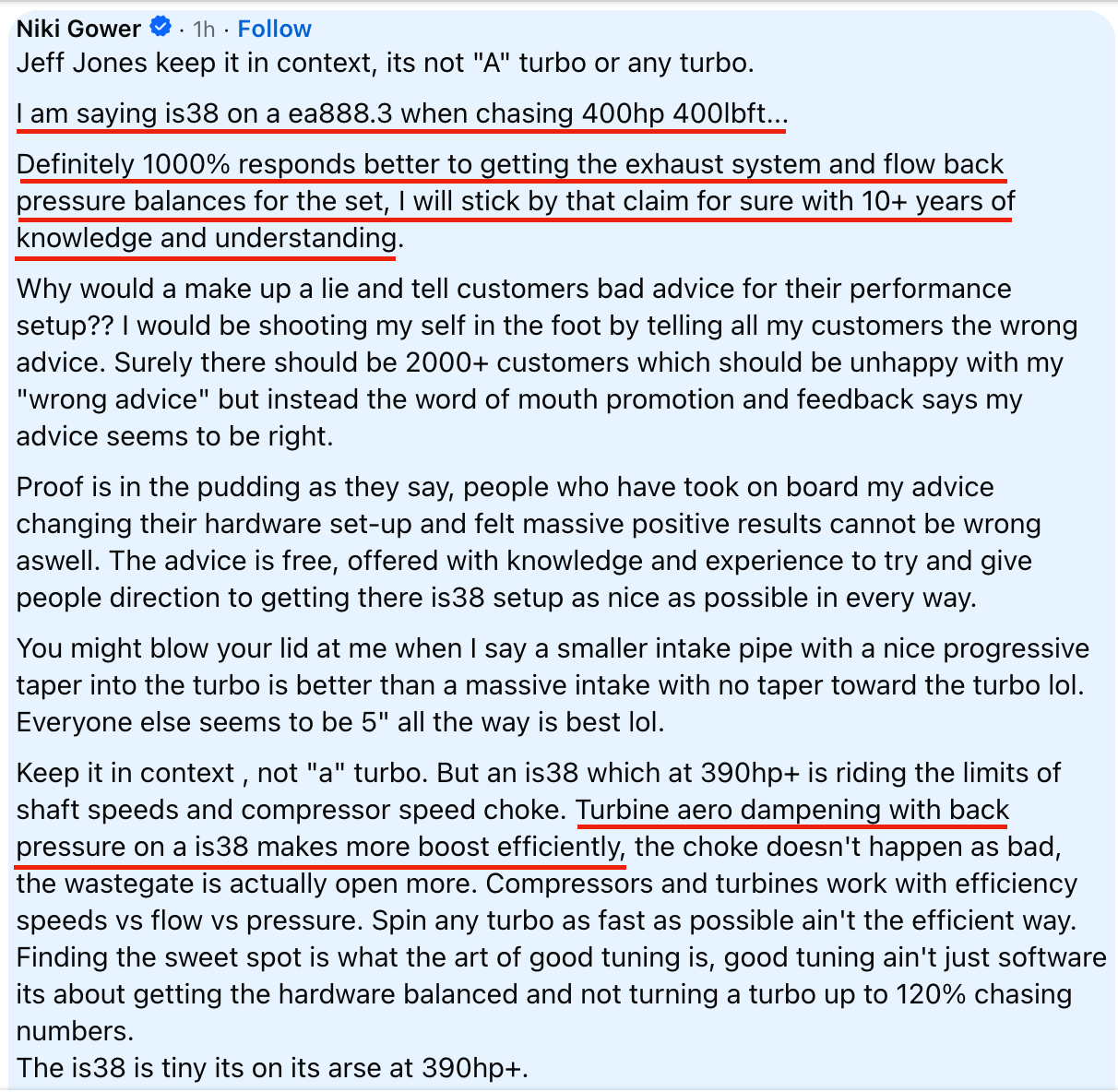
Point of concern:
- Keep it in context… I am saying IS38 on EA888.3 – (Does not resolve the contradiction)
- Definitely 1000% … 10+ years of knowledge – (This is an appeal to experience, not evidence, and doesn’t address the mechanism)
- Turbine aero dampening with back pressure … wastegate is actually open more – (This is produced by less backpressure, not more)
IS38 Only:
When challenged, the tuner attempted to narrow the claim by stating that the behavior was unique to the IS38 on the EA888.3 when targeting 400 hp / 400 lb‑ft.
Turbine physics do not change by turbo model, vehicle platform, or power level. No special case exists where added post‑turbine backpressure increases turbine efficiency or prevents overspeed.
The narrowing is rhetorical, not a technical explanation.
Shift of venue
Because Facebook is a poor medium for technical clarity, I emailed R‑Tech on August 26 to discuss my concerns about the information being provided. Given the expectation that a Blog Post would be made about this exchange, my objectives were to introduce accountability, clarity, and a written record.
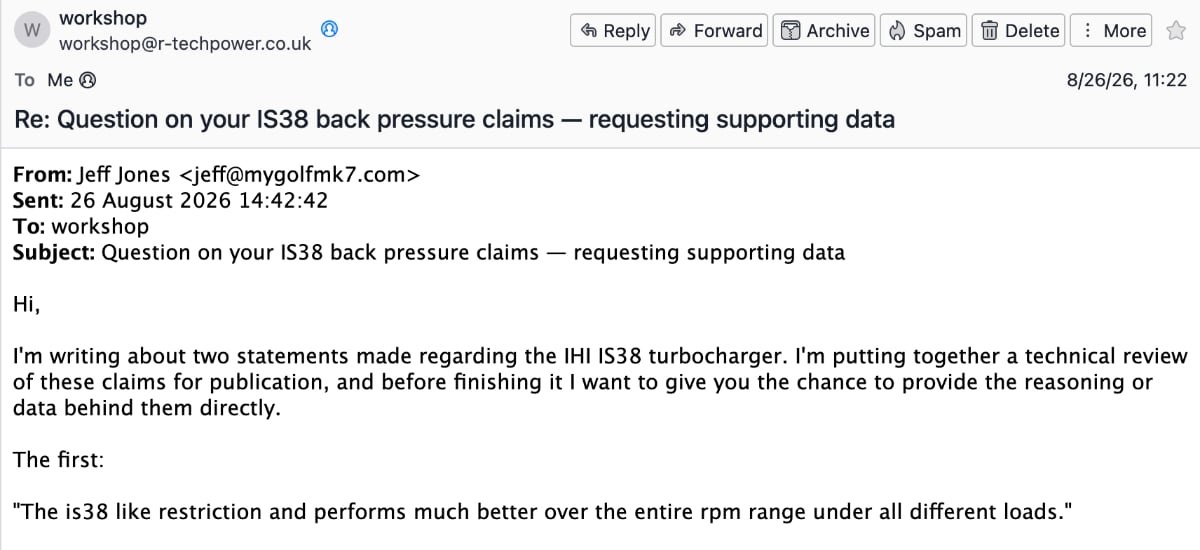
Briefly summarizing, the claims and my questions were:
- “The is38 like restriction and performs much better over the entire rpm range under all different loads.” – I’d like to understand the reasoning behind the claim that the IS38 “likes restriction.”
- “The only reason I recommend a resonator with a valved rear box is to dramatically reduce the risk… the failure rate with is38 was huge and all followed a common pattern linked to the exhaust. If it was a non valved rear box then its a different story and combination.” – What’s the actual failure rate? What did inspection of the failed units actually show?
On the same day, another person at R-Tech replied to my email and offered to have Niki speak with me if I provided my phone number. I replied the following day and asked to keep the discussion by email to ensure the facts were clear and easy to reference for this publication. I received a response on August 28 saying Niki did not have time to respond during the day but could do so after working hours.
By September 2nd, I had not heard from Niki Gower, so I sent a follow-up email inquiring if Niki intended to respond. As of the date of this publication, September 14, nobody has responded.
The Contrast
Notably, while I waited for a response to my questions, R-Tech posted on its R-Tech Performance Tuning Facebook Page, even discussing the subject of my questions.
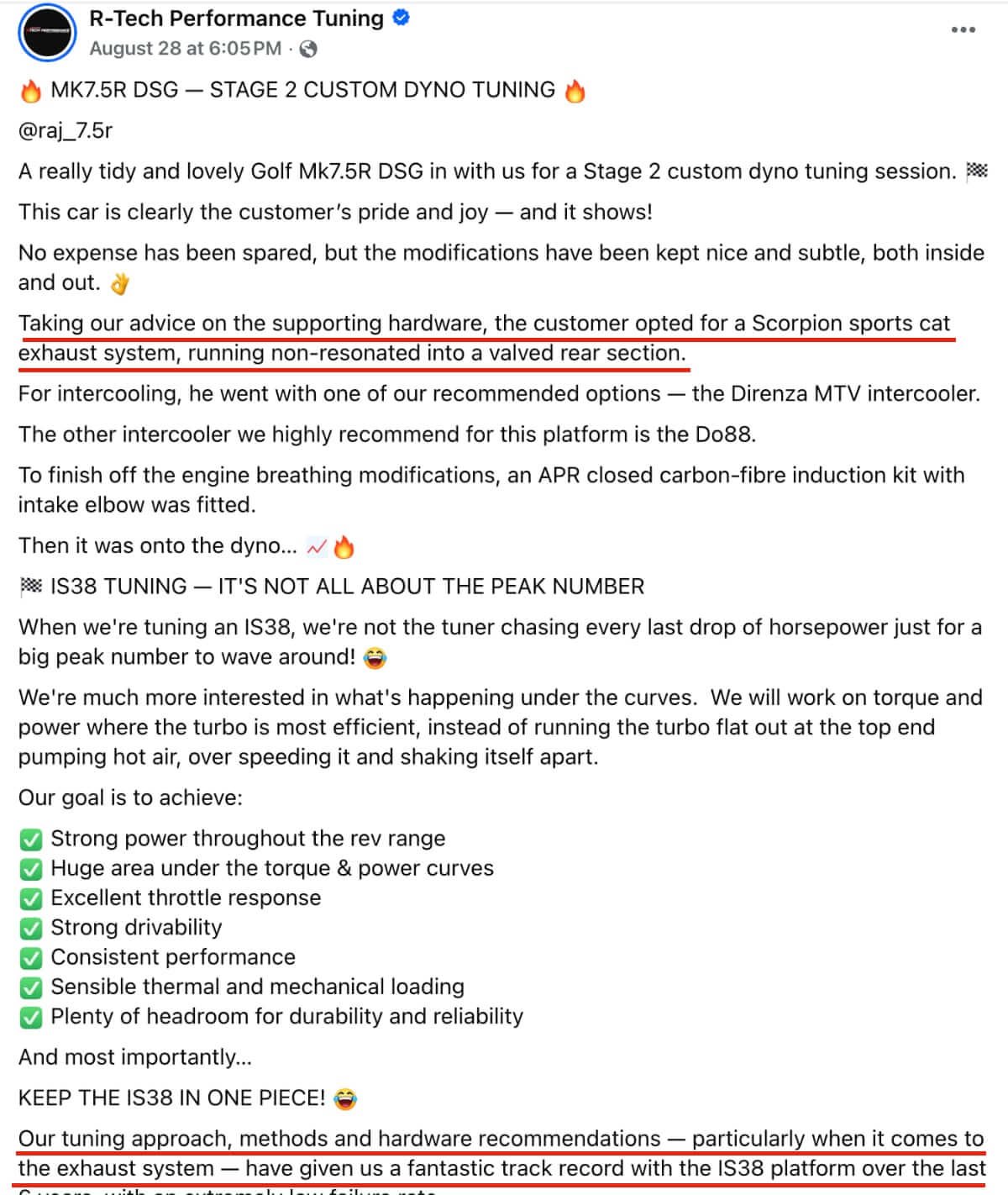
Between the time R-Tech responded to me on the 28th, saying, “Unfortunately Niki is tuning cars throughout the working day and doesn’t get time to respond to emails,” and today, as I write this, September 9th, R-Tech has made twenty-five posts (25) like the one above to its Facebook page.
| Date | Event | R-Tech Activity |
|---|---|---|
| Aug 26 | Inquiry Sent | Facebook Posts |
| Aug 28 | Niki is too busy to write | More FB Posts |
| Aug 29 – Sept 2 | No response | More FB Posts |
| Sep 9 | Still no response | Continues posting tuning writeups (25 since Aug 28) |
The issue isn’t time availability—it is selective non‑response. I offered to work entirely around his schedule and asked only that the format stay written, since none of what I’m asking for requires real-time conversation. I also sent a closing check-in: Is a written reply coming or not? Either answer is fine, and I’ll proceed with the write-up either way. That went unanswered too.
How misinformation spreads
While waiting for a reply, consumers began repeating the misinformation; my first point about misinformation propagation.
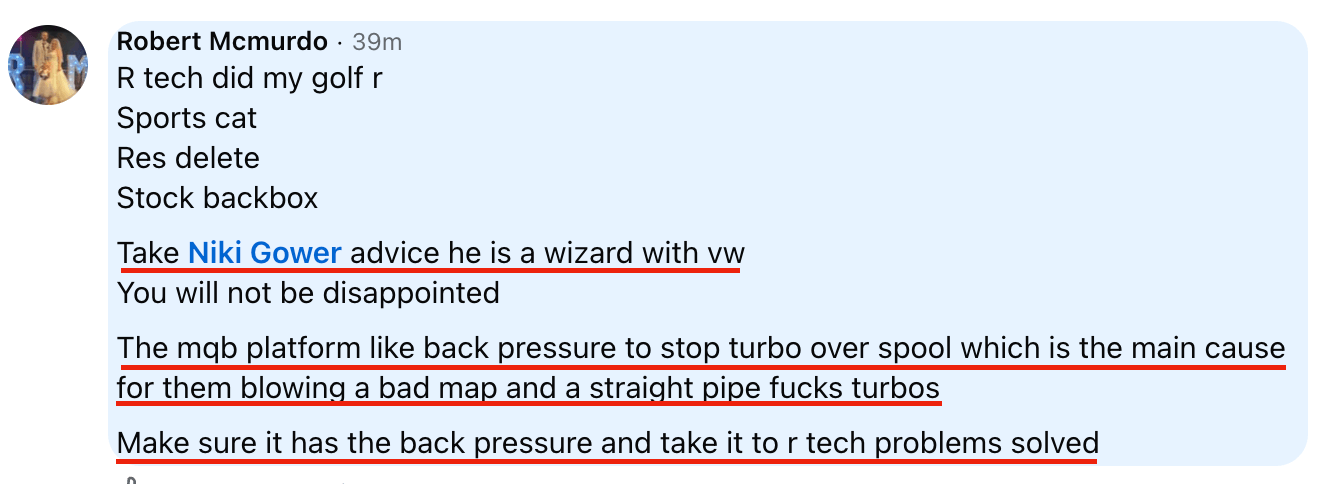

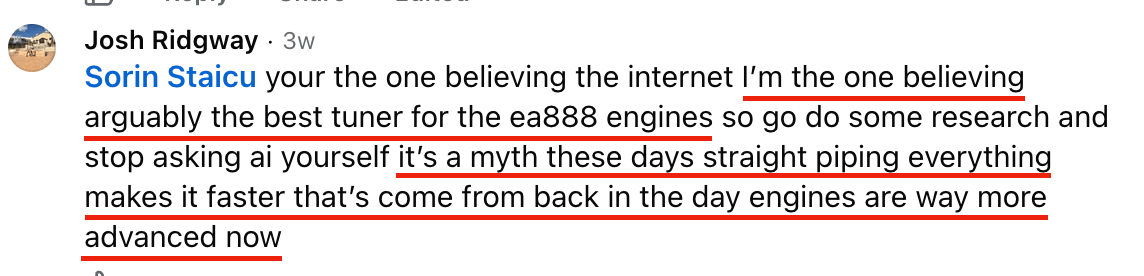

Here’s an example of how a tuner made authoritative claims that became community folklore, even though they contradicted turbine physics and lacked evidence.
Why This Matters
These incorrect beliefs about backpressure being offered as advice can lead to:
- Poor exhaust choices
- Misdiagnosed turbo failures
- False confidence in an exhaust’s “protective restriction”
When a tuner misunderstands fundamental physics, their recommendations and the community’s ‘consensus‘ can drift far from reality.
Evidence over authority
In the responses, many people urged Brennan to trust authority over evidence. My second point: Appeals to authority.
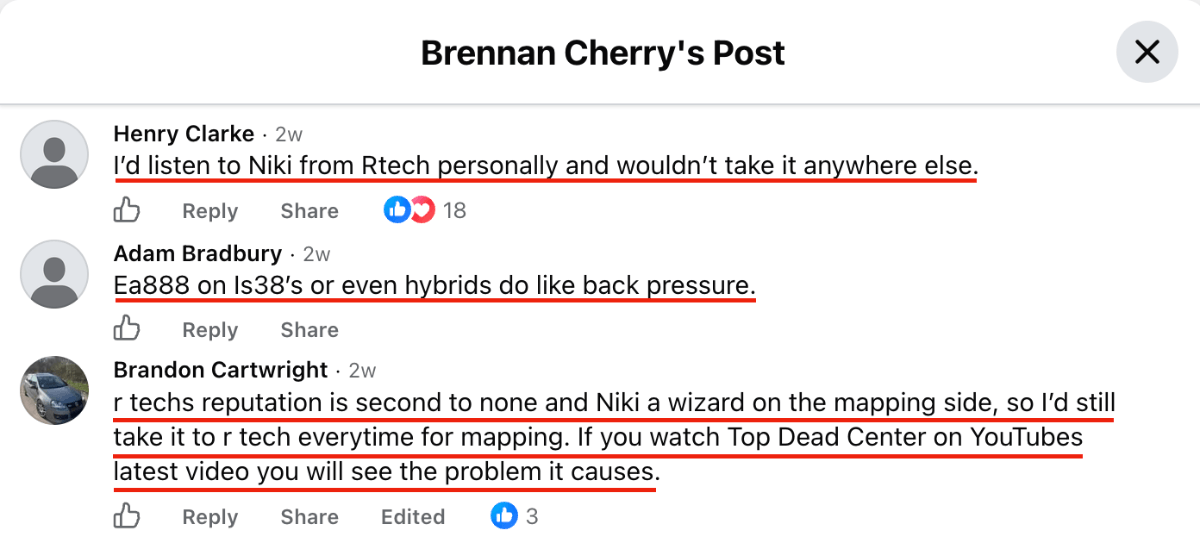
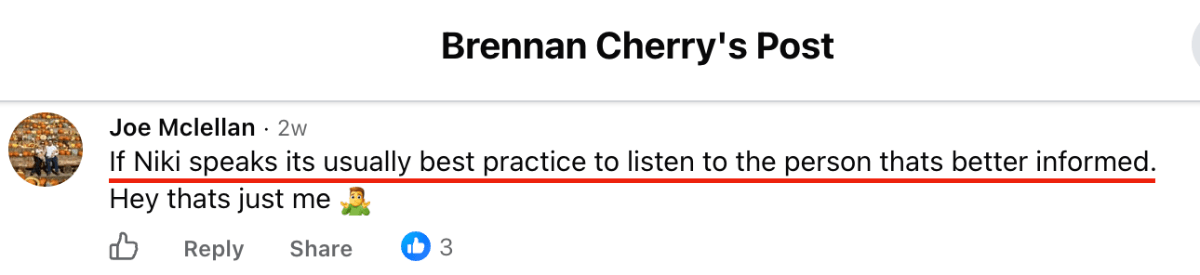
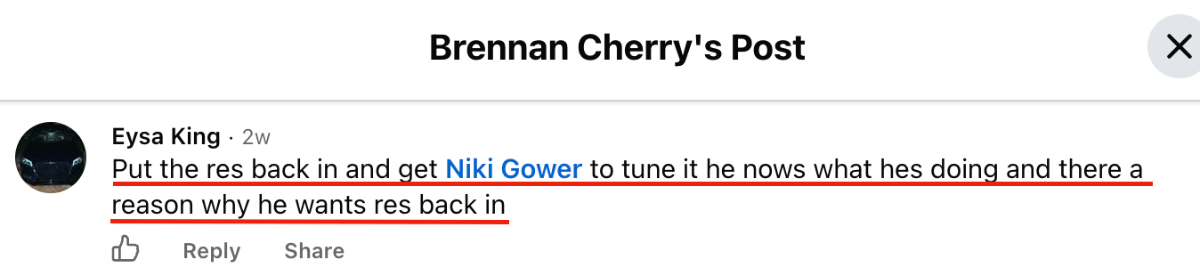
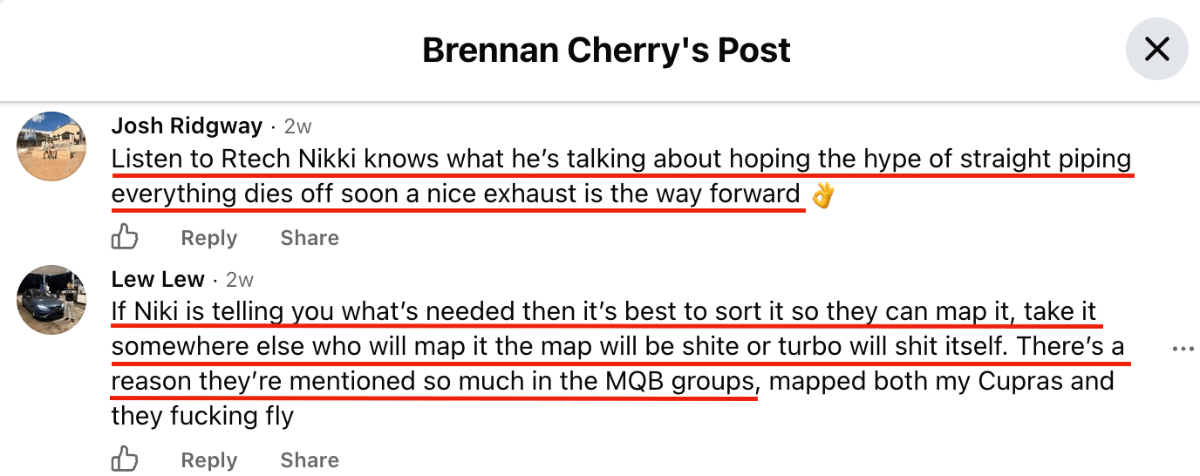
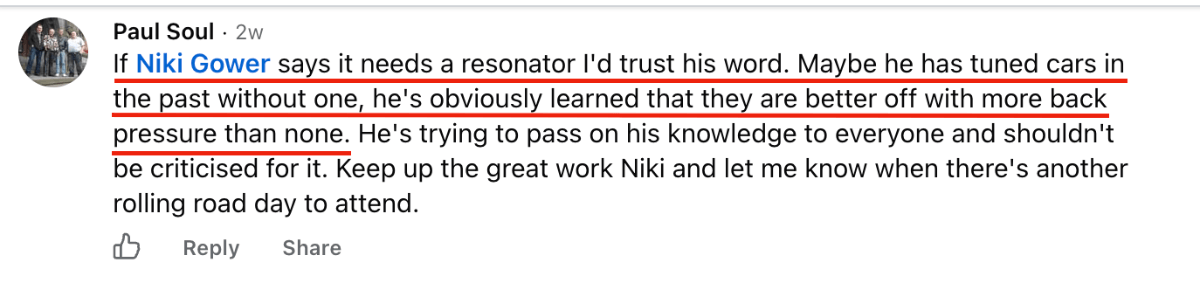

Unfortunately, “my tuner said so” is not a valid argument.
Conclusion:
After two weeks, the technical questions remain unanswered. The tuner’s claims still contradict turbine physics. And the community continues repeating misinformation rooted in authority rather than evidence.
The lesson is simple: expertise must be demonstrated, not assumed.
Mk7 owners deserve accurate, evidence‑based information — not fear‑driven recommendations or physics‑defying explanations.
This site’s aim remains the same: to publish clear, technically grounded analysis that helps owners make informed decisions.
Backpressure Discussions:
The following videos explain the role of exhaust backpressure in turbocharger operations:
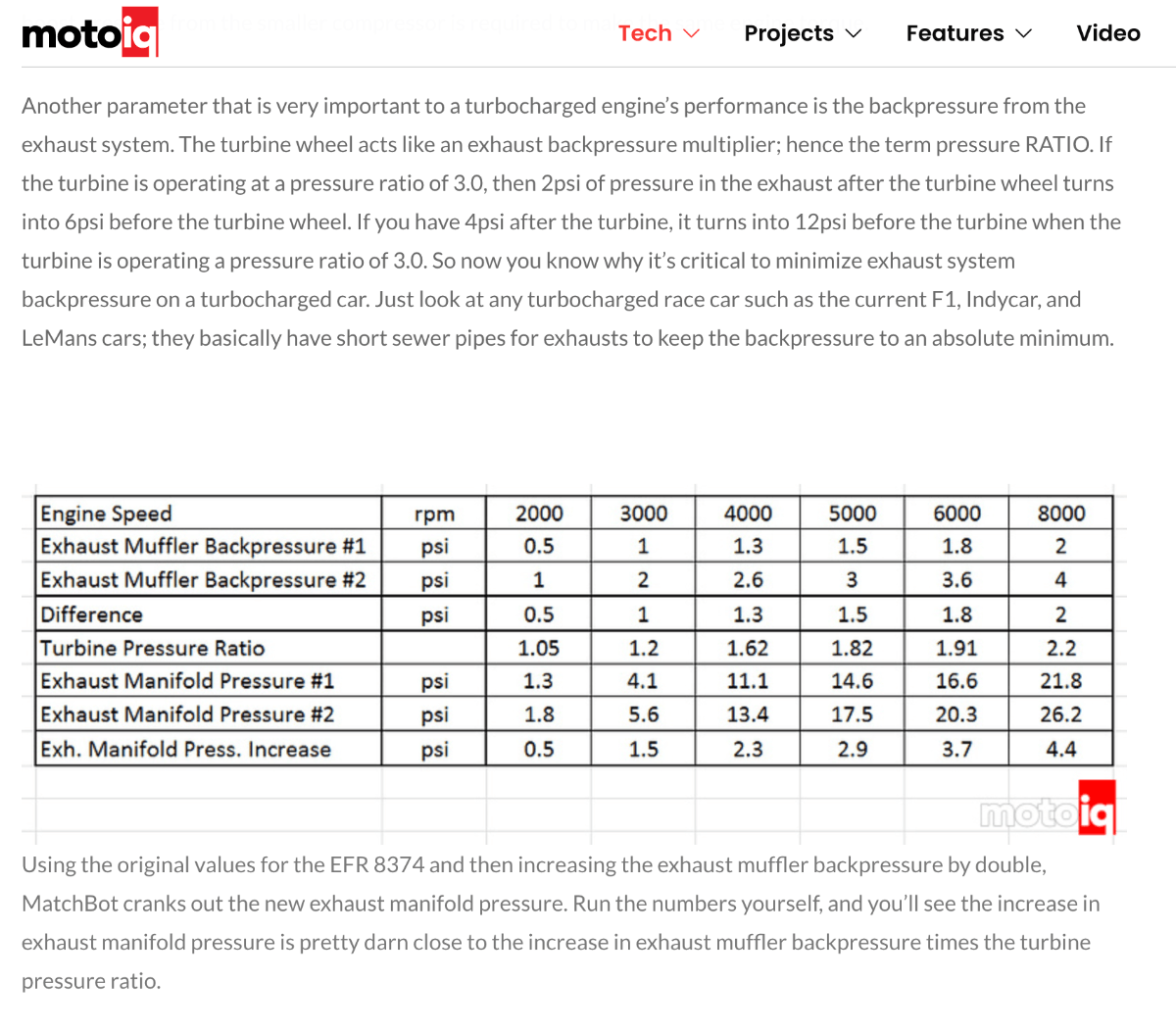
The following is an excerpt from an article at MotoIQ.com
Hi Jeff,
I had a similar online discussion about the 1hdfte landcruiser engine. The forum member was convinced that ‘an aftermarket 3″ exhaust is worse for the turbo than the standard 2.5″, as the increased volume of air in the 3″ system means it creates more back pressure hence less power’. In addition ‘the decreased flow velocity of exhaust gas in the 3″ system then creates more inertia then the faster moving factory 2.5″ system, so even more turbo lag’. In today’s society there is a documented increasing lack of (a) basic scientific knowledge (b) an ability to critically think. Keep on fighting for physics and logic though.