

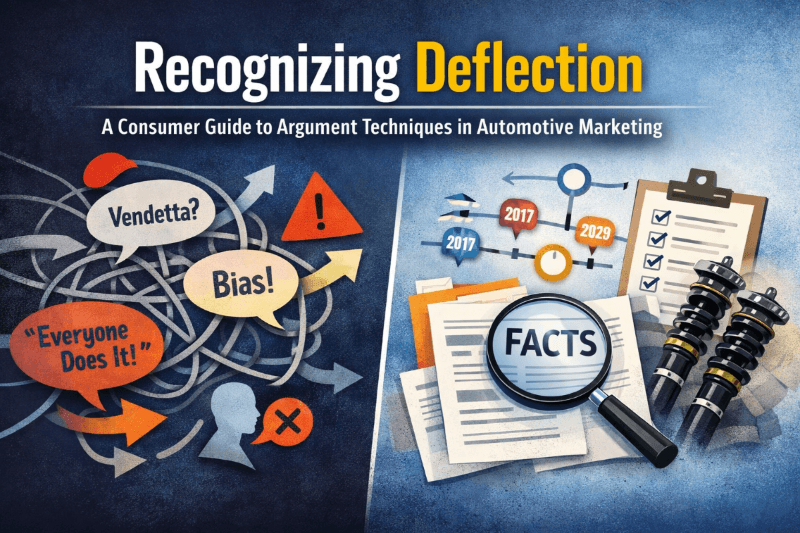
Consumers in the MQB community deserve clear, accurate information, not misinformation, when comparing aftermarket parts. But sometimes, when you raise factual questions about product origins, timelines, or similarities, the conversation gets derailed—not by evidence, but by rhetorical techniques that obscure the issue.
This post uses guidance from the Debunking Handbook to help readers recognize these techniques. The goal is to equip consumers with tools to understand and navigate misleading argument styles.

The Context:
The original post presented three straightforward facts about the Silver’s NEOMAX coilovers:
- Silver’s NEOMAX coilovers for the Mk7 platform were released in 2017
- EQT’s Balanced Line coilovers were launched publicly in 2019
- The two products share clear visual and structural similarities
These facts help MQB owners understand the timeline, origin, and context of the products they’re comparing.
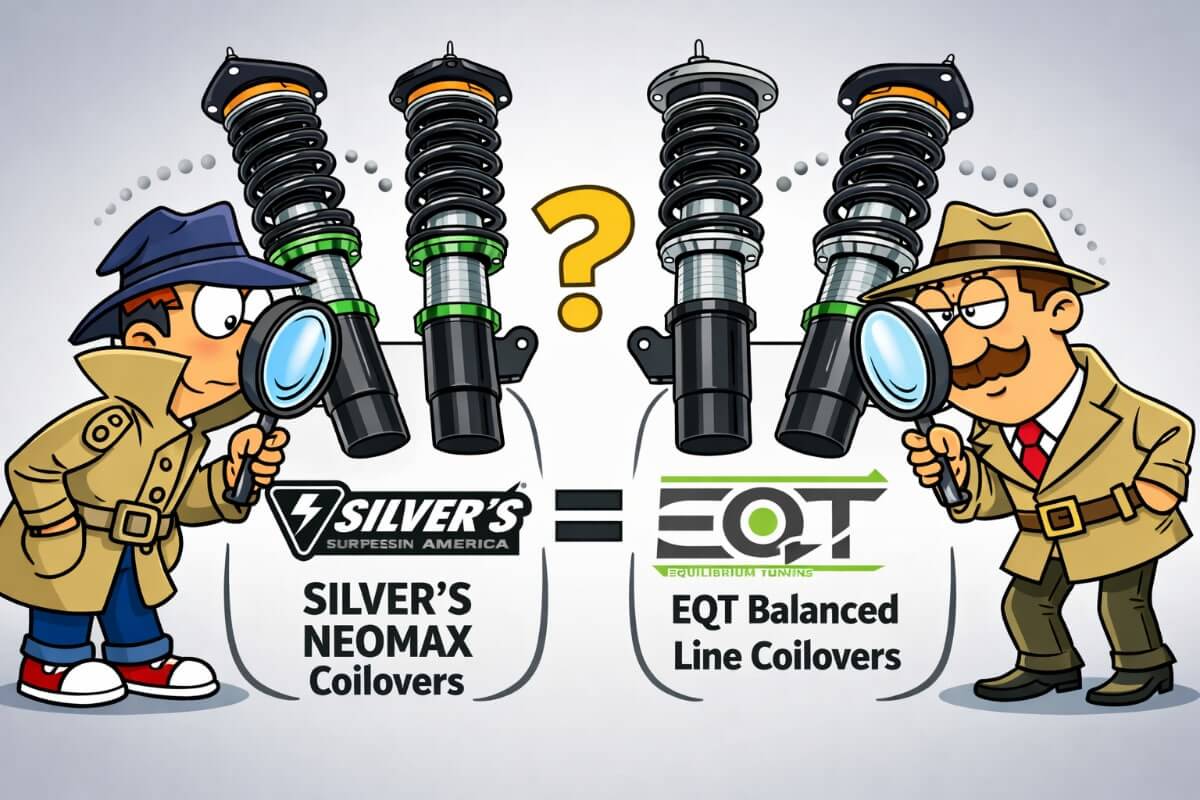
When this information was presented to consumers, rather than addressing those facts directly, EQT’s owner, Ed Susman, responded with a series of rhetorical moves that shifted the conversation away from the evidence.
How the Debunking Handbook Helps
The Debunking Handbook identifies several common techniques used to deflect or obscure factual information.
Misinformation often spreads not through false facts, but through misleading rhetorical techniques. The exchange with Ed demonstrates several common ones.
Below are the key techniques, each illustrated with examples from the conversation.
Technique 1: Reframe the Question as a Personal Attack
What it looks like: Before addressing any evidence, frame the entire discussion as motivated by personal grievance rather than factual inquiry. (Ad Hominem fallacy)
The example: The response to the coilover comparison began: “This is yet another episode in a saga of attempts to bad mouth and discredit EQT.” – Ed Susman

Why it’s a deflection: This framing asks readers to evaluate the questioner’s motives rather than the evidence. It works by substituting a character judgment for a factual response. Notice what it does not do: address the timeline, the specification comparisons, the warranty language, or any other documented element of the analysis.
The Debunking Handbook identifies this as a technique that exploits a well-documented cognitive tendency — when people distrust the source of information, they discount the information itself. Attacking the messenger is not a counter-argument. It is an invitation to stop evaluating the evidence.
Technique 2: Appeal to Common Practice
What it looks like: Acknowledge that the described behavior exists, but argue that because it is widespread, it cannot be problematic.
The example: “Private labeling is very common in the industry and nobody else is pressured to reveal exactly which factory/manufacturer makes each specific part.” – Ed Susman

Why it’s a deflection: Common practice does not establish an ethical or legal standard. The question was never whether private labeling is common — it is, and the blog post made that explicit. The question was whether the specific marketing language accurately represents the product’s origin to consumers. Pointing to industry norms does not answer that question.
When you see “everyone does it,” ask: does everyone do this specific thing — and if so, does that make it accurate?
Technique 3: Selective Engagement
What it looks like: Respond to the weakest or most peripheral elements of an analysis while leaving the strongest evidence entirely unaddressed.
The example: Across multiple responses, the exchange addressed white-labeling in general, compared EQT to APR and Fortune Auto, and questioned the motives behind the analysis. What was never addressed: the warranty statement that reproduces Silver’s language verbatim, including Silver’s effective date, the identical technical specifications, the verbatim quality control language describing a manufacturing facility EQT does not possess, and the Mk8 Golf R reference that was added retroactively to a product already on the market for years.


Why it matters: The strength of an argument is determined by its weakest point. When a respondent consistently engages peripheral points while leaving the core evidence untouched, that pattern is itself informative. The Debunking Handbook describes this as a characteristic technique of motivated reasoning — address what can be addressed, ignore what cannot.
When evaluating a response to documented evidence, check what was addressed and what was not. The omissions are often more revealing than the responses.
Technique 4: The Straw Man
What it looks like: Substitute a different, easier-to-answer question for the one actually being asked, then answer the substitute question.
The example: “Again, show us any other company that specifically states that their white labeled product is not their own and specifies exactly where that product is manufactured.” – Ed Susman
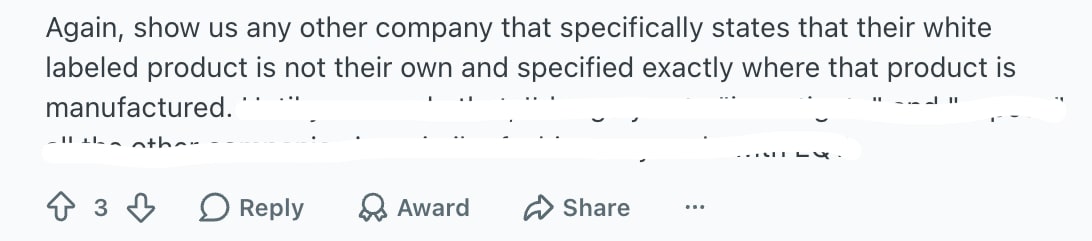
Why it’s a deflection: Nobody asked for that. The question was whether EQT’s marketing language — specifically phrases like “developed and torture tested on our own Golf R” and the About Us claim that their “R&D department continues to design and manufacture lots of in-house hardware” — accurately represents a product whose underlying platform Silver’s had already released years earlier. The straw man response addresses a fabricated version of the question that is far easier to answer than the actual one.
When a response answers a question you didn’t ask, identify the question that actually was asked and return to it.
Other Techniques Worth Noting
The four techniques above are the ones this exchange illustrated most clearly, but they were not the only ones present. Also appearing in this exchange were the unsubstantiated counterclaim — asserting the opposite of a documented fact without providing supporting evidence (“we have always been transparent about the source”) — and whataboutism, the repeated redirection to other companies, such as APR and Fortune Auto, as a substitute for addressing the evidence at hand. Both techniques follow the same structural logic as those discussed above: redirect attention, avoid the evidence.
Rhetorical Strength vs. Evidentiary Strength
One of the most important lessons from this exchange is that Ed’s arguments are rhetorically strong but evidentially weak. This distinction matters because rhetorical strength is highly effective on social media — where speed, confidence, and emotional framing often outweigh facts — but rhetorical strength does not survive close examination.
Understanding the difference helps consumers recognize when they’re being persuaded by style rather than substance.
The Debunking Handbook explains that misinformation spreads most effectively when it:
- Feels intuitive
- Triggers emotion
- Uses simple narratives
- Attacks motives instead of evidence
- Creates social alignment (“everyone knows this”)
Ed’s responses check every one of these boxes.
For example:
This reframes the discussion as a personal vendetta — a simple, emotionally charged narrative — rather than a factual analysis of the product’s history.
Or
Ed Susman – Rhetorical Technique
The original claim never required disclosure of the manufacturer. This response reframes the issue by substituting an easier question — whether EQT should name its supplier — for the actual question: whether EQT’s marketing creates a misleading impression about development. Reframing works because it lets the responder answer the question they prefer rather than the one asked.
These tactics are high‑impact in a fast‑moving comment thread, where readers skim and react emotionally.
But they are low‑impact under scrutiny, because they do not address the evidence.
What These Techniques Have in Common
Each of the techniques above shares a structural feature: they redirect attention away from documented evidence and toward something else — motives, industry norms, easier questions, unsupported assertions, or peripheral issues. None of them produce new evidence that addresses the original analysis.
The coilover comparison that prompted this exchange is documented at the link below. The timeline, specification comparisons, and warranty language are primary sources. Readers can evaluate them directly.
This post is part of an ongoing series examining advertising claims and consumer transparency in the VW/Audi aftermarket.