

Background:
In enthusiast groups, technical claims may appear authoritative because they’re delivered confidently.

But confidence is not evidence, and social media is an environment where a vendor can make engineering statements without ever being required to prove them.
The recent behavior of Ed Susman, the owner of EQT, shows how social media can allow unsupported technical claims to mislead consumers and disadvantage honest businesses.
Unsupported Claims:
A consumer asked a straightforward question about a turbocharger they were interested in.
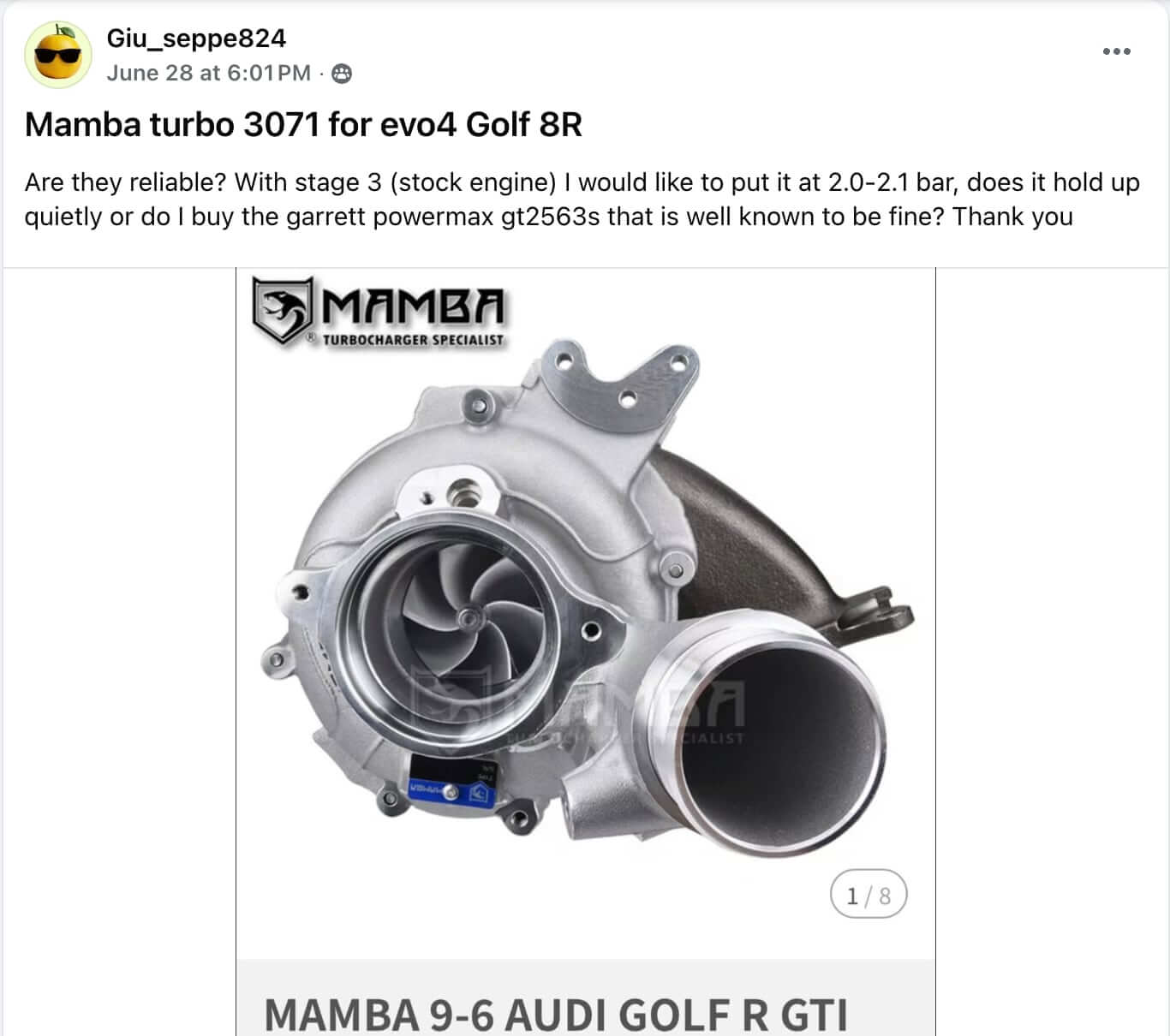
Instead of providing data or responding to follow‑up questions, Ed made multiple objective claims about spool behavior, durability, and comparative performance—then ignored every request for substantiation.
Claim Example #1:
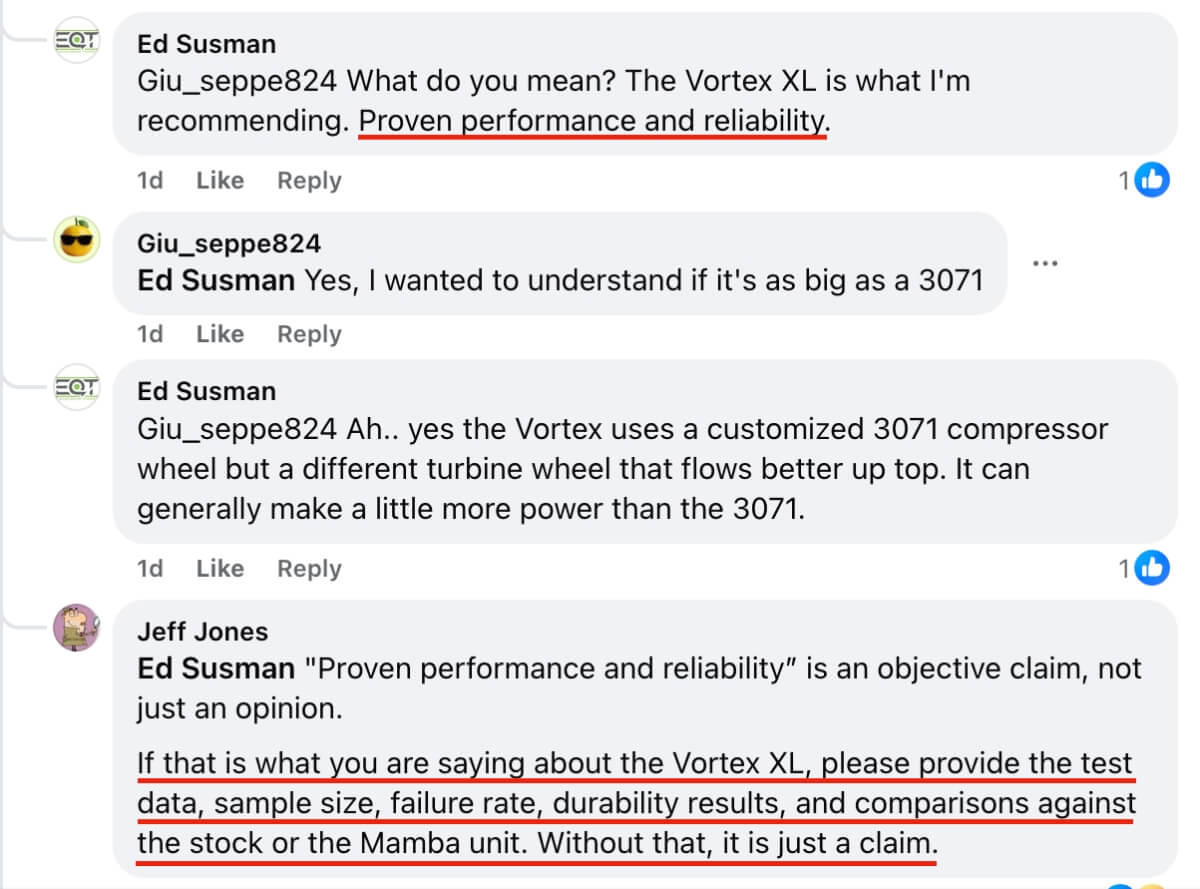
I asked Ed to provide the test data, sample size, failure rate, durability results, and comparisons against the stock or the Mamba unit to support his statement. He did not respond.
Claim Example #2:
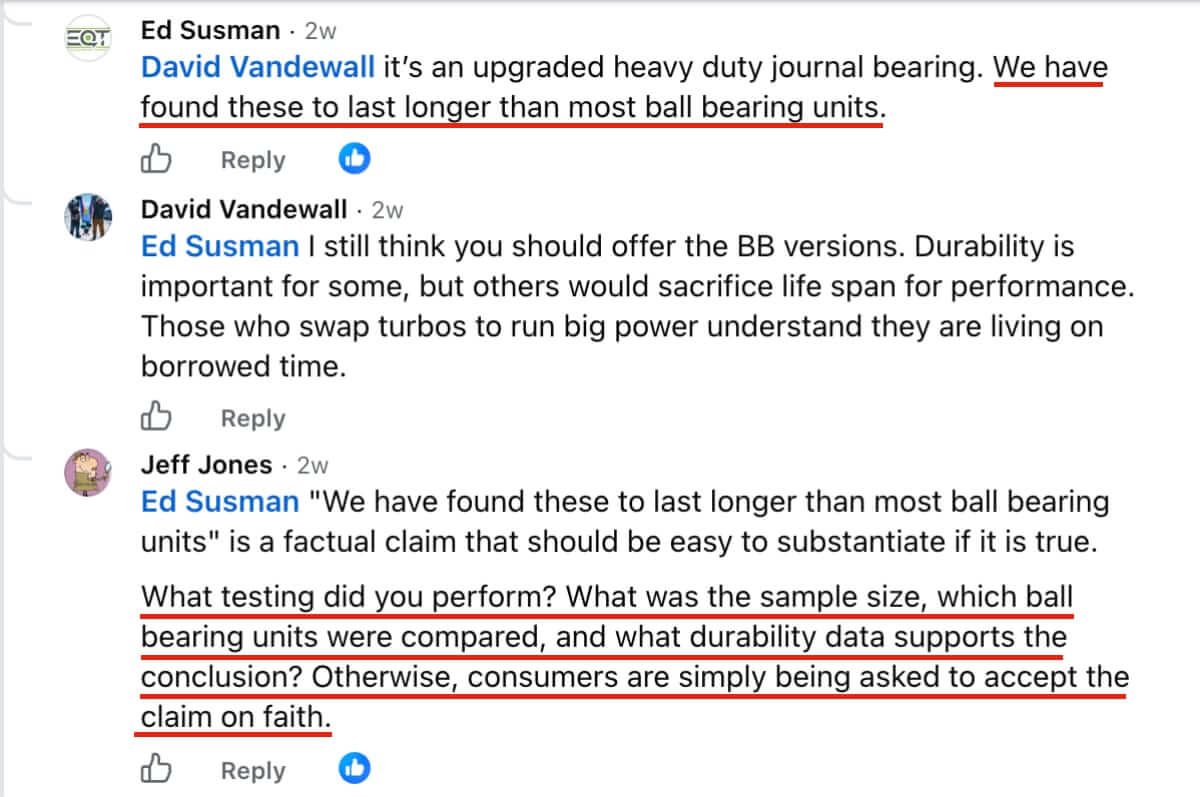
I asked what testing was performed, what the sample size was, which ball bearing units were compared, and what durability data supported the conclusion. He did not respond.
Claim Example #3:
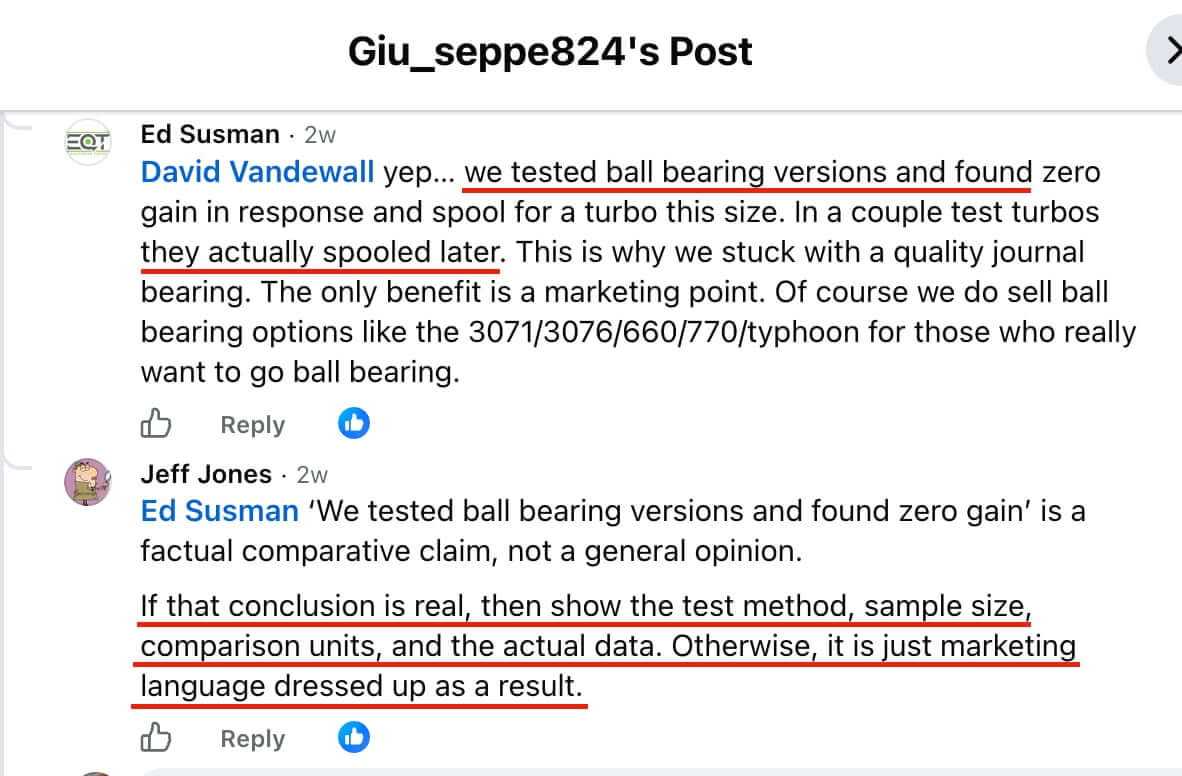
I asked for the test method, sample size, comparison units, and the actual data behind the conclusion. He did not respond.
Claim Example #4:
I asked what turbochargers were compared, what test methodology was used, what vehicles and supporting hardware were involved, and what data led to the conclusion. He did not respond, and another reader in the thread noted the same pattern.
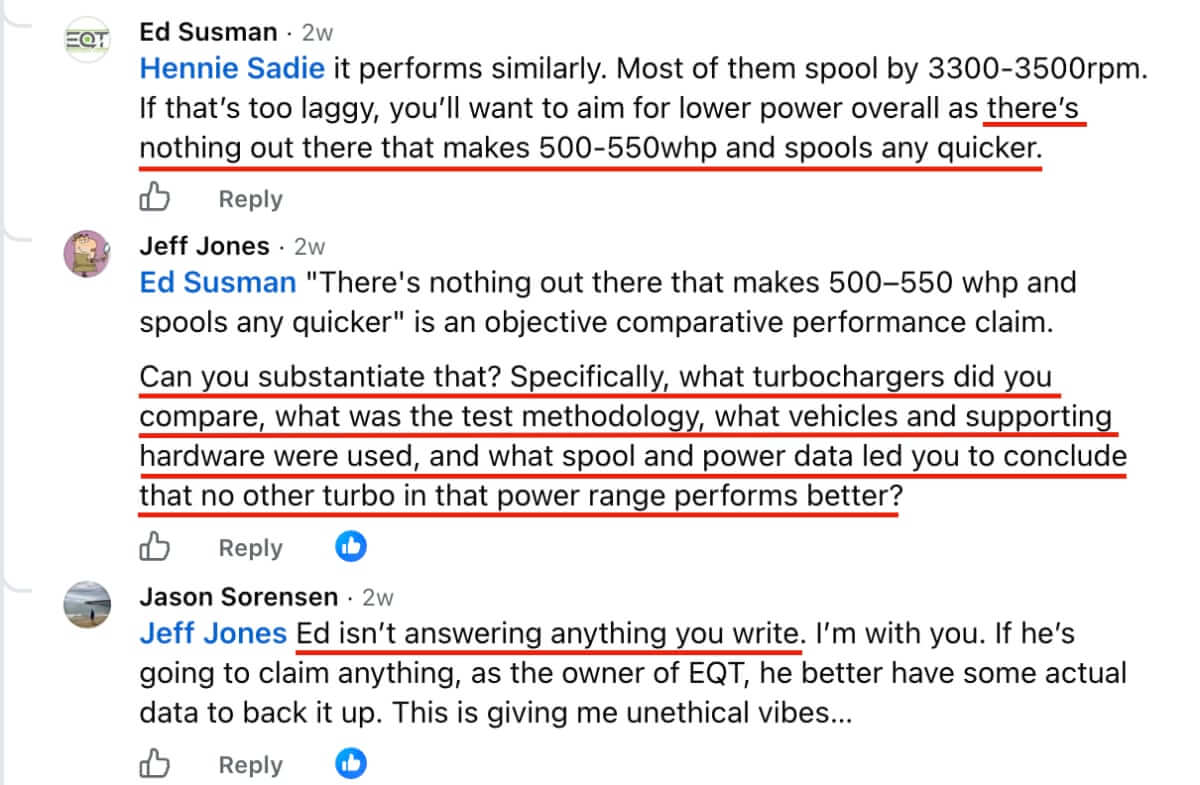
Each example is a specific, falsifiable claim: a reliability claim against “most ball bearing units,” a performance claim against every other turbo in a stated power band, and a durability claim about a product Susman sells as a reseller rather than manufactures.

Claims at that level of specificity are exactly the kind that should be backed by test data, and are the kind I expect a seller to produce if the data existed.
The Standard Elsewhere:
Social media makes this kind of exchange easy to get away with, but it isn’t the only place it happens. Previously, I emailed EQT directly with the same kind of specific questions about the basis for their claims and received no response. Later on social media, Ed Susman confirmed why:
“We received your e-mail, we had a good laugh, and we deleted it. We don’t recognize you as any sort of authority on the matter and as such didn’t feel compelled to respond to your e-mail full of demands.”
Ed Susman – Owner of Equilibrium Tuning
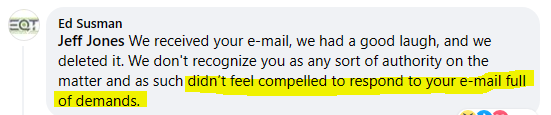
The email asked specific questions about the basis for EQT’s claims — it did not contain demands. That response shows that the lack of substantiation isn’t a function of the platform; it’s a choice made the same way whether the request arrives in a comment thread or in a direct email.
In my own career, I’ve worked with OEM suppliers in the aviation industry, including Boeing, Lockheed Martin, Northrop Grumman, Raytheon, and others, none of whom would accept an anecdote or an unsupported assertion in place of controlled test data, sample sizes, and documented validation.
A reliability or comparative performance claim gets substantiated before it’s presented as fact, not after someone challenges it.

The FTC’s standard for advertising claims is built on the same principle: a business making an objective, measurable claim needs a reasonable basis for it when the claim is made.
In my opinion, statements like “proven performance and reliability” or “we have found these to last longer than most ball bearing units,” made with no data offered on request, are the kind of claim that the standard exists to address. I’m not a regulator (I’ve operated within the Federal Acquisition Regulations framework), and this isn’t a finding — it’s my assessment of the gap between what was claimed and what was substantiated when asked.
On social media, unsupported statements can impact readers without review, oversight, or any requirement to answer questions. A salesman like Ed Susman can promote his products, disparage competitors, and avoid scrutiny simply by ignoring requests for proof.
Consumer Harm:
This kind of exchange influences purchase decisions based on how confidently something is stated rather than on what data supports it.

It also puts transparent businesses — the ones that publish test results and back up their claims — at a disadvantage. They’re competing against vendors who face no requirement to substantiate what they say and can simply not respond when asked.
Core Issue:
In my view, that’s the core problem: Ed’s claims were made in a setting where substantiation wasn’t required before reaching a consumer.
The same statements, made to an OEM procurement or engineering team, would need supporting data before anyone acted on them.

Whether they’d survive a formal FTC inquiry isn’t something I can say with certainty, but the gap between “documented and tested” and “stated with confidence” is the same gap either way, and it’s worth consumers knowing that gap exists before they rely on a claim like this.
Consumers Deserve Better:
Consumers deserve evidence-based guidance, not marketing framed as expertise. Businesses that act transparently deserve a marketplace where honesty is not a competitive disadvantage.
Not An Isolated Incident:
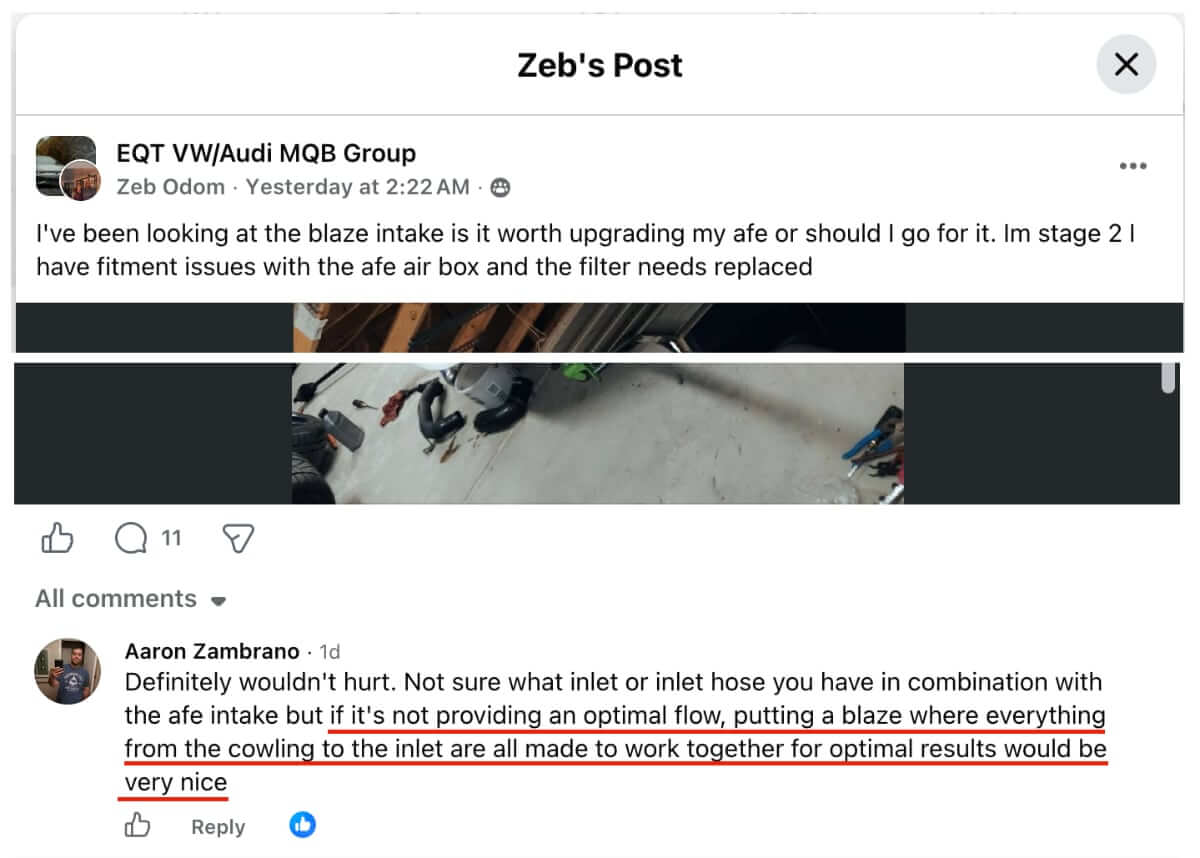
Another recent exchange in the EQT Facebook group shows the same pattern. A consumer asked whether upgrading from an AFE intake to the Blaze intake would be worthwhile, and the response came immediately.
putting a blaze where everything from the cowling to the inlet are all made to work together for optimal results would be very nice.
Aaron Zambrano – Equilibrium Tuning Representative
The EQT representative immediately claimed that the Blaze intake provides optimal performance because its components are made to work together for optimal results.
Optimal – best; most likely to bring success or advantage
This is an objective comparative claim presented as fact, yet it is directly contradicted by measured data.
A test that reverses the Blaze filter orientation yields a measurable improvement, disproving the idea that the existing design already achieves “optimal” flow.
This is the more general problem: in social media groups, unsupported statements often go unchallenged. When consumers accept these claims without scrutiny, vendors face no pressure to provide evidence.