
Background:
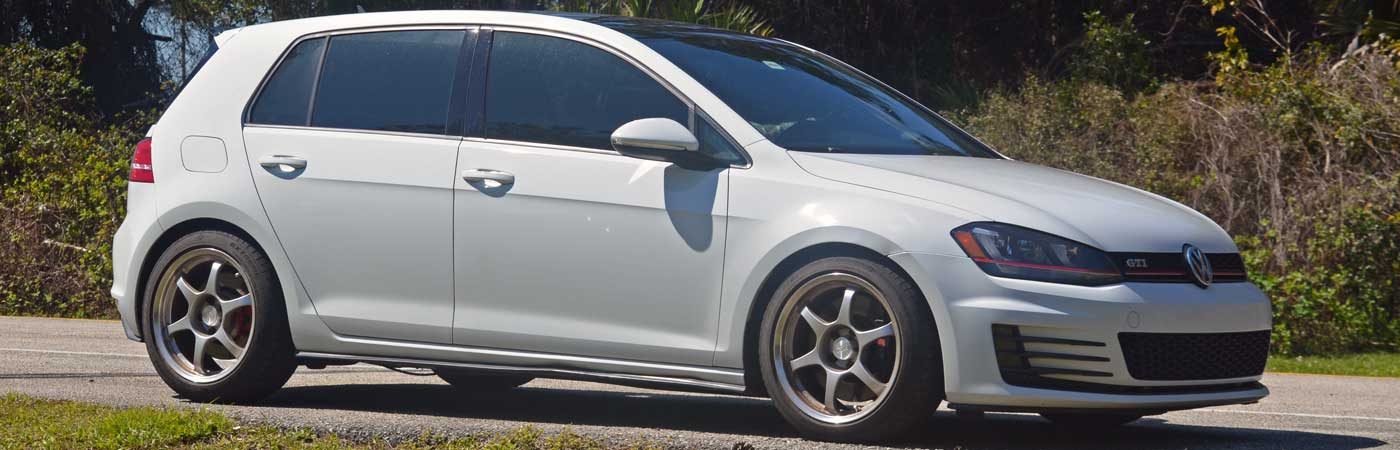
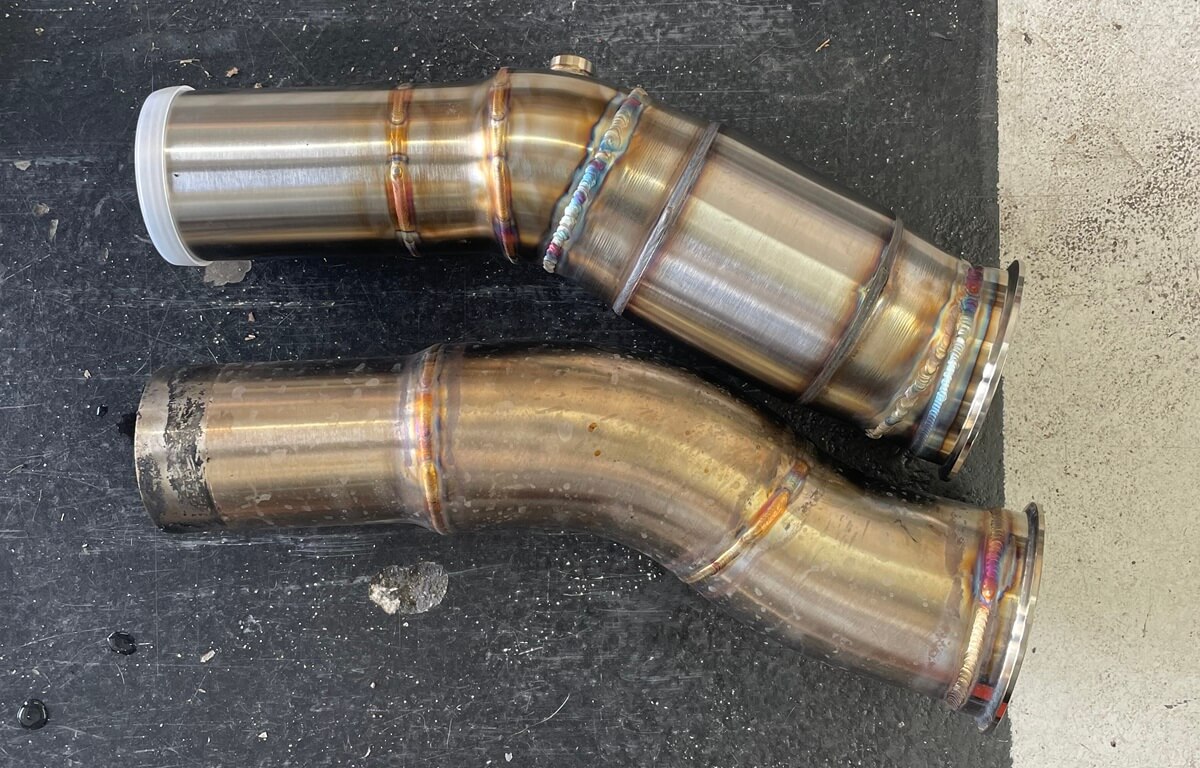
I previously discussed the CC Design exhaust midpipe with GESi cat as part of an audio analysis. In this post, I compare turbocharger and vehicle performance data between the catless and GESi catted versions of the midpipe.
Test Process:
A series of full-throttle third-gear pulls are made from 2,500 to 6,500 RPM.
Test Results:
Data Quality and Environmental Consistency
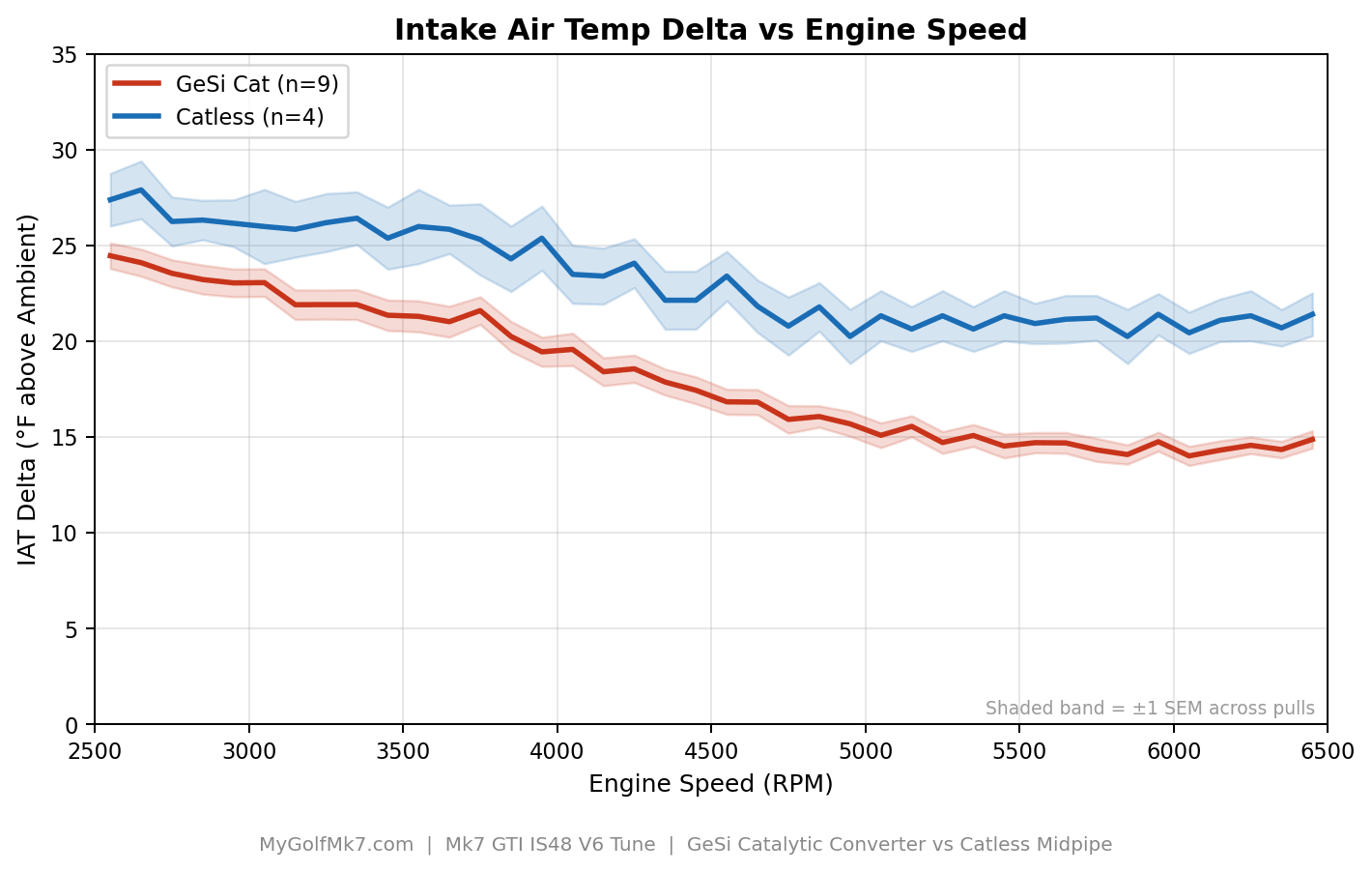
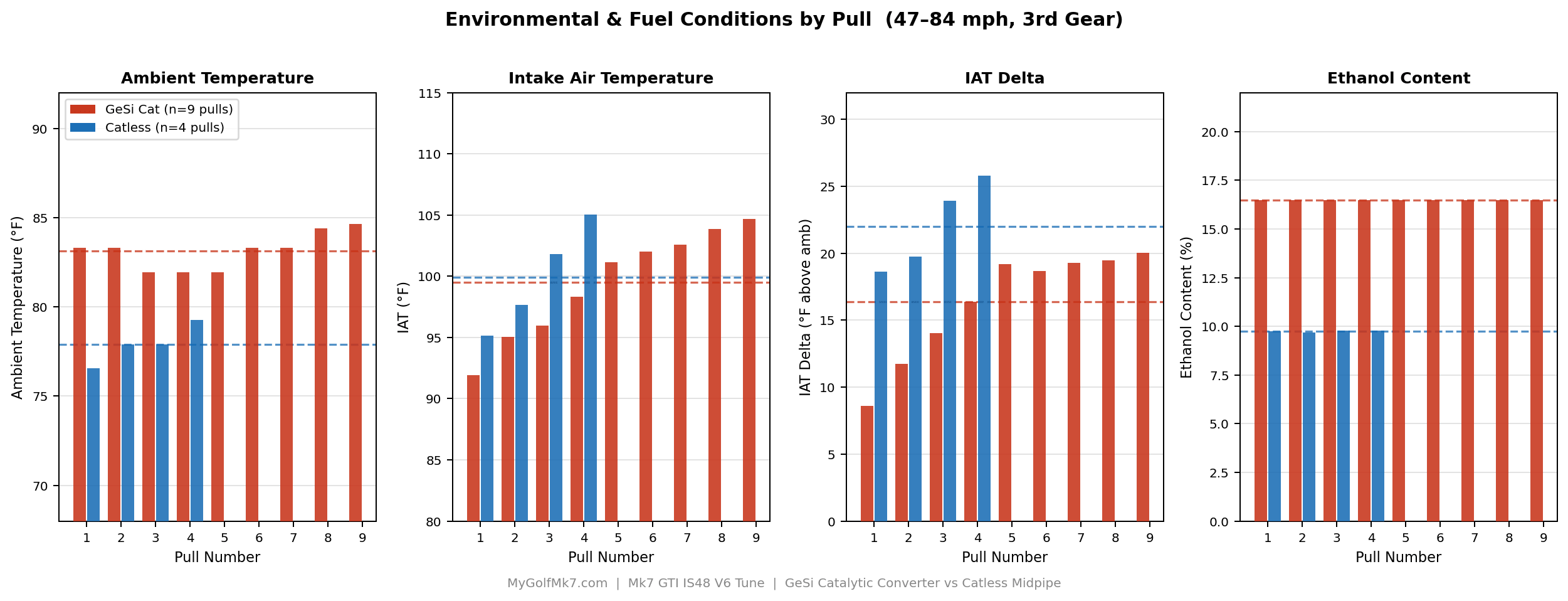
Ambient temperature during the GESi sessions was 82–85°F, while the catless sessions were 76–79°F — a mean difference of +5.2°F. This means catless had a small advantage in intake air density. Despite this, IAT absolute values are statistically indistinguishable (99.6°F vs 100.0°F), but IAT delta above ambient is 5.7°F higher in the catless configuration (shown below).
Ethanol content:
The GESi sessions used fuel with 16.5% ethanol, while the catless sessions used fuel with 9.75% ethanol — a 6.75 percentage-point difference. This is a meaningful difference for the timing retard and ignition timing results.
Pulls:
Pull counts: 9 GESi pulls vs. 4 catless pulls. The catless dataset is undersized for high-power statistical comparisons, but effect sizes on the primary variables (WGDC, timing retard) are large enough that significance is clear regardless.
Wastegate Duty Cycle:
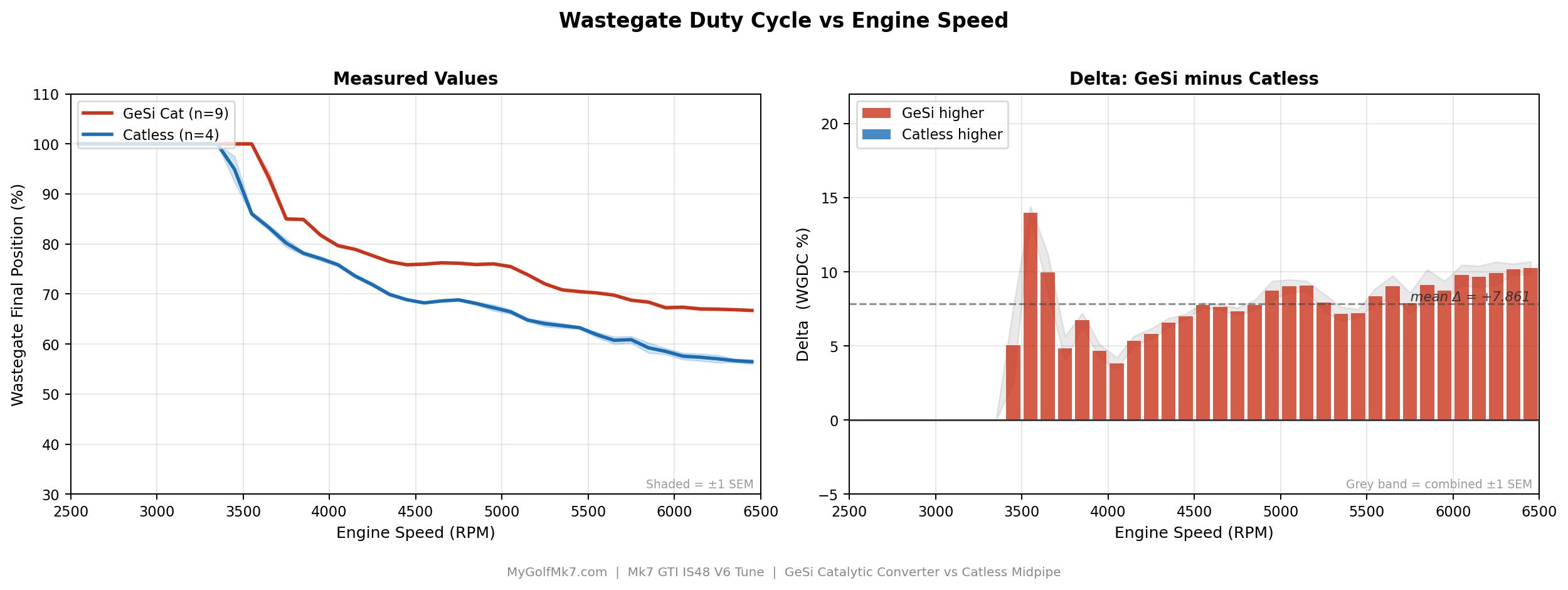
On average, the WGDC at 6500 RPM is +7.9% higher with the GESi cat installed (74.8% vs 67.0%). This is the expected result of adding a catalytic converter to the exhaust path.
Ignition Timing
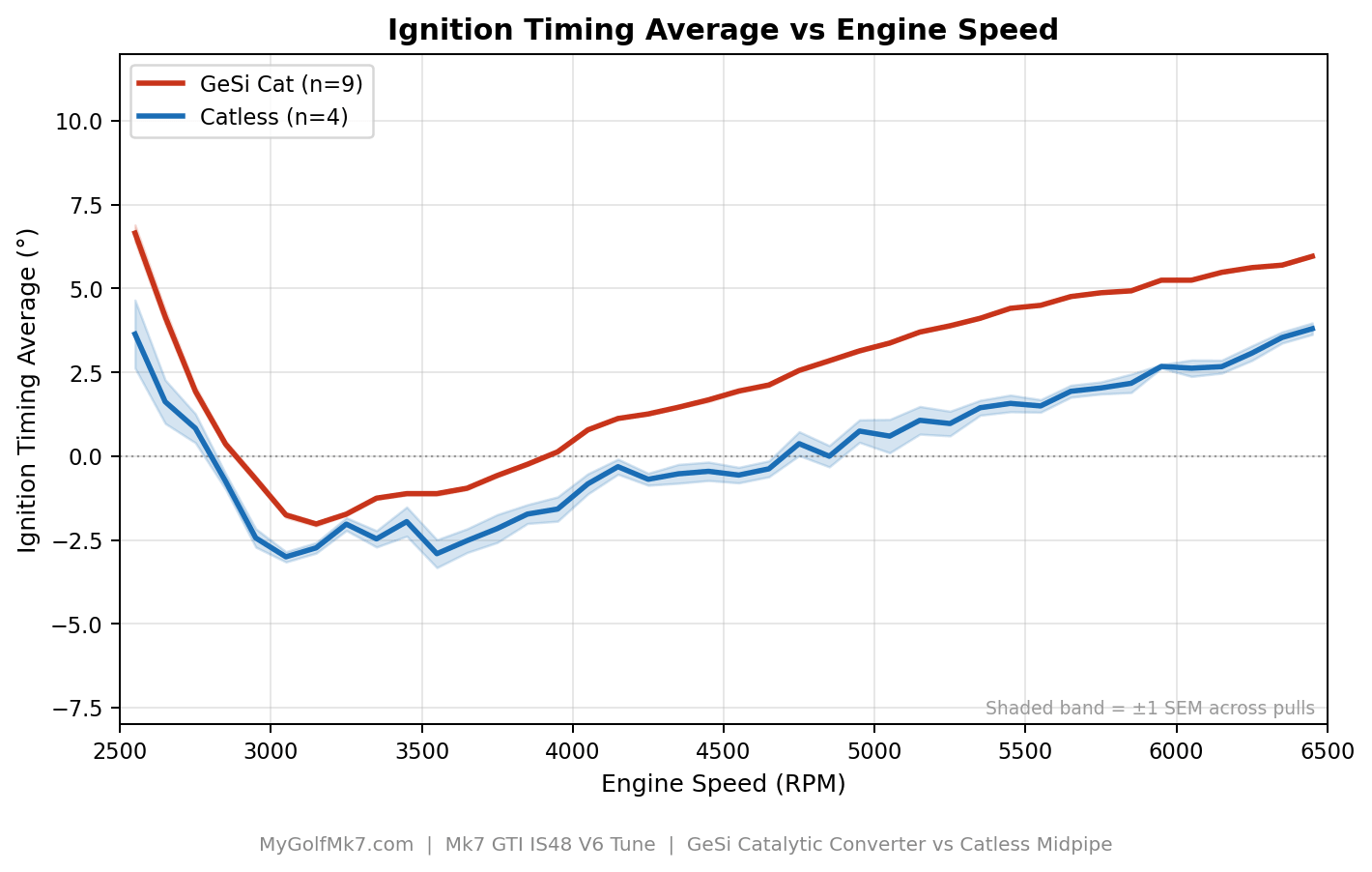
Average ignition timing is 2.97° for GESi [E16] vs 0.57° for catless [E10] — a 2.4° difference entirely attributable to knock retard on the catless configuration.
Ignition Retard
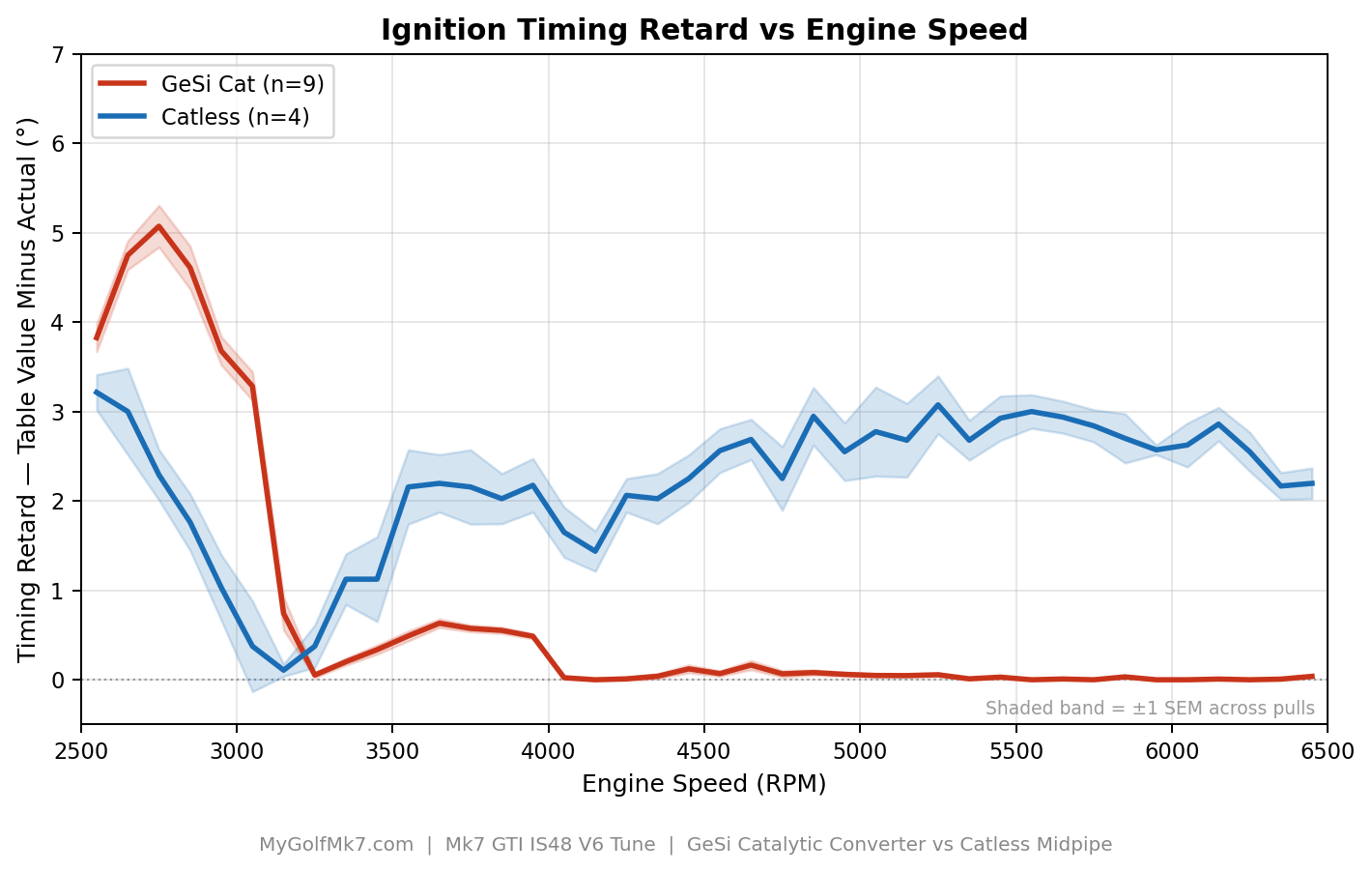
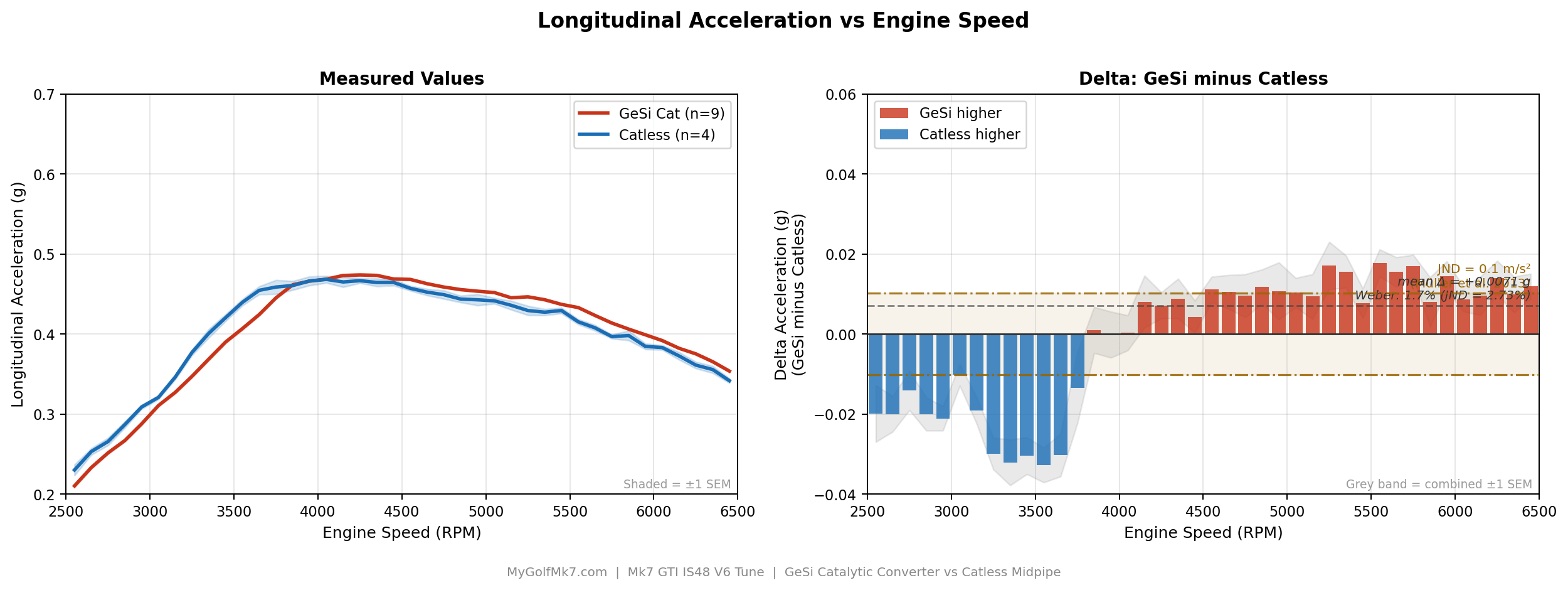
Mean timing retard (table value minus actual delivered timing) is 0.12° with GESi [E16] vs. 2.52° with catless [E10] — a difference of −2.4°. The catless configuration is experiencing knock-driven timing retard on every pull, worsening with heat soak: Pull 1 = 1.96°, Pull 2 = 2.15°, Pull 3 = 3.03°, Pull 4 = 2.89°. The GESi configuration shows essentially no knock activity (≤0.30° on any individual pull, with an average of 0.12°). This difference directly explains the acceleration finding below.
Boost
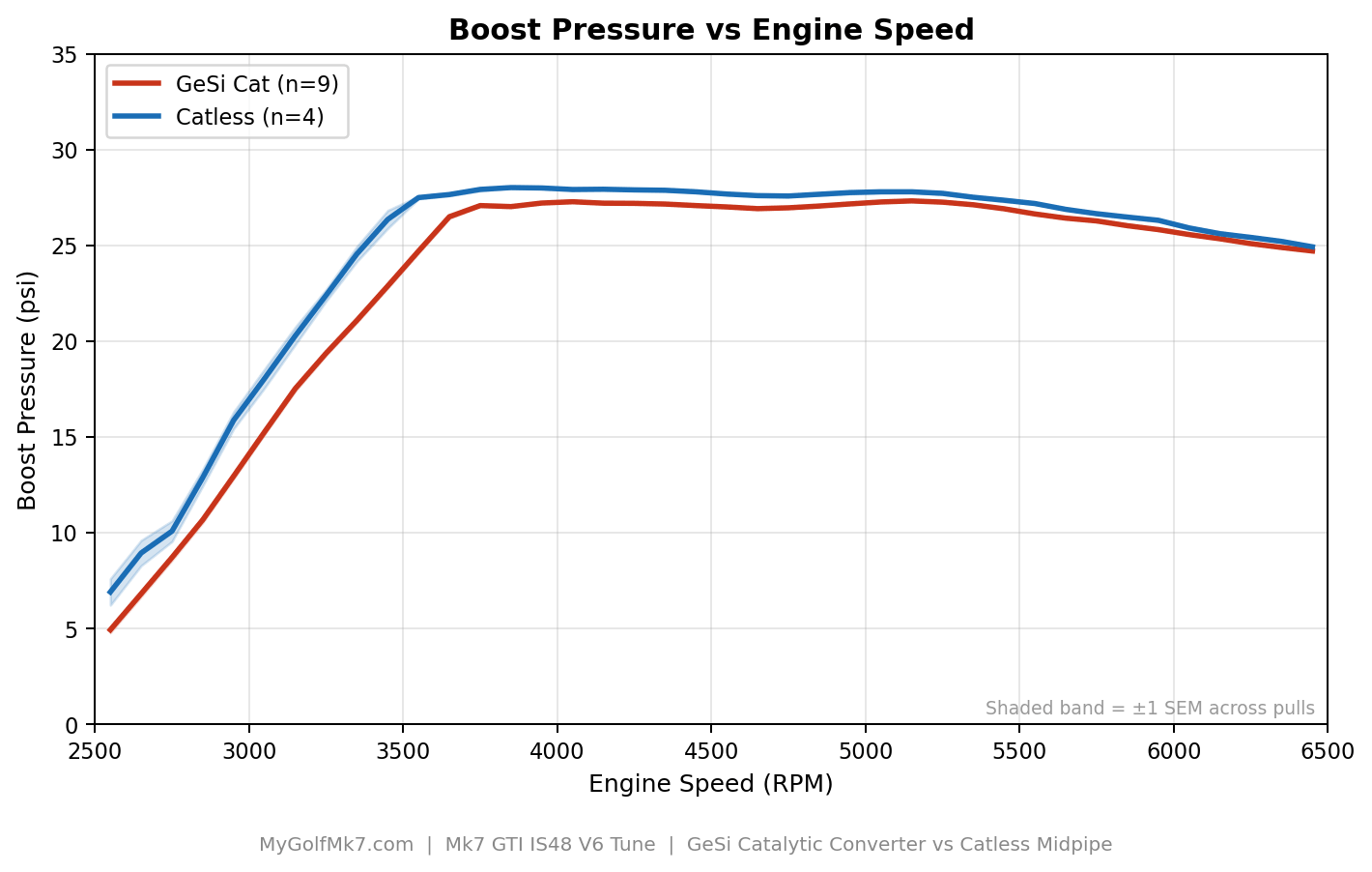
Catless is slightly higher at 27.28 psi vs GESi 26.66 psi (Δ = −0.62 psi).
Acceleration
GESi mean: 0.438 g (4.30 m/s²) vs catless: 0.431 g (4.23 m/s²), Δ = +0.007 g (+70 mm/s²). The measured acceleration advantage of the GESi [E16] configuration is not perceptible to the driver. The catless configuration [E10] produces its result while experiencing a 2.4° timing retard; its “potential” performance under knock-free conditions is not realized.
Conclusion:
The GESi catalytic converter demonstrates the expected WGDC signature of added exhaust restriction (+7.9% WG closure to maintain equivalent boost targets).
The acceleration result slightly favors GESi but is below the perceptibility threshold and is influenced by the difference in Ethanol percentage (E16 vs E10) of the fuel.