

Introduction:
When a topic generates debate, people often talk past each other—focusing on conclusions rather than the reasoning that leads to them, or, worse, leaning on misinformation to support their position.
This happens frequently in automotive discussions—especially when vendors make claims about engineering, development, or product uniqueness that consumers cannot easily verify.

An argument diagram is a tool that makes the structure of reasoning visible. Instead of presenting a conclusion and hoping readers follow the logic, an argument diagram shows how each claim is supported, what evidence it relies on, and what assumptions must be true for the argument to hold.
At its core, an argument diagram breaks a discussion into four parts:
- Conclusion — the main claim being defended
- Premises — the reasons offered in support of the conclusion
- Evidence — the data, documents, or observations that make the premises credible
- Assumptions — unstated ideas the argument depends on
By laying these elements out visually, the diagram shows how the pieces fit together. Strong arguments have clear support links between evidence, premises, and the conclusion. Weak arguments rely on missing evidence, unsupported assumptions, or reasoning that doesn’t actually lead to the conclusion.
Argument diagram concept example:
In the diagram below, each box represents a specific claim or piece of evidence. Arrows show the direction of support: evidence supports premises, premises support the conclusion. This makes it easy to see why the conclusion follows—or why an objection fails to address the actual structure of the argument.
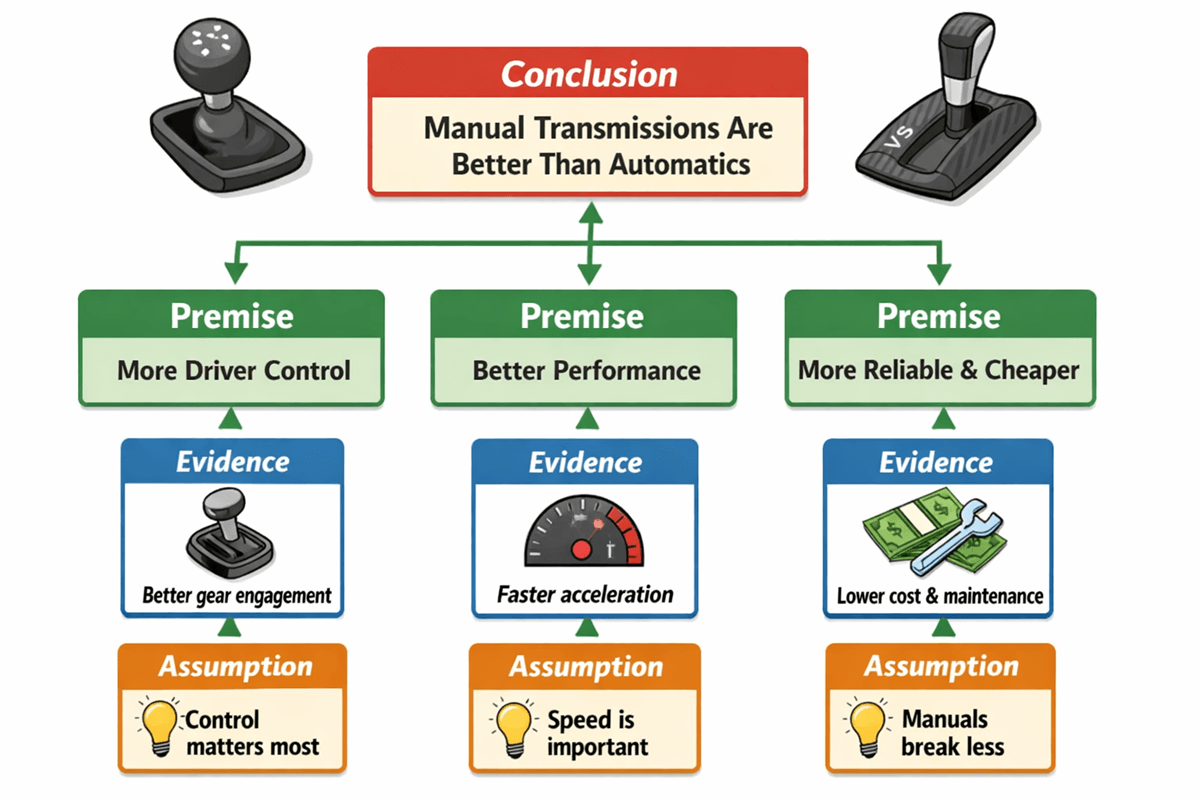
Argument diagrams are especially useful when evaluating product claims, technical assertions, or disputes about what a company did or did not do. They shift the discussion away from opinions and toward the quality of the reasoning itself.
If someone disagrees with the conclusion, the diagram makes their task clear: they must challenge a premise, introduce new evidence, or show that an assumption is false.
The Silver’s NEOMAX vs.EQT Balanced Line discussion is an ideal case study because the disagreement wasn’t about preferences—it was about factual claims, timelines, and representations made to consumers.
Note: If you’re interested in learning more about creating Argument Diagrams, Carnegie Mellon University offers a free Argument Diagramming course.
Argument diagram case study
In a previous post, I discussed how comparing Silver’s NEOMAX coilovers with EQT’s balanced line coilovers prompted a response from EQT owner Ed Susman that employed a number of rhetorical techniques that obscured the issue being raised (How to recognize deflection and misinformation).
The argument diagram below shows Ed Susman’s responses to that post.
Instructions for reading the diagram:
- The diagram is read from the top down.
- The Main Claim is the conclusion the post defends.
- Below it sits the Standard Applied — the evaluative framework that explains why the evidence supports the claim.
- In this case, that framework is the FTC reasonable consumer standard, which holds that advertising claims are assessed based on the impression a reasonable consumer would form, and that implied claims carry the same legal weight as explicit ones.
- These standards apply to automotive aftermarket products just as they do to any consumer good: if a vendor implies a development process or warranty structure, those claims must be accurate before being presented to buyers.
- Below the standard are the Evidence boxes, divided into two tiers.
- Tier 1 boxes are independently conclusive — any one of them is sufficient to support the conclusion on its own.
- Tier 2 boxes are corroborating — they strengthen the case but are not independently decisive.
- The Counterarguments section maps the objections raised in response to the post. (Each box identifies the argument made, the type of reasoning it uses, and a brief assessment of whether it engages the evidence. None of these patterns constitutes a rebuttal unless they attach to a specific evidence box and provide a reason to doubt it.)
- Where applicable, the diagram also includes an Admissions section. (These are statements made by the vendor in their own responses that inadvertently confirm elements of the evidence rather than challenging them. Admissions are analytically significant because they come from the same party who is disputing the conclusion — when a respondent’s own words validate the evidence being used against them, that carries more weight than external confirmation alone.)
- Clicking any box in the diagram opens a detailed analysis panel explaining the full reasoning behind its assessment.
Note: The top half of the argument diagram is an overview, while the lower half provides the supporting analysis.
Note: Tier 1 evidence is independently sufficient—each item, on its own, demonstrates that EQT’s development narrative cannot be accurate.
(click here to open the diagram as a new full page)
Conclusions:
The diagram shows that every counterargument Ed Susman gave failed to engage the evidence.
For consumers, this matters because product narratives—especially those implying engineering development—shape purchasing decisions. When a vendor’s own statements contradict its marketing, the reasonable consumer standard requires that the marketing be corrected.
Instead, Susman’s counterarguments rely on three recurring rhetorical techniques: tu quoque, ad hominem, and unsupported assertion.
- Tu quoque — redirecting criticism by pointing to alleged faults in others rather than addressing the evidence.
- Ad hominem — attacking the analyst rather than the argument.
- Unsupported assertion — stating a claim without evidence.
These techniques redirect attention to other companies, to the analyst’s motives, to bare claims that the marketing is accurate, without addressing the timeline, the warranty date, or the Mk8 text insertion. Rhetorical redirection is not a rebuttal.
The most significant finding in the diagram is not what Susman challenged but what he confirmed. While disputing the conclusion, he stated that:
- EQT has sourced from Silver’s for over ten years
- The product development process consisted of specifying a setup to Silver’s rather than independent engineering
- The product is “at least somewhat unique” — a characterization that falls well short of the development narrative on EQT’s product page.
Most directly, in response to another participant, he stated: “The supplier is Silver’s. They supply many different brands.” These admissions come from the same person, who asserts that EQT’s marketing creates no false impression. The gap between what Susman said in this exchange and what EQT’s product page says is precisely what this post documents.
A further finding from the exchange concerns Susman’s assertion that EQT has always been transparent about the source of their coilovers.

EQT’s product page directly contradicts it. There is no disclosure of Silver’s as the manufacturer, no country of origin, no reference to any supply chain relationship, and no link to any supporting documentation.
A reader of EQT’s product page has no basis on which to identify Silver’s as the source of the product they are purchasing. The claim of longstanding transparency is not merely unsubstantiated — it is falsified by the observable content of EQT’s own website, which any reader can verify independently.
That a business owner would make this assertion while defending marketing practices that are the subject of a documented consumer transparency analysis reflects on the standards of conduct the business operates by.
References:
Carnegie Mellon University: Argument Diagramming course – “Argument diagramming is a great visual tool for evaluating claims that people make. By the end of the course, you will be able to think critically about arguments or claims and determine whether or not they are logical.“
University of Washington: Calling Bullshit course – Our world is saturated with bullshit. Learn to detect and defuse it.
The Debunking Handbook 2020 – “Misinformation is false information that is spread either by mistake or with intent to mislead. When there is intent to mislead, it is called disinformation. Misinformation has the potential to cause substantial harm to individuals and society.”
Reddit post – Link to the posting on Reddit, which received the comments from Ed Susman