
Background:
The last time I did anything with the MGM7 intake I’ve been developing was during the Shuenk IS48 dyno session, when I used the prototype elbow and intake during the dyno session.
I’m not interested in having a large intake just for the sake of it being large, so I adjusted the design to taper the pipe more uniformly, which narrowed the middle section compared to the most recent version used during dyno testing.
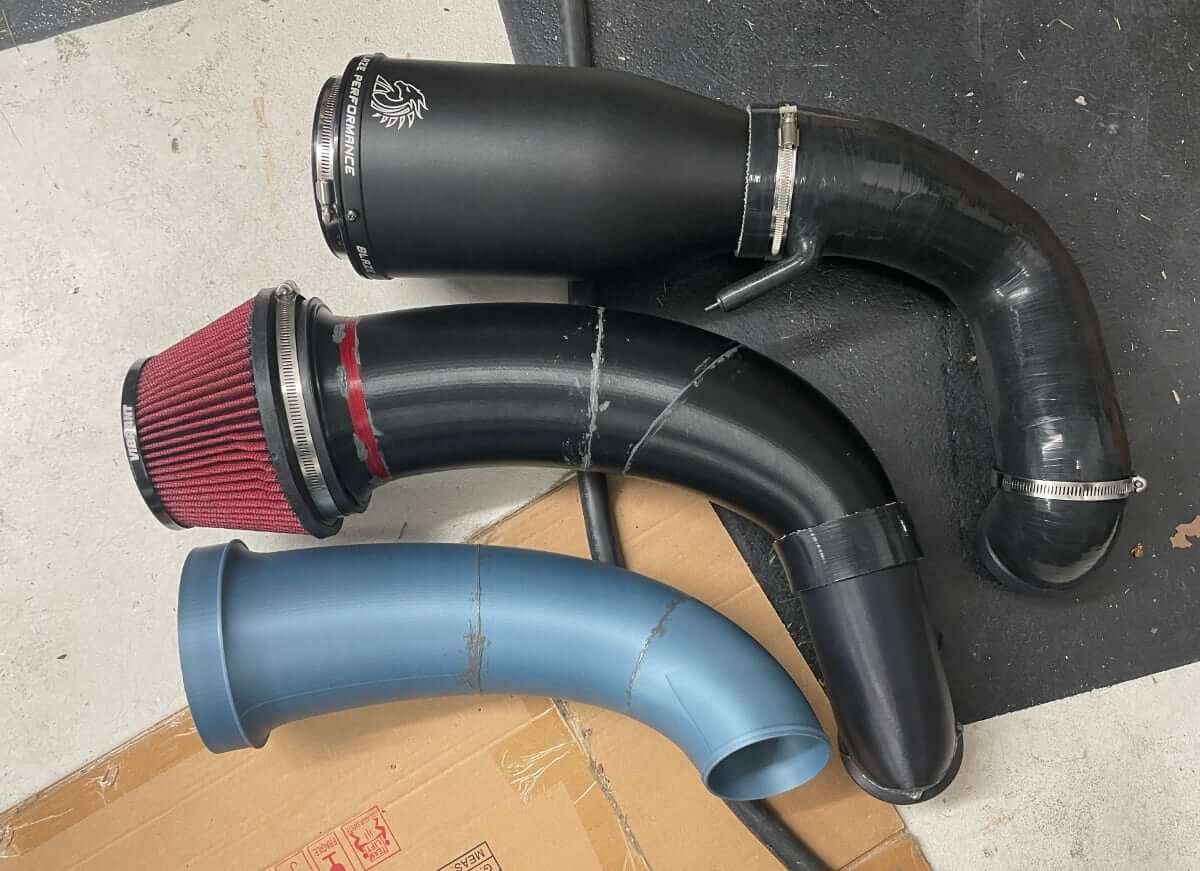
With the new design printed, I set up to conduct a flow test of the most recent versions along with a commercial intake, the Blaze AToM Race. All three intakes to be tested are shown in the picture below.
Test Setup:
The MGM7 intakes are connected to an MGM7 prototype inlet elbow, which is then attached to a flow bench adapter that simulates the compressor housing inlet of the Shuenk IS48 ported shroud turbocharger.
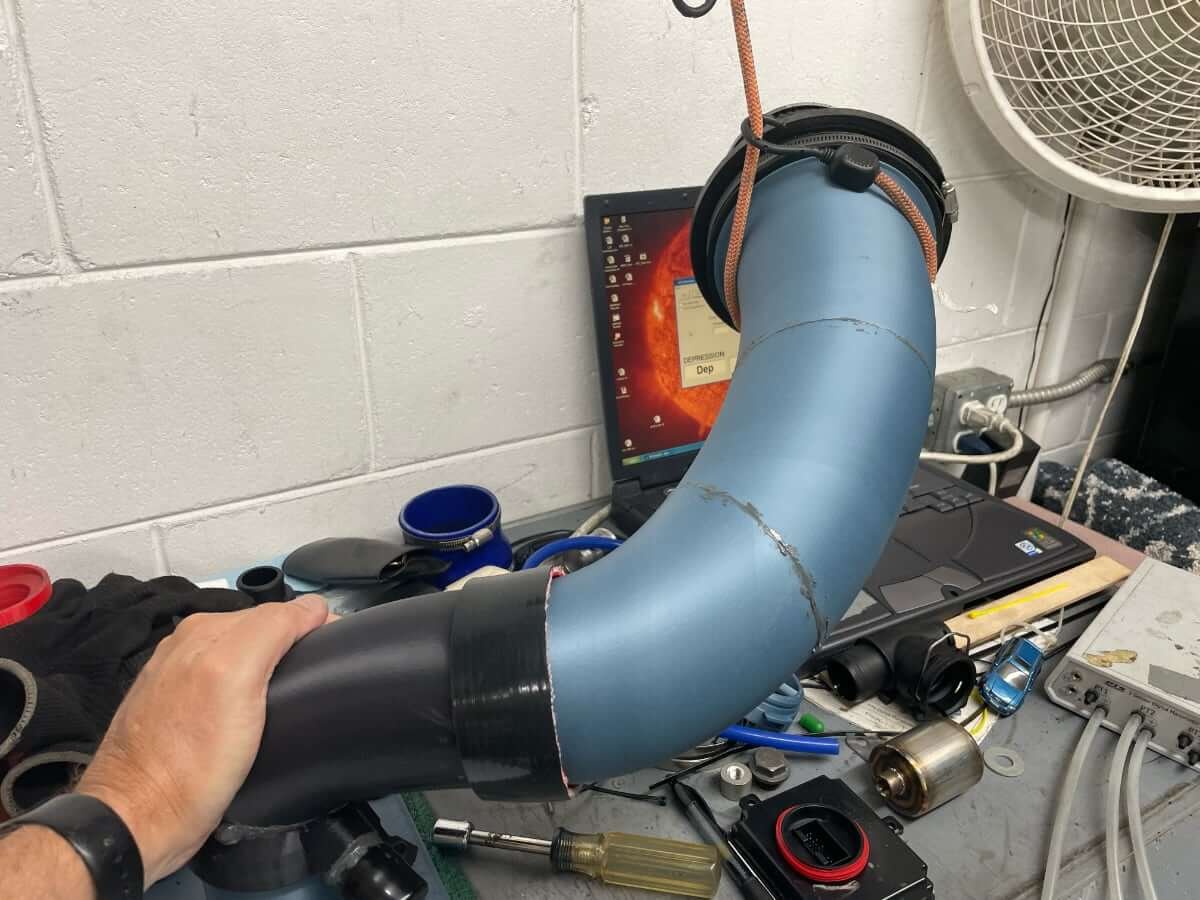
The flow bench is operated at a depression of 16″ of H2O, and the airflow through the intakes is measured.
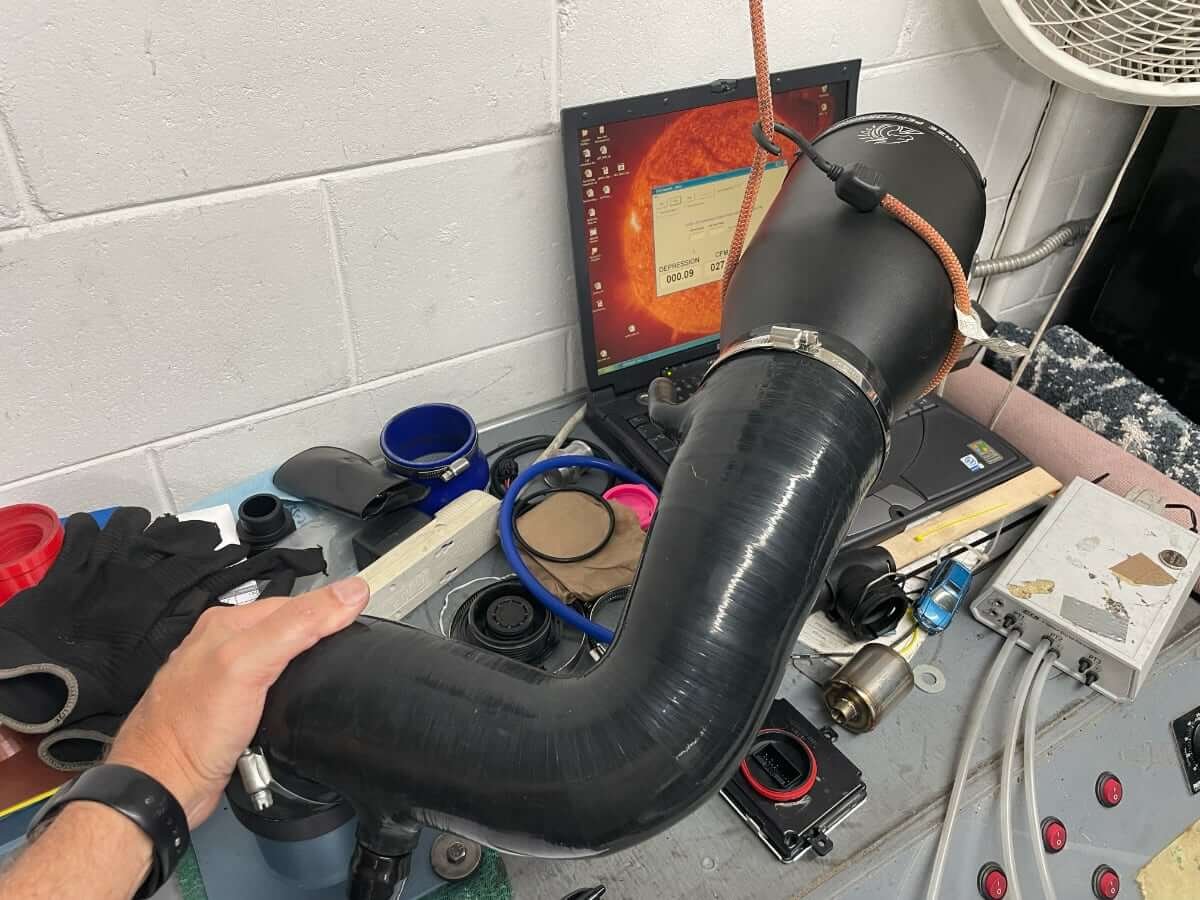
The Blaze intake has an inlet hose that replaces the inlet elbow; therefore, I have an adapter flange to join the Blaze hose to the IS48 bench adapter.
Test Results:
The larger MGM7 intake (black) flows 588 CFM @ 16″ of H2O.
This is 10 CFM higher than the last time I tested this intake, but I updated the MGM7 elbow since the last flow test, and that could be the source of the change. Alternatively, 10 CFM at a flow rate of 588 CFM is a small difference and could be attributed to other factors such as the orientation of the inlet pipe to the inlet elbow, the space separating the inlet pipe from the inlet elbow inside the silicone coupler, or the alignment of the inlet elbow to the bench adapter.
The smaller MGM7 intake (gray) flows 578 CFM @ 16″ of H2O. The slight decrease in airflow is intriguing because when assembling this intake, I had not taken the time to smooth the interior bead of epoxy that holds the intake sections together. This leaves me wondering, “What if” the epoxy had been smoothed along the interior wall, how much, if any, more airflow would it have recorded?
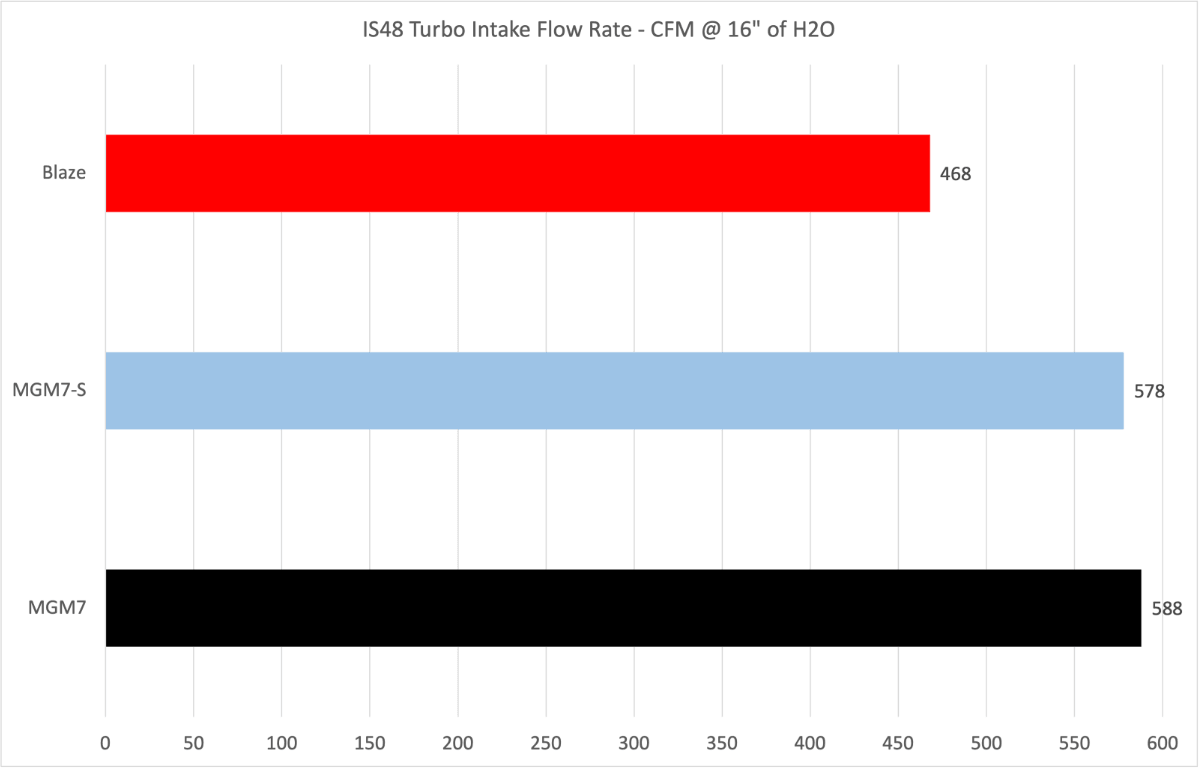
The last intake tested was the Blaze AToM, which flowed 468 CFM @ 16″ of H2O. This is the same flow rate that was measured the last time I tested the Blaze with this configuration.
The MGM7 (black) and (gray) flow 26% and 24% more, respectively, than the commercial intake.
Conclusions:
A revision to the MGM7 intake was made that reduces the middle section diameter of the inlet pipe. A flow test was then performed to compare the revised intake to the prior version, and the new intake was found to flow 578 CFM, a 10 CFM reduction at a depression of 16″ of H2O.
The revised intake was assembled without smoothing the interior bead of epoxy that joins the intake segments, and it is hypothesized that smoothing the epoxy might have produced higher airflow.