
Introduction
For several years, EQT representatives — including owner Ed Susman — have repeatedly described the Blaze Performance AToM intake as the “best” intake option for MQB vehicles. Yet in all that time, they’ve provided no testing, data, or substantiation to support those claims.
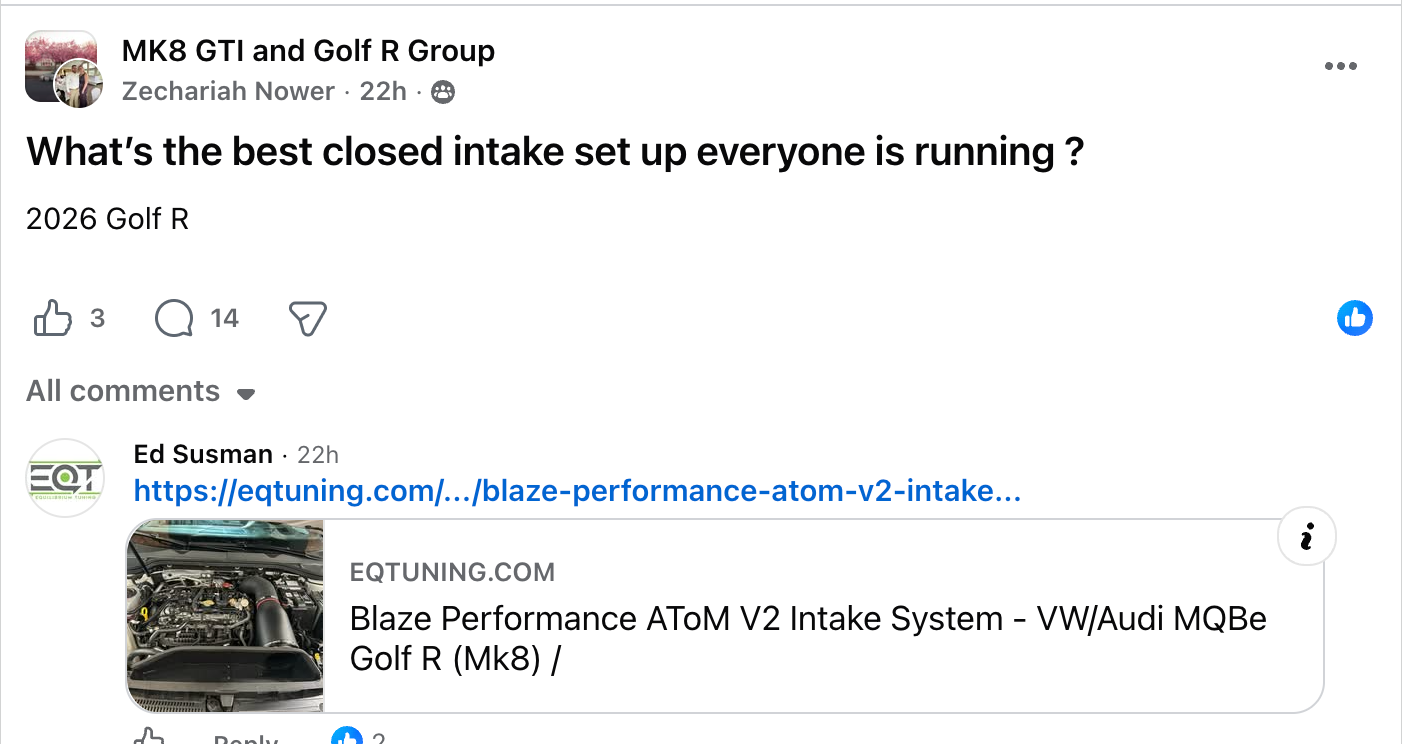
This pattern continues. In a recent Facebook exchange, a consumer asked: “What’s the best closed intake setup?” Ed Susman immediately replied by promoting the Blaze AToM intake. He provided no substantiation for why it would outperform alternatives.
This behavior is not new.
2022 Claim
In December 2022, I documented how EQT repeatedly made performance claims about the Blaze intake without offering any evidence.
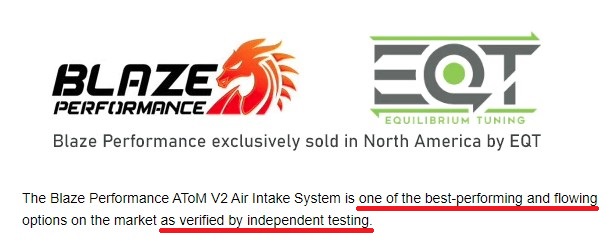
Since then, I’ve asked EQT multiple times—publicly and privately—to substantiate these claims. Those requests have gone unanswered. The recent Facebook exchange simply reinforces the same trend.
My own testing
I’ve conducted flow testing on the Blaze AToM directly with Blaze Performance, the manufacturer, since before EQT began selling the intake.

Since then, I’ve run multiple controlled comparisons across both flow-bench and on-vehicle street testing methodologies, and have never found evidence supporting the performance claims EQT and Ed Susman have made for it:
- Blaze AToM Race vs. APR PEX — Street Test
- Racingline R600 vs. Blaze AToM — Street Data
- Modified Stock vs. Blaze AToM — Street Test
- Making a Case for the Stock Airbox
Why this matters
This matters because vendors making performance claims don’t operate in a vacuum. The FTC’s substantiation guidelines require that any objective claim — especially one implying superiority — be supported by reliable evidence.
But social media operates with virtually no oversight. Unsupported claims can circulate freely, influencing consumer perception not through data, but through repetition (4 years and counting).
Bottom line
When a vendor repeatedly promotes a product as the “best” while declining to respond to requests for substantiation, consumers are left with marketing framed as engineering.
In enthusiast groups where many car owners rely on vendor statements to guide modification decisions, the absence of evidence isn’t just a technical issue — it’s a consumer‑protection issue.
Until EQT provides data to support its claims about the Blaze AToM intake, consumers should view those claims with caution and rely on independently verified testing rather than unsubstantiated assertions.