

Overview:
In October, R-Tech’s Niki Gower told readers of his business’ Facebook Group that, related to this website, “most of his other previous tests are massively flawed.”
Shortly before that, Gower described most of this site’s “real world” testing as “great.” Both statements cannot be true.
This article examines what happened when I asked Gower to explain the alleged flaws, and why answers never arrived.
Background:
A previous post analyzed a claim by tuner Niki Gower of UK-based R-Tech that
the is38 likes back pressure
Niki Gower – R-Tech tuner
The statement is problematic because it contradicts the fundamental scientific principles of how a turbine operates.
I emailed R-Tech for more details, but Gower did not respond. Instead, after my post analyzing the claim was published, Niki Gower went on Facebook and mischaracterized my questions while still failing to address the concern I had raised, which I discussed in a second post.
Test Criticism:
One of the more surprising comments from my exchange with R-Tech wasn’t about turbochargers or backpressure.
It was this statement from Niki Gower about me:
most of his other previous tests are massively flawed…
Niki Gower – R-Tech tuner
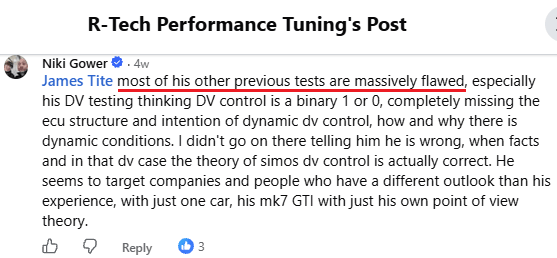
That’s a remarkable claim when you stop and think about it.
The MyGolfMk7.com testing archive spans 8 years and contains over 400 published tests covering topics ranging from intercoolers and intake systems to diverter valves, turbochargers, downpipes, sensors, fueling, and tunes.
If “most” of those tests are massively flawed, we are not talking about one mistake. We are talking about hundreds of flawed conclusions. Such a claim should be supported with numerous examples.
Technical Criticism:
When someone claims a test is flawed, the expectation is that they can explain:
- Which test is flawed.
- What methodological error exists.
- Why the error matters.
- How the error changes the conclusion.
Without those details, claiming “your testing is flawed” is not a technical criticism; it’s an assertion.
So I asked Niki to identify the tests he meant and explain the flaws he believed existed.
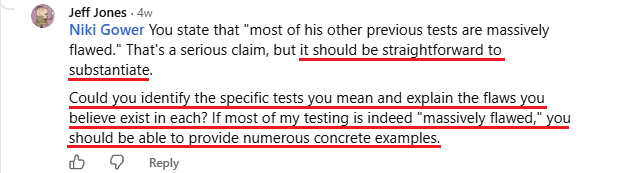
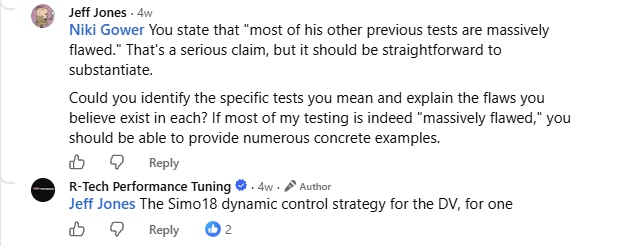
Instead of identifying numerous tests, the discussion narrowed to a single example: my diverter valve (DV) testing.
I then asked two straightforward follow-up questions:
How does supposedly failing to account for Simos18 dynamic DV control make the test massively flawed? Which conclusion in the article does it invalidate?
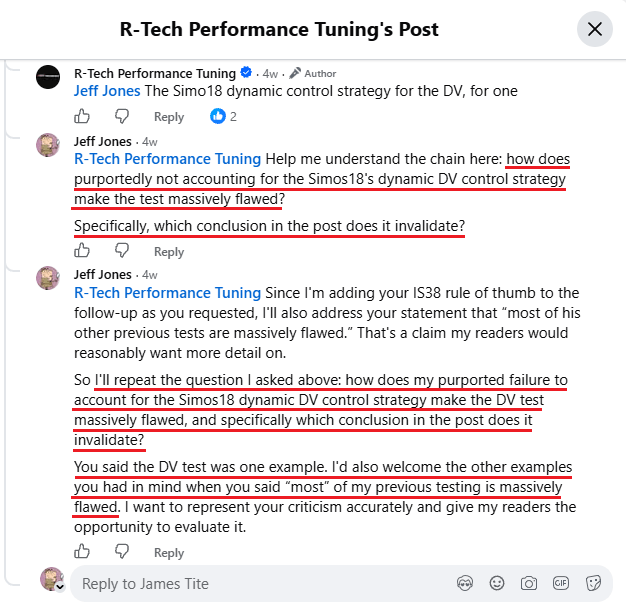
The questions went unanswered. No explanation was ever provided for how the alleged misunderstanding of Dynamic DV Control invalidated the test’s conclusions.

Earlier Comments:
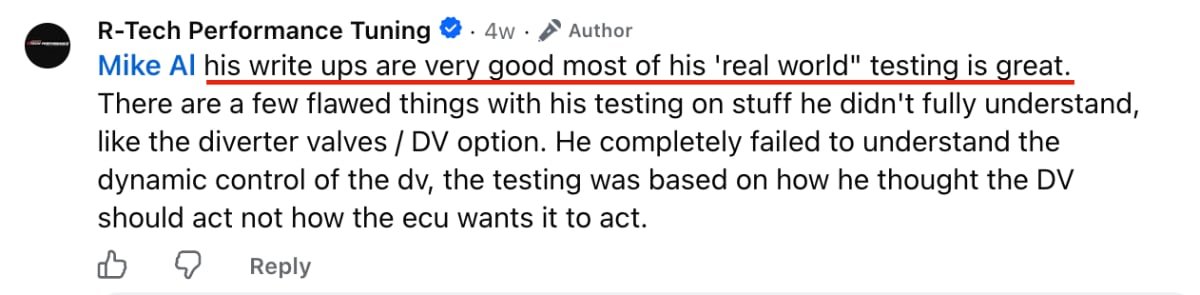
Oddly, earlier in the same discussion, Gower said the website testing was “great”.
his writeups are very good most of his ‘real world” testing is great.
R-Tech Performance Tuning
The DV Testing:
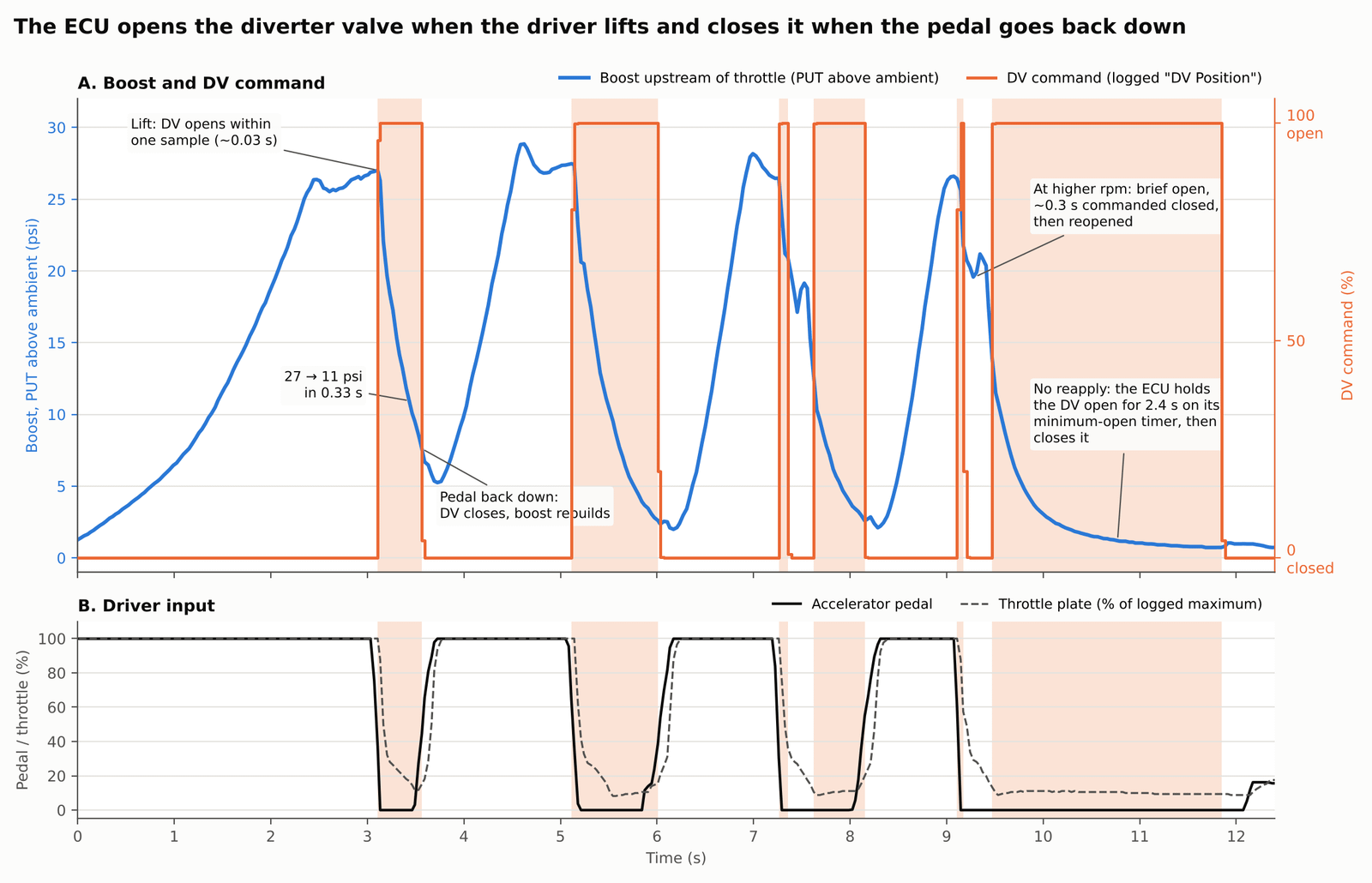
The DV test Gower claimed was massively flawed was one where I operated the GTI at full throttle, let off the accelerator so boost would drop, and then quickly went back to full throttle.
Gower claimed this was massively flawed:
most of his other previous tests are massively flawed, especially his DV testing thinking DV control is a binary 1 or 0, completely missing the ecu structure of and intention of dynamic dv control…
Niki Gower – R-Tech tuner
The DV control Open (100%/1)-Close (0%/0) command is visible in a datalog of the DV Position variable.
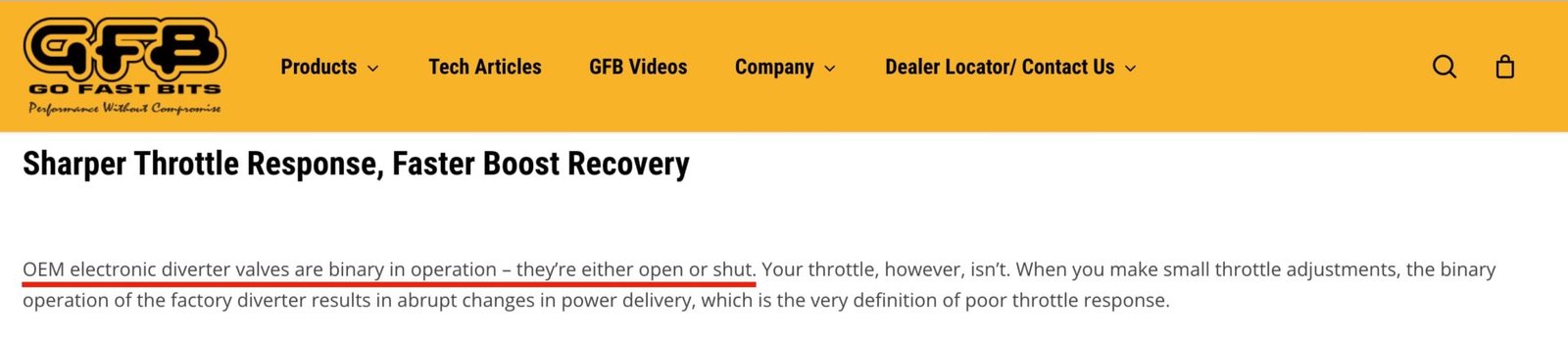
Aftermarket valve manufacturer: Go Fast Bits offers this information about the DV valve:
OEM electronic diverter valves are binary in operation – they’re either open or shut.
Go Fast Bits
Despite multiple requests, no explanation was provided linking Dynamic DV Control to an incorrect test result.
The Criticism Changed:
A couple of weeks later, Gower would again speak about Dynamic DV control, this time in the context of comparing OEM and Turbosmart valves to a GFB T9381 valve.
In this discussion, Gower would state:
The conditions the benefits of dynamic control ain’t at full throttle or full load volume release going straight back into gear.
Niki Gower – R-Tech tuner
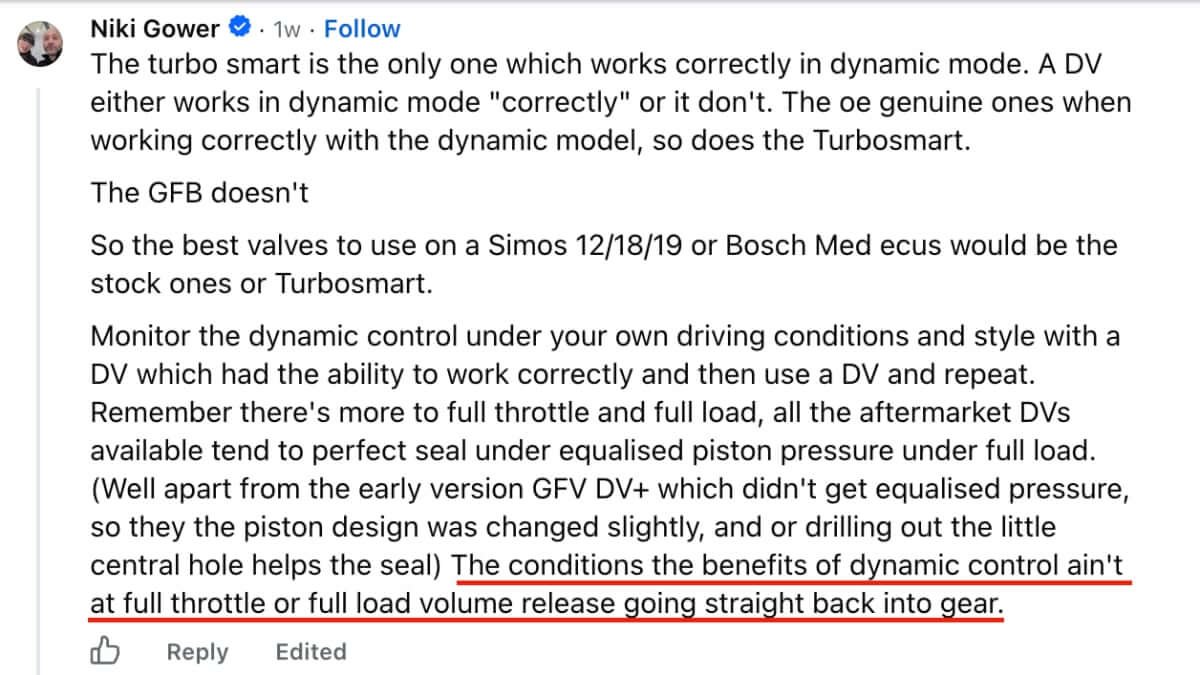
If Dynamic DV Control has no effect under the full-throttle operating conditions I tested, how does supposedly failing to account for it make the test massively flawed?
I asked Gower, but again, he would not answer my question.
No answers:
Why did the answers never arrive?
Readers can draw their own conclusions, but one possibility is difficult to ignore. As the exchange progressed, Gower’s criticism narrowed and became more specific.
What began as a claim that “most” of the testing was “massively flawed” narrowed to a single diverter-valve test. The alleged flaw in that test was a failure to account for Dynamic DV Control.
Yet later, Gower explained that the benefits of Dynamic DV Control occur under different operating conditions than those of my DV test.
At that point, Gower’s criticism no longer explained why the test was supposedly flawed, and no explanation was ever provided that connected Dynamic DV Control to an incorrect conclusion.

Why it matters to consumers:
Many readers cannot independently evaluate turbine expansion ratios or diverter-valve behavior.
As a result, consumers naturally rely on authority figures, such as a tuner.
The danger occurs when people accept a tuner’s criticism because of who made it rather than because it was substantiated.
Conclusions:
The discussion began with two incompatible characterizations of the testing published on MyGolfMk7.com. On the one hand, R-Tech tuner Niki Gower described most of the site’s real-world testing as “great.” On the other hand, he later claimed that “most” of the testing was “massively flawed.”
When asked to reconcile those statements by identifying the allegedly flawed tests and explaining the flaws, the criticism narrowed to a single diverter-valve test. Even then, Gower gave no explanation showing how the supposed issue changed the test’s conclusions.
Consumers should remember that confidence, reputation, and experience are not substitutes for evidence.
When someone claims that hundreds of tests are massively flawed, the appropriate response is simple:
Which tests? What flaws? Which conclusions change?