

Background:
Developing an inlet elbow for the Shuenk IS48 turbocharger reminded me of an exchange I had with Equilibrium Tuning owner Ed Susman about the inlet hose used by the Blaze intake.
In tests where the inlet flange/elbow is eliminated, meaning only the intake is being measured, the Blaze ATOM slightly trails a modified stock airbox.
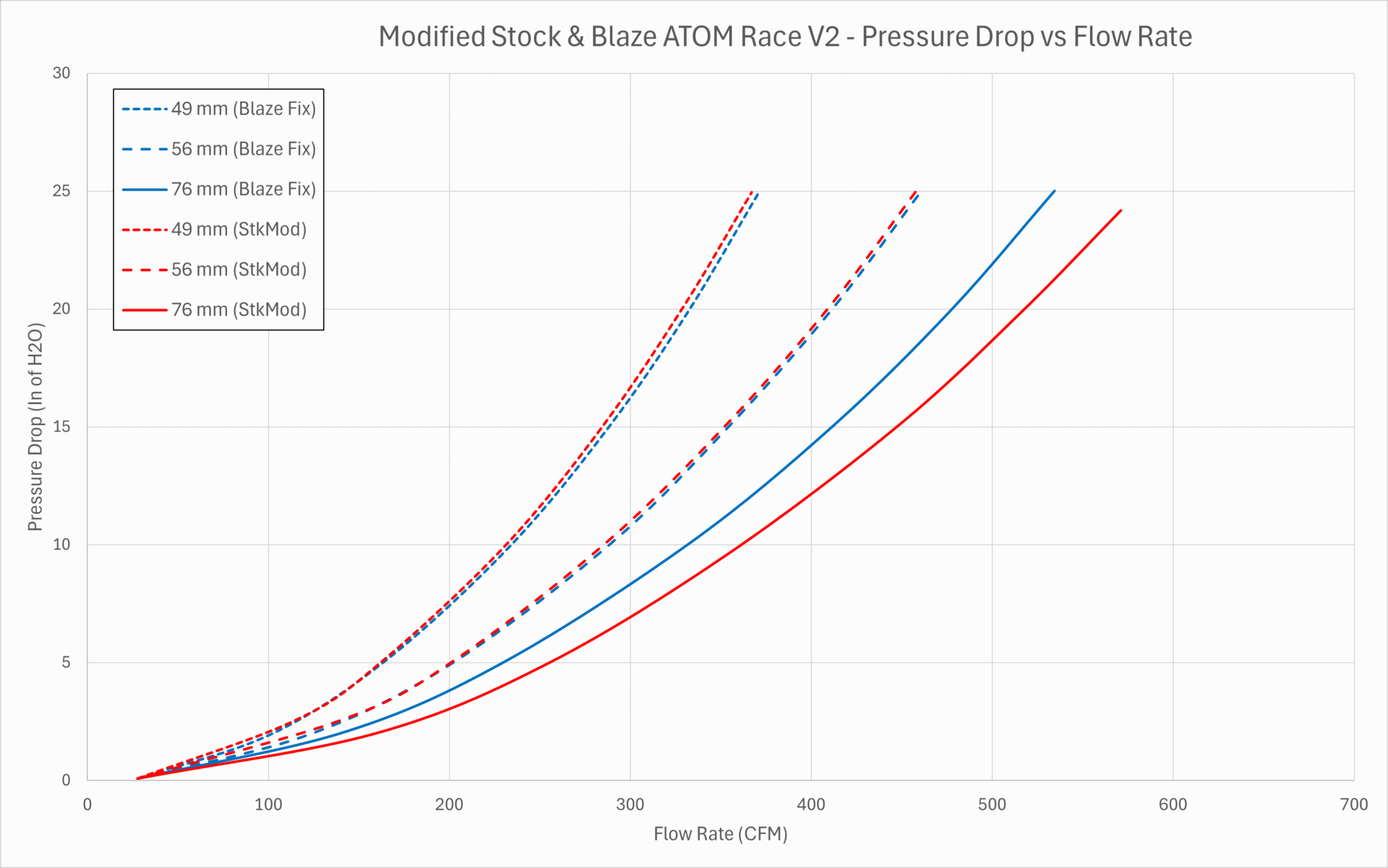
When I discussed this outcome, Ed Susman asked whether I had also conducted the test using the Blaze ATOM inlet hose that attaches to the Typhoon turbo, without a turbo inlet flange.
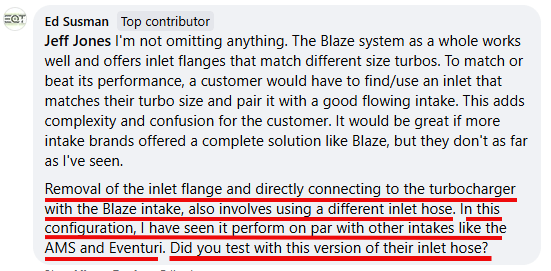
I had not. On the surface, it didn’t seem likely that there would be a significant difference between the standard Blaze inlet hose that I was testing with and the Blaze hose for the Typhoon turbo.
Given that the rest of the Blaze intake is unchanged between setups, the rest of the intake is in the same position and contains the same parts. The turbocharger is located in the same place; it was logical that the Typhoon inlet hose would only be made slightly longer to reach the turbocharger inlet without using an inlet flange.
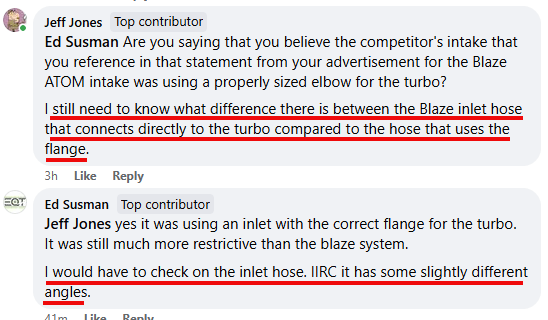
I asked Ed if there was a difference between the Blaze Atom inlet hose that connects to the turbo (Typhoon) and the standard one that uses an inlet flange.
Ed replied by saying:
I would have to check on the inlet hose. IIRC (if I recall correctly) it has some slightly different angles.
Ed Susman – Owner of Equilibrium Tuning
What Ed was saying didn’t make sense, and I didn’t expect him to check and get back to me.

Test article:
Since Ed Susman suggested that the Blaze inlet hose for the typhoon turbo would yield different results, I set out to compare the two products.
In an ominous sign that Ed had been bullshitting again, my first attempt to test the Blaze inlet hose was foiled when Ed’s company cancelled my order for the hose.

Note: When a business makes performance claims about a product it profits from selling, and then actively works to avoid having that product subjected to a comparison test, it’s a good sign that the business is hiding something.
Consumer assist:
Luckily, I’m not the only Mk7 owner interested in learning the truth about how aftermarket parts perform, and another person sent me one of the Typhoon inlet hoses to test.
Putting the Blaze ‘standard‘ hose next to the ‘typhoon‘ hose, there was no apparent difference in the “angle” of the bends, as Ed Susman had suggested.

As I had suspected, the only significant difference was that the typhoon hose outlet is slightly longer.


Given the products’ similarity, it was unlikely that the typhoon hose would improve the Blaze intake’s flow performance, as Ed Susman had implied.
Test Procedure:
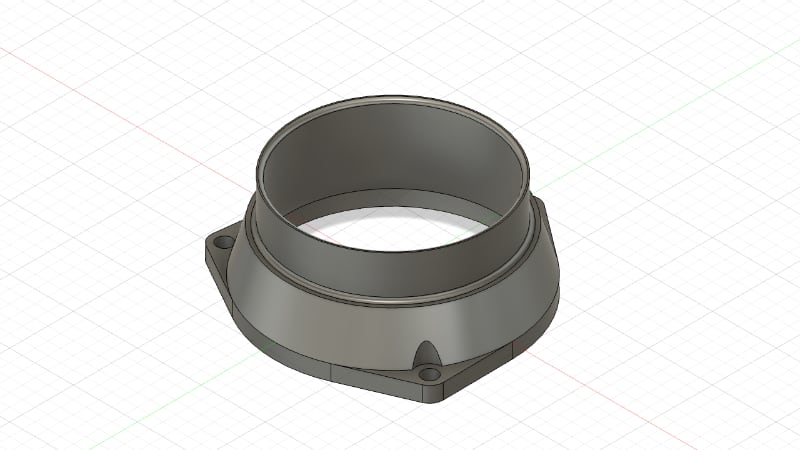
Step one was to attach an adapter to the flow bench that the Blaze inlet hoses would attach to.
The Blaze ATOM intake was then assembled and attached to the flow bench.

The flow bench is operated at a depression of 28″ of H2O, and the airflow rate through the intake is recorded.

The Blaze ATOM with ‘standard‘ hose flows 531 CFM @ 28″ of H2O, and the Blaze ATOM with the ‘typhoon‘ hose flows 520 CFM @ 28″ of H2O.
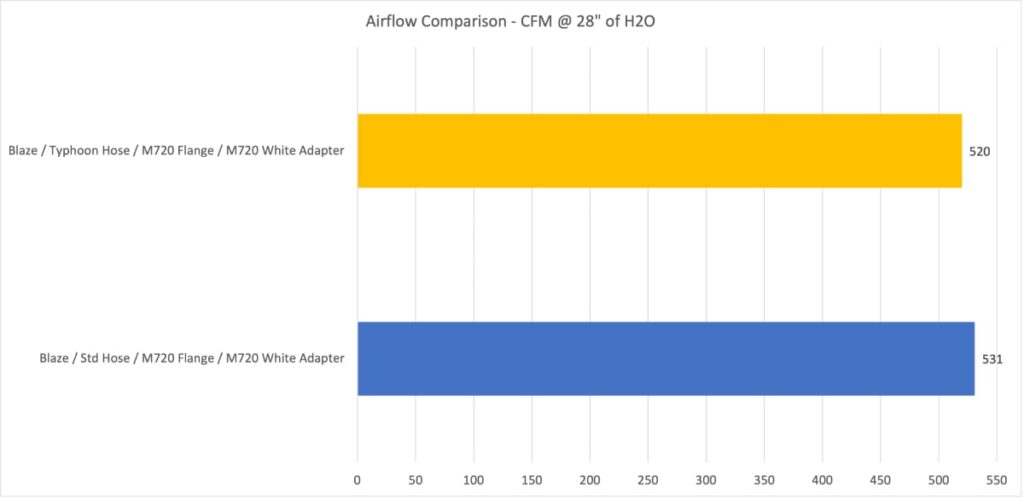
Interestingly, the hose meant for the larger, higher-flowing turbocharger causes a greater pressure loss.
The airflow through the typhoon hose is reduced, likely due to the additional length of the hose’s outlet section. Surface friction is a significant source of pressure loss in a pipe, and a longer pipe creates more friction that opposes the airflow.
Note: As a practical matter, this difference in flow rates is likely inconsequential. The flow bench is a high-resolution measurement tool designed to detect small changes.
Fact Checking Ed Susman:
Aside from being wrong about the Typhoon hose potentially making the Blaze ATOM intake perform better, it makes it perform slightly worse, the exchange brought up another red flag regarding Ed Susman’s public mischaracterization of my data.
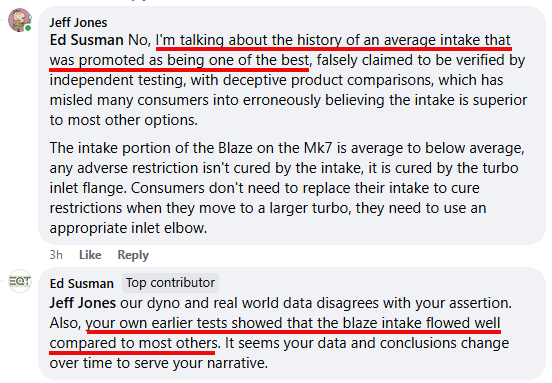

Ed tries to gaslight me about the outcome of the tests I have performed. The man is truly a master bullshitter.
Flow test data:
Looking at the flow test results for the Blaze ATOM intake with a stock turbo adapter, among the 26 intakes tested, the Blaze ATOM is around the 50th percentile.
This is the definition of average, not “well compared to most others.”

In a more demanding test using a larger hybrid turbo adapter, among the 13 intakes tested, the Blaze ATOM performance is at the 38th percentile. Again, not “well compared to most others,” as Ed Susman falsely claims the test results show.

Neither of these results supports the assertion that the data shows the Blaze ATOM is “better than most.”
Conclusions:
Ed Susman of Equilibrium Tuning implied that a test comparing the Blaze ATOM intake with an APR PEX and modified stock intake, when attached directly to a flow bench, failed to account for the difference caused by the Blaze typhoon inlet hose.
When I attempted to purchase a Blaze ATOM typhoon hose from Equilibrium Tuning to test its claims, EQT refused to sell it to me, indicating a lack of transparency in its advertising.
Ed Susman, the sole distributor of the Blaze intake in North America, believed the Blaze standard hose and typhoon hose have slightly different angles. A comparison of the two products from various angles does not support this.
Ed Susman also claimed that the flow testing that I have conducted points to the Blaze ATOM flowing “better than most“, despite being demonstrably false – an apparent effort to gaslight consumers.

When a seller misrepresents objective test results, buyers can end up paying for parts that don’t perform as advertised — wasting money and potentially degrading vehicle performance.
Because this behavior favors short-term sales over transparency, consumers should demand complete test data and independent verification before trusting promotional claims from salespeople.
References:
The following are links to other examples of reviews of misleading or unethical conduct by EQT:
- Equilibrium Tuning unsubstantiated claims about product performance
- Equilibrium Tuning misleading claims for independent product testing
- Ed Susman’s false statements about the flow bench that I use
- Ed Susman’s false statements about my consideration of data
- Ed Susman’s false statements about the testing I’ve done being flawed
- Ed Susman’s false statements about the testing that I perform being limited
- Ed Susman’s false statements about me being a hack
- Ed Susman’s false statements about questions I emailed to the business containing “demands”
- Ed Susman’s false statements to another consumer who commented on my review
- Ed Susman’s statements about professionalism being optional
- Ed Susman’s false statements to a performance shop employee who questioned Ed’s claims
- Ed Susman makes threats to suppress a consumer review
- Ed Susman bullshits a consumer on social media
- Equilibrium Tuning unsubstantiated claim about tune reliability being OEM-like.
- Ed Susman’s false statements to consumers about a tune reliability post.
- Equilibrium Tuning false advertising of independent testing.
- Ed Susman’s bullshitting has consequences for consumers.
- Ed Susman’s bullshitting a consumer about the ARM Motorsport intercooler.
- Equilibrium Tuning misleads consumers about intercoolers.