

Examining the Evidence
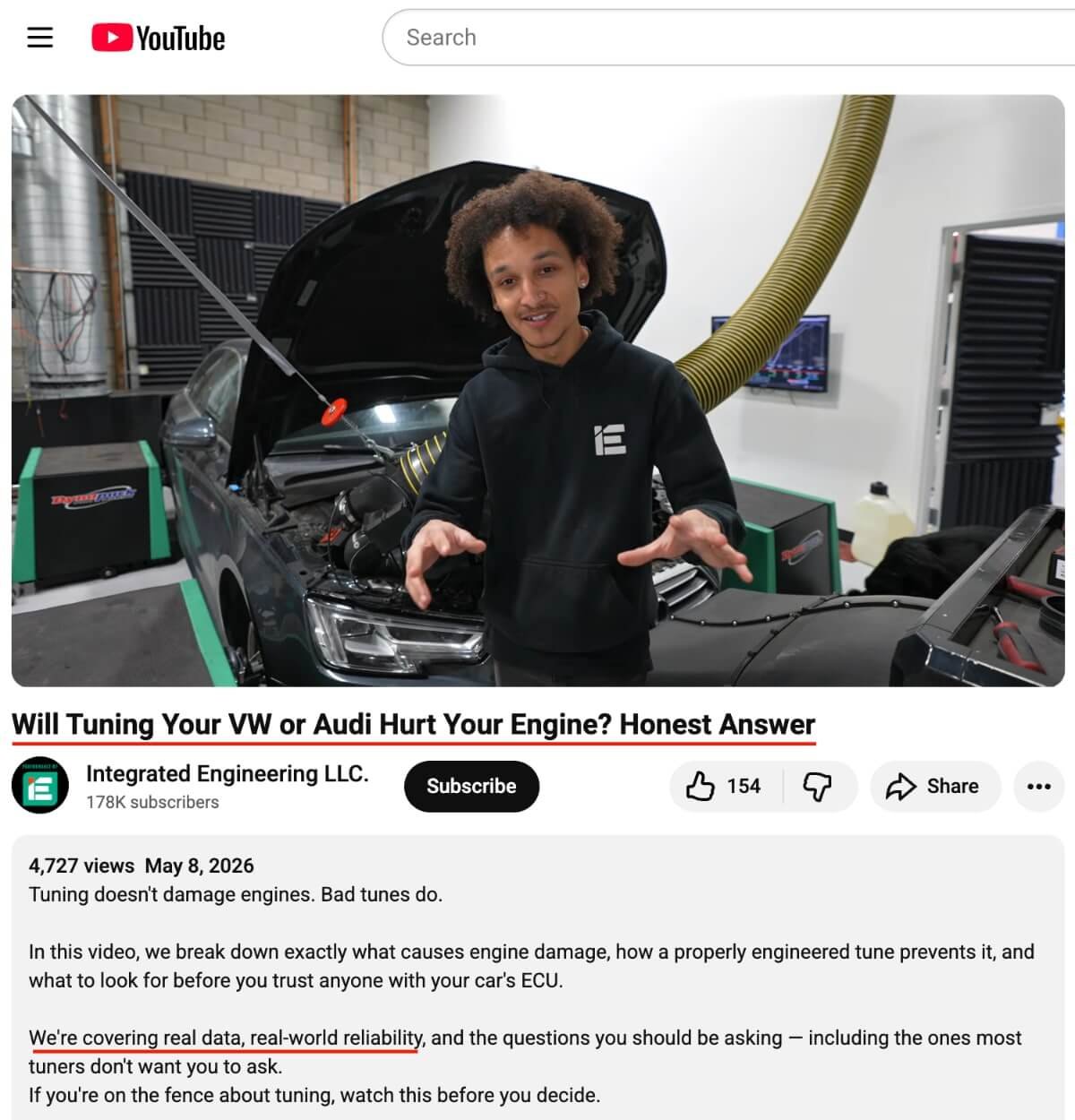
Integrated Engineering (IE) recently published a YouTube video titled Will Tuning Your VW or Audi Hurt Your Engine? Honest Answer. The video addresses a question that any GTI owner considering an ECU tune should be asking.
It is worth examining because the video’s answer is not supported by the evidence it claims to present, and because it was not released in isolation. It is the latest entry in a documented exchange between IE and myself regarding the substantiation of IE’s reliability claims.
Background: The Original Claim
IE markets its engine software modifications as a product that “maximizes power output without sacrificing reliability,” or similar language.
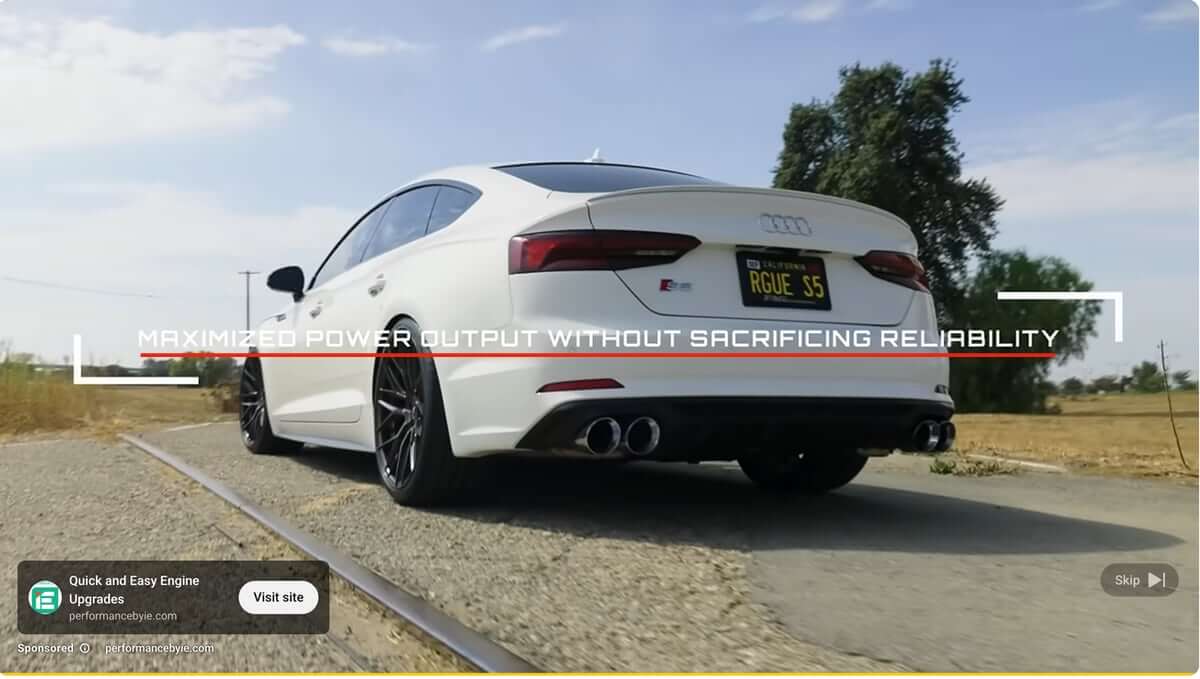
That is an objective claim — specifically, a claim about a safety-related outcome that a reasonable consumer would rely on when making a purchasing decision. Under Federal Trade Commission truth-in-advertising standards, objective claims must be supported by competent and reliable evidence before making them. The standard for safety or durability claims is higher than for general performance claims.
On December 1, 2025, I submitted a written substantiation request to IE asking for the basis behind that claim. The request asked for seven specific categories of information:
- Written test procedures and acceptance criteria in place before the claim was first used
- Sample size and replication details, plus any observed failures and how they were treated
- Durability or accelerated-life testing procedures and results
- Independent third-party test reports or evaluations
- Statistical analyses, failure rates, confidence intervals, and a statement of the operating envelope for the claim
- Warranty or guarantee policy covering engine or drivetrain damage attributable to the software
- Certification that this documentation existed prior to marketing the reliability claim
IE’s Response: December 20, 2025
IE responded on December 20, 2025. The response described a development process. It referenced thermal testing, environmental field validation across altitudes and climates, a senior calibrator approval committee, and a geographically diverse beta group accumulating tens of thousands of miles before release. IE also described AutoProtect, a proprietary firmware feature that monitors engine performance and intervenes when anomalies are detected.
IE provided none of the seven requested categories of substantiation. There were no failure rates, sample sizes, statistical outcomes, third-party evaluations, warranty terms, or certification that any of this documentation existed before marketing the claim. IE stated that specific engineering procedures and internal logs are proprietary trade secrets.
Trade-secret status does not exempt an advertiser from the obligation to possess substantiation. It means the records are not public — it does not mean they do not need to exist. A process description, however detailed, is not a substitute for outcome data. Describing how testing is conducted is different from demonstrating what that testing found.
The YouTube Video
IE subsequently published the video referenced above. The description promises: “We’re covering real data, real-world reliability.” The title frames the content as an “Honest Answer.”
The video contains no quantitative data. It includes no failure rates, sample sizes, statistical outcomes, or referenced test results. The reliability evidence presented consists of process descriptions that closely mirror the December 20 email response and a personal statement from the presenter that he has run IE tunes on his own vehicles for approximately seven years without issues.
The “real data” claim in the description is not accurate. A personal anecdote from a single individual is not data. Customer reviews linked on IE’s website are not data. Describing a testing process without reporting its outcomes is not data. Promising “real data” in the video description and delivering testimonial content misrepresents the evidentiary character of the video.
The categorical safety claim is unqualified. The description states: “Tuning doesn’t damage engines. Bad tunes do.” This is presented without any disclosed limitations — no minimum fuel octane requirement, no required hardware at various power levels, no statement of intended use. My original substantiation request specifically asked for the operating envelope for IE’s reliability claim. That information was not provided in December and does not appear in this video.
The presenter’s relationship to IE is not disclosed. The individual in the video states that he has been running IE tunes on his personal vehicles for approximately seven years. This is offered as evidence that the tunes are reliable. Under the FTC’s Endorsement and Testimonial Guidelines, an endorser must clearly and conspicuously disclose any material connection to the advertiser. If this individual is an IE employee, contractor, or owner, that relationship is material to how a viewer should weigh the testimonial. The video includes no such disclosure.
AutoProtect is presented as a safety validation, not a safety feature. The video describes AutoProtect as evidence that IE’s tunes are safe because the system intervenes when problems arise. The existence of an intervention mechanism does not prove reliability—it only shows that IE anticipated failure conditions and built in a response. Whether that response is effective, how often it intervenes, and what outcomes result are the data points that would actually support a reliability claim. None of that is provided.
Pre-Publication Contact: May 16, 2026
Before publishing this article, I contacted IE on May 16, 2026, with a pre-publication inquiry identifying six specific questions about the video. I stated that publication would proceed regardless of response, that I preferred to present a complete and accurate account, and that I would report IE’s response or non-response accurately.
IE’s automated system acknowledged receipt of the inquiry the same day and stated that support staff was reviewing the request. I subsequently received automated follow-up emails asking me to rate the quality of support I had received. As of September 26, 2026 — 130 days after submission — I have received no substantive reply to any of the six questions.
The questions I asked IE prior to publication were:
- What specifically constitutes the “real data” referenced in the video description?
- What operating conditions apply to the claim that “tuning doesn’t damage engines”?
- Is the video presenter an employee, contractor, or owner affiliated with IE?
- Has the substantiation documentation requested in my original inquiry since been compiled, and will IE provide it?
- Is AutoProtect the primary basis for IE’s reliability claim, and does IE possess outcome data supporting it?
- Was the video published with knowledge of my prior substantiation inquiry?
IE has not answered any of these questions.
What FTC Standards Actually Require
The FTC’s substantiation guidelines require advertisers to have a reasonable basis for objective claims before making them—not after they are challenged. For claims that bear on safety or durability, the applicable standard is competent and reliable scientific evidence: tests or studies conducted by qualified professionals using accepted methods, yielding results that objectively support the claim.
A company that markets a product with a reliability claim and cannot produce that evidence when asked has not met the standard — regardless of how thorough its internal process is described to be.
IE has now had two formal written opportunities to provide substantiation and has not done so. The YouTube video, published after IE received my original substantiation request, repeats and amplifies the same unsubstantiated claims in a new format. That sequence—notice of the substantiation concern followed by continued and expanded conduct—is relevant to whether the practice is knowing or willful.
What This Means for Consumers
Consumers considering an IE tune for their Volkswagen or Audi should understand what they are and are not being told.
The statement that IE tunes maintain reliability may be true. IE has not shown systematic, documented evidence that its software does not cause engine damage—evidence that would let a prospective buyer evaluate the reliability claim against a meaningful standard rather than anecdotes and process descriptions.
The absence of that evidence does not prove the tunes are unreliable. It means consumers are being asked to accept a safety-related marketing claim that the FTC requires to be substantiated. That distinction is worth understanding before making a purchasing decision.
A Note on This Article
This article does not claim that IE’s products are unreliable. It highlights the gap between what IE claims in its marketing and what it has been willing or able to demonstrate when asked directly. Consumers deserve to know about that gap.