

Background:
In this video, the person featured states that they added an IS38+ turbocharger to their Mk7 GTI, turning it into a 400-HP daily driver.
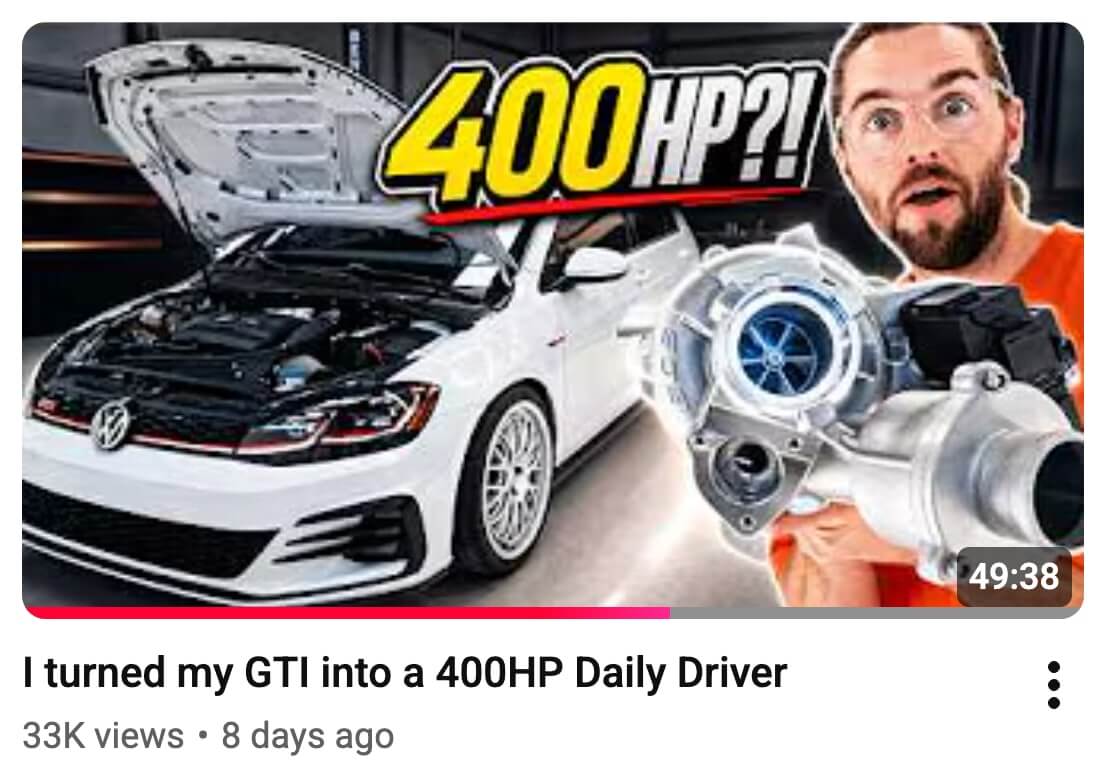
After watching the first two minutes of the video, it was evident that the person was restating the ECS Tuning advertising, and that they didn’t actually turn their GTI into a 400 HP daily driver, since they did not perform the fuel system upgrades that would be necessary to get to 400 HP using an IS38 turbocharger.
The video piqued my interest in looking more closely at what ECS Tuning claims their IS38+ turbocharger provides consumers.
Evaluating the Advertising Claims
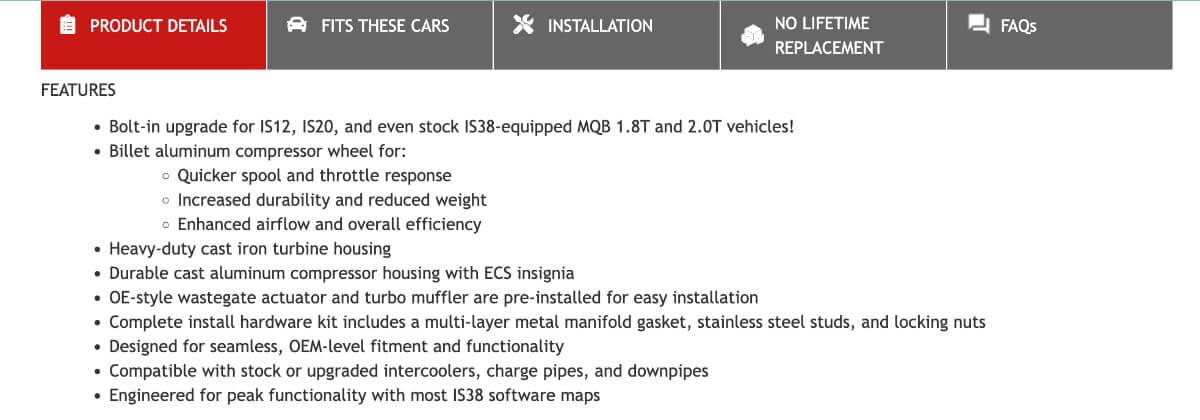
The ECS Tuning OEM+ IS38 Turbocharger Upgrade is marketed as a drop-in replacement for the factory IHI IS38 found in the Mk7 Golf R and Audi S3. Its primary differentiating feature is a billet-aluminum compressor wheel instead of the OEM cast-aluminum wheel.
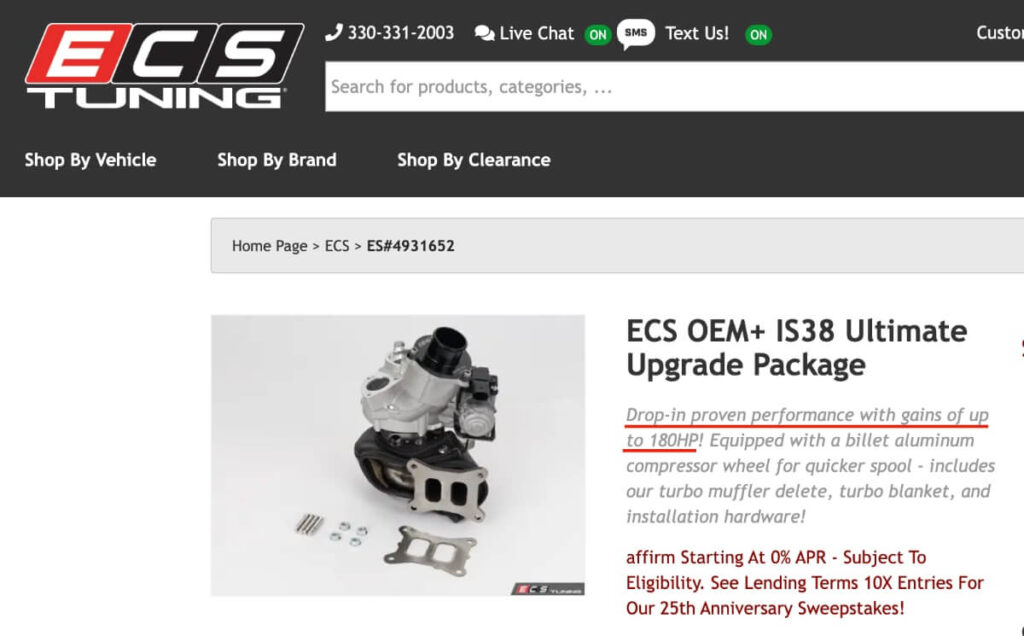
The product page begins with “gains of up to 180HP” and goes on to claim quicker spool, faster throttle response, greater efficiency, superior heat resistance, and reliability that exceeds the OEM unit. Those are specific, objective claims. This post examines the evidence ECS provides to support its claims.
The 180 HP Headline
The advertisement begins with: “Drop-in proven performance with gains of up to 180HP.” No comparison baseline is stated. Reading further, ECS frames the IS38 as the “big brother” to the IS12 and IS20 and describes it as the go-to upgrade for IS12 and IS20 owners. That context strongly implies the 180 HP figure is referenced against a stock vehicle equipped with one of those smaller turbochargers — not against the OEM IHI IS38 that this product is sold as an alternative to.
That distinction matters. I published an analysis comparing the power outputs of IS20 and IS38 using averaged dyno data from multiple Stage 2 vehicles on each platform. The result was approximately 50 WHP separating the two turbochargers.
That is the actual turbocharger contribution when comparing similar vehicles. A 180 HP gain requires a comparison against a completely stock car, and producing that number in practice requires an aftermarket tune, supporting fuel system modifications, and high ethanol content fuel in addition to the turbocharger. The billet compressor wheel — the only hardware feature that distinguishes ECS’s product from an OEM IHI IS38 — contributes none of that.
Spool, Response, Efficiency, and Airflow
The advertisement repeatedly claims that the billet wheel produces quicker spool-up, faster throttle response, greater efficiency, and increased airflow.

The underlying mechanism — reduced rotational inertia from a lighter compressor wheel — is a sound claim. A lighter rotating mass should improve spool response. The problem is that ECS provides no weight for its wheel or for the OEM wheel. There is no boost-versus-RPM comparison data showing the spool difference under similar operating conditions, and no data to support the efficiency and airflow claims. Without data, these remain assertions.
The Turbine Housing

ECS states: “High-quality cast iron is used for the turbine housing, ensuring superior heat resistance in demanding applications.” Without providing a comparison with the OEM IHI IS38 turbine housing material, the claim of superior heat resistance lacks a reference point. That means the word “superior” has no measurable meaning in the context of this advertisement, and the claim cannot be evaluated.
Reliability and the Premature Failure Assertion
ECS claims its product “exceeds OE reliability” and supports this, in part, by asserting that the OEM IHI IS38 is “known to suffer from premature bearing failure, bushing wear, and turbine housing cracks.” No failure rate data or failure mode documentation is provided. Premature failure means failure before the expected service life under normal operating conditions, and establishing that requires data.

ECS also qualifies the failure claim with “especially when pushed beyond their limits.” This does not strengthen the argument. Every mechanical component will fail when operated beyond its design limits, including ECS’s own turbocharger.
Sponsored Content
A YouTube content creator sponsored by ECS Tuning published a video in which they described the ECS OEM+ IS38, using the same claims found in the product advertising — that the billet compressor wheel improves responsiveness and durability, and that the turbine housing provides superior heat management. The creator also stated that they now have a 400-HP daily-driver GTI.
Repeating manufacturer advertising copy in a sponsored video is not independent verification of those claims, and a viewer watching the video has no way to distinguish between the creator’s own observed results and the manufacturer’s marketing language.
A stock Mk7 GTI produces approximately 220 WHP. Applying ECS’s “up to 180HP” claim to that baseline produces roughly 400 HP. The creator did not describe any of the system modifications — an upgraded low-pressure fuel pump, multi-port injection, downpipe, intercooler, and intake modifications — that would be required to support an IS38-equipped GTI producing 400 WHP on high-ethanol-content fuel. Without that hardware, 400 WHP is not a realistic power level on the Mk7 GTI platform. The more likely explanation is that the 400 HP figure is the ECS advertising claim applied to the creator’s own car rather than a result they measured.
Correspondence with ECS Tuning
On June 18, 2026, I sent an email inquiry to ECS Tuning at their sales and customer service email addresses requesting substantiating evidence for each of the claims described above. On June 24, I forwarded the original inquiry with supplementary questions addressing the modified vehicle configuration for the 180 HP claim and the performance claims made in the sponsored YouTube content. No response has been received as of the date of this post.

A company that has conducted the testing its advertising describes should be able to respond to a straightforward request for evidence of that testing.
The product development section of the advertisement references FARO laser scanning, SolidWorks CAD, in-house 3D printing, and rigorous long-term testing. That same description, word for word, appears in the ECS advertising for their charge pipe product. Whether it reflects product-specific development work for this turbocharger or serves as a general marketing template is a question the correspondence was intended to answer.
What This Means for a Consumer
The ECS OEM+ IS38 may be a well-made product. But a consumer purchasing this turbocharger as a replacement for an OEM IHI IS38 is not gaining 180 HP. They are purchasing a product whose advertised performance advantages over the OEM unit — spool improvement, efficiency gains, superior heat resistance, and improved reliability — are unsupported by any data that ECS has made publicly available or provided when asked directly.